
UNITED STATES
SECURITIES AND EXCHANGE COMMISSION
Washington, D.C. 20549
FORM 10-K
| ANNUAL REPORT PURSUANT TO SECTION 13 OR 15(d) OF THE SECURITIES EXCHANGE ACT OF 1934 | |||||||||||
| For the fiscal year ended | |||||||||||
| OR | |||||||||||
| TRANSITION REPORT PURSUANT TO SECTION 13 OR 15(d) OF THE SECURITIES EXCHANGE ACT OF 1934 | |||||||||||
| For the transition period from to | |||||||||||
Commission file number 1-06089
(Exact name of registrant as specified in its charter)
| (State or other jurisdiction of | (I.R.S. Employer | |||||||
| incorporation or organization) | Identification No.) | |||||||
(Address of principal executive offices, including zip code)
(816 ) 854-3000
(Registrant's telephone number, including area code)
Securities registered pursuant to Section 12(b) of the Act:
| Title of each class | Trading Symbol(s) | Name of each exchange on which registered | ||||||
Securities registered pursuant to Section 12(g) of the Act:
Common Stock, without par value
(Title of Class)
Indicate by check mark whether the registrant is a well-known seasoned issuer as defined in Rule 405 of the Securities Act. Yes ☑ No ☐
Indicate by check mark if the registrant is not required to file reports pursuant to Section 13 or Section 15(d) of the Act. Yes ☐ No ☑
Indicate by check mark whether the registrant (1) has filed all reports required to be filed by Section 13 or 15(d) of the Securities Exchange Act of 1934 during the preceding 12 months (or for such shorter period that the registrant was required to file such reports), and (2) has been subject to such filing requirements for the past 90 days. Yes ☑ No ☐
Indicate by check mark whether the registrant has submitted electronically every Interactive Data File required to be submitted pursuant to Rule 405 of Regulation S-T (§232.405 of this chapter) during the preceding 12 months (or for such shorter period that the registrant was required to submit such files). Yes ☑ No ☐
Indicate by check mark whether the registrant is a large accelerated filer, an accelerated filer, a non-accelerated filer, a smaller reporting company or an emerging growth company. See definitions of "large accelerated filer," "accelerated filer," "smaller reporting company," and "emerging growth company" in Rule 12b-2 of the Exchange Act.
Large Accelerated Filer ☑ Accelerated filer ☐ Non-accelerated filer ☐ Smaller reporting company ☐ Emerging growth company ☐
If an emerging growth company, indicate by check mark if the registrant has elected not to use the extended transition period for complying with any new or revised financial accounting standards provided pursuant to Section 13(a) of the Exchange Act. ☐
Indicate by check mark whether the registrant has filed a report on and attestation to its management’s assessment of the effectiveness of its internal control over financial reporting under Section 404(b) of the Sarbanes-Oxley Act (15 U.S.C.7262(b)) by the registered public accounting firm that prepared or issued its audit report. Yes ☑ No ☐
If securities are registered pursuant to Section 12(b) of the Act, indicate by check mark whether the financial statements of the registrant included in the filing reflect the correction of an error to previously issued financial statements. ☐
Indicate by check mark whether any of those error corrections are restatements that required a recovery analysis of incentive-based compensation received by any of the registrant’s executive officers during the relevant recovery period pursuant to §240.10D-1(b). ☐
Indicate by check mark whether the registrant is a shell company (as defined in Rule 12b-2 of the Act). Yes ☐ No ☑
The aggregate market value of the registrant's Common Stock (all voting stock) held by non-affiliates of the registrant, computed by reference to the price at which the stock was sold on December 31, 2024, was $7,028,811,568 .
Number of shares of the registrant's Common Stock, without par value, outstanding on July 31, 2025: 133,947,444 .
Documents incorporated by reference
The definitive proxy statement for the registrant's 2025 Annual Meeting of Shareholders, to be filed no later than 120 days after June 30, 2025, is incorporated by reference in Part III to the extent described therein.
2025 FORM 10-K AND ANNUAL REPORT
TABLE OF CONTENTS
INTRODUCTION
"H&R Block," "the Company," "we," "our" and "us" are used interchangeably to refer to H&R Block, Inc., to H&R Block, Inc. and its subsidiaries, or to H&R Block, Inc.'s operating subsidiaries, as appropriate to the context.
Specified portions of our proxy statement are "incorporated by reference" in response to certain items. Our proxy statement will be made available to shareholders no later than 120 days after June 30, 2025, and will also be available on our website at www.hrblock.com.
FORWARD-LOOKING STATEMENTS
This report and other documents filed with the Securities and Exchange Commission (SEC) may contain forward-looking statements. In addition, our senior management may make forward-looking statements orally to analysts, investors, the media and others. Forward-looking statements can be identified by the fact that they do not relate strictly to historical or current facts. They often include words or variation of words such as "expects," "anticipates," "intends," "plans," "believes," "commits," "seeks," "estimates," "projects," "forecasts," "targets," "would," "will," "should," "could," "may" or other similar expressions. Forward-looking statements provide management's current expectations or predictions of future conditions, events or results. All statements that address operating performance, events or developments that we expect or anticipate will occur in the future are forward-looking statements. They may include estimates of revenues, client trajectory, income, effective tax rate, earnings per share, cost savings, capital expenditures, dividends, share repurchases, liquidity, capital structure, market share, industry volumes or other financial items, descriptions of management's plans or objectives for future operations, services or products, or descriptions of assumptions underlying any of the above. They may also include the expected impact of external events beyond the Company's control, such as outbreaks of infectious disease, severe weather events, natural or man-made disasters, or changes in the regulatory environment in which we operate.
Readers are cautioned not to place undue reliance on these forward-looking statements, which speak only as of the date they are made and reflect the Company's good faith beliefs, assumptions and expectations, but they are not guarantees of future performance or events. Furthermore, the Company disclaims any obligation to publicly update or revise any forward-looking statement to reflect changes in underlying assumptions, factors, or expectations, new information, data or methods, future events or other changes, except as required by law.
By their nature, forward-looking statements are subject to risks and uncertainties that could cause actual results to differ materially from those suggested by the forward-looking statements. Factors that might cause such differences include, but are not limited to, a variety of economic, competitive, operational and regulatory factors, many of which are beyond the Company's control. Investors should understand that it is not possible to predict or identify all such factors and, consequently, should not consider any such list to be a complete set of all potential risks or uncertainties.
Details about risks, uncertainties and assumptions that could affect various aspects of our business are included throughout this Form 10-K. Investors should carefully consider all of these risks, and should pay particular attention to Item 1A, Risk Factors, and Item 7 under "Critical Accounting Estimates" of this Form 10-K.
H&R Block, Inc. | 2025 Form 10-K | 1 | ||||
PART I
ITEM 1. BUSINESS
OVERVIEW
H&R Block provides help and inspires confidence in its clients and communities everywhere through global tax preparation services, financial products, and small business solutions. We blend digital innovation with human expertise and care to help people get the best outcome at tax time and also be better with money by using our mobile banking app, Spruce℠. Through Block Advisors and Wave, we help small-business owners thrive with year-round bookkeeping, payroll, advisory and payment processing solutions.
H&R Block, Inc. was organized as a corporation in 1955 under the laws of the State of Missouri. A complete list of our subsidiaries as of June 30, 2025 can be found in Exhibit 21.
During fiscal year 2025, we prepared | ||
11.3 million U.S. assisted tax returns(1) | ||
| and our clients filed | ||
3.8 million DIY online paid tax returns(1) | ||
| which contributed to our consolidated revenues of | ||
$3.8 billion, | ||
| net income from continuing operations of | ||
$609.5 million, | ||
EBITDA(2) from continuing operations of | ||
$976.3 million, | ||
| and diluted EPS from continuing operations of | ||
$4.42 per share. | ||
| We repurchased | ||
6.5 million shares of our common stock, | ||
| and declared dividends of | ||
$1.50 per share, | ||
| which was an increase of | ||
$0.22, or 17.2%, per share from the prior year. | ||
(1) U.S. assisted tax returns prepared includes tax returns prepared in U.S. company-owned and franchise operations, including virtual returns. An assisted tax return is defined as a current or prior year individual or business tax return that has been accepted by the client. A DIY online paid return is defined as a current year individual or business tax return that has been accepted by the client.
2 | 2025 Form 10-K | H&R Block, Inc. | ||||
RECENT DEVELOPMENTS
On July 11, 2025, we entered into a Fifth Amended and Restated Credit and Guarantee Agreement, which amended and restated the existing unsecured committed line of credit (CLOC), extended the scheduled maturity date to July 11, 2030, maintained the aggregate principal amount of $1.5 billion, and revised the interest rate table. Other material terms remain substantially unchanged from our existing CLOC. See our Current Report on Form 8-K filed on July 15, 2025 for additional information.
On August 7, 2025, Jeffrey J. Jones II notified the Board of Directors of the Company of his intention to retire as President and Chief Executive Officer of the Company, effective as of December 31, 2025. Mr. Jones will also retire from the Board of Directors, effective on December 31, 2025. On August 8, 2025, the Board appointed Curtis A. Campbell, currently the Company's President, Global Consumer Tax and Chief Product Officer, to succeed Mr. Jones as President and Chief Executive Officer, effective immediately upon Mr. Jones’ retirement. See our Current Report on Form 8-K filed on August 11, 2025 for more information.
FINANCIAL INFORMATION ABOUT INDUSTRY SEGMENTS
We provide assisted and do-it-yourself (DIY) tax preparation solutions through multiple channels (including in-person, online and mobile applications, virtual, and desktop software) and distribute H&R Block-branded services and products, including those of our bank partners, to the general public primarily in the United States (U.S.), Canada and Australia. Tax returns are either prepared by H&R Block tax professionals in one of our company-owned or franchise offices, virtually or via an online review or prepared and filed by our clients through our DIY tax solutions. We also offer small business solutions through our company-owned and franchise offices (including in-person, online and virtual) and online through Wave. We report a single segment that includes all of our continuing operations.
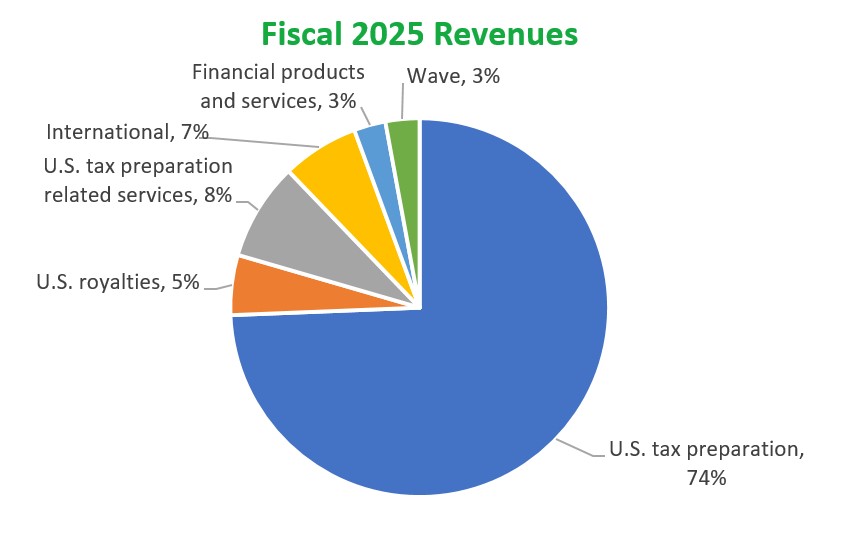
TAX PREPARATION SERVICES
Assisted income tax return preparation and related services are provided by tax professionals via a system of retail offices operated directly by us or our franchisees. These tax professionals provide assistance to our clients either in person or virtually in a number of ways. Clients can come into an office, digitally "drop off" their documents for their tax professional, approve their return online, or have a tax professional review a return they prepared themselves through Tax Pro Review®.
Our online software may be accessed through our website at www.hrblock.com or in a mobile application, while our desktop software may be purchased online and through third-party retail stores. Our generative AI powered technology, AI Tax Assist, and human help is offered to clients who prepare a paid DIY online return at no additional charge.
Assisted tax returns are covered by our 100% accuracy guarantee, whereby we will reimburse a client for penalties and interest attributable to an H&R Block error on a tax return. DIY tax returns are covered by our 100% accuracy guarantee, whereby we will reimburse a client (up to a maximum of $10,000 in the U.S.) if our software makes an arithmetic error that results in payment of penalties and/or interest to the respective taxing authority that the client would otherwise not have been required to pay.
We offer franchises as a way to expand our presence in certain geographic areas. In the U.S., our franchisees pay us approximately 30% of gross tax return preparation and related service revenues as a franchise royalty.
H&R Block, Inc. | 2025 Form 10-K | 3 | ||||
OTHER OFFERINGS
During fiscal year 2025, we also offered U.S. clients a number of additional services, including Refund Transfers (RT), our Peace of Mind® Extended Service Plan (POM), H&R Block Emerald Prepaid Mastercard® (Emerald Card®), SpruceSM, H&R Block Emerald Advance® (EA) term loans, Tax Identity Shield® (TIS), Refund Advances (RA), and small business financial solutions. For our Canadian clients, we also offer POM, H&R Block's Instant Refund®, H&R Block Pay With Refund®, and small business financial solutions.
Refund Transfers. RTs enable clients to receive their tax refunds by their chosen method of disbursement and include a feature enabling clients to authorize payment of their tax preparation and related fees from their tax refunds. Depending on circumstances, clients may choose to receive their RT funds by a load to their Emerald Card®, a deposit to their SpruceSM spending account, by receiving a check or by direct deposit to an existing account. RTs are available to U.S. clients and are frequently obtained by those who: (1) do not have bank accounts into which the Internal Revenue Service (IRS) can direct deposit their refunds; (2) like the convenience and benefits of a temporary bank account for receipt of their refund; and/or (3) prefer to have their tax preparation fees paid directly out of their refunds. RTs are offered through our relationship with our bank partner. We offer a similar program, H&R Block Pay With Refund®, to our Canadian clients through a Canadian chartered bank.
Peace of Mind® Extended Service Plan. We offer POM to U.S. and Canadian clients who obtain assisted tax preparation services, whereby we (1) represent our clients if they are audited by a taxing authority, and (2) assume the cost, subject to certain limits, of additional taxes owed by a client resulting from errors attributable to H&R Block. The additional taxes paid under POM have a cumulative limit of $6,000 for U.S. clients and $3,000 CAD for Canadian clients with respect to the federal, state/provincial and local tax returns we prepared for applicable clients during the taxable year protected by POM.
H&R Block Emerald Prepaid Mastercard® and SpruceSM. The Emerald Card® and SpruceSM debit cards can be used for everyday purchases and ATM withdrawals anywhere Debit Mastercard® (Mastercard is a registered trademark of Mastercard International Incorporated) is accepted. Clients can receive their tax refunds and RT funds and direct EA or RA proceeds directly onto an Emerald Card® or into their SpruceSM spending account offered through our bank partner. Additional funds can be added to the Emerald Card® and to SpruceSM year-round, such as through direct deposit or at participating retail reload providers. The Emerald Card® and SpruceSM debit card can be added to clients' mobile wallets. We distribute the Emerald Card® and the SpruceSM debit card issued by our bank partner.
H&R Block Emerald Advance® Term Loans. EA term loans are offered by our bank partner to clients, in November and December, in amounts of $350 to $1,300. EA term loans are interest bearing with principal and interest due in full on March 31, and there are no annual fees or required monthly payments.
Tax Identity Shield®. Our TIS program offers clients assistance in helping protect their tax identity and access to services to help restore their tax identity, if necessary. Protection services include a daily scan of the dark web for personal information, a monthly scan for the client's social security number in credit header data, notifying clients if their information is detected on a tax return filed through H&R Block, and obtaining additional IRS identity protections when eligible.
Refund Advance Loans. RAs are interest-free loans offered by our bank partner, which are available to eligible U.S. assisted clients in company-owned and participating franchise locations, including virtual clients, in January and February. In tax season 2025, RAs were offered in amounts of $250, $500, $750, $1,250 and $4,000, based on client eligibility as determined by our bank partner.
H&R Block's Instant Refund®. Our Canadian operations advance refunds due to certain clients from the Canada Revenue Agency (CRA), for a fee. The fee charged for this service is mandated by federal legislation which is administered by the CRA. The client assigns to us the full amount of the tax refund to be issued by the CRA and the refund amount is then sent by the CRA directly to us.
Small Business Financial Solutions. Our Block Advisors small business certified tax professionals provide small businesses with financial expertise in taxes, bookkeeping and payroll through our office network (including in-person, online and virtual). Wave provides small business owners with an online solution to manage their finances, including payment processing, payroll and bookkeeping services.
4 | 2025 Form 10-K | H&R Block, Inc. | ||||
SEASONALITY OF BUSINESS
Because the majority of our clients file their tax returns during the period from February through April in a typical year, a substantial majority of our revenues from income tax return preparation and related services and products are earned during this period. As a result, we generally operate at a loss through the first two quarters of our fiscal year.
COMPETITIVE CONDITIONS
We provide assisted and DIY tax preparation services and products, as well as small business financial solutions, and face substantial competition in and across each category, including from tax return preparation firms, software providers, accounting firms, independent tax preparers, certified public accountants and governmental organizations, including the IRS, state and foreign tax authorities.
We are one of the largest providers of tax return preparation solutions and electronic filing services in the U.S., Canada, and Australia with 22.8 million returns filed by or through H&R Block in fiscal year 2025.
GOVERNMENT REGULATION
Our business is subject to various forms of government regulation, including U.S. Federal and state tax preparer regulations, financial consumer protection and privacy regulations, state regulations, franchise regulations and foreign regulations. See further discussion of these items in our Item 1A. Risk Factors and Item 7 under "Regulatory Environment" of this Form 10-K.
HUMAN CAPITAL
Fulfilling our Purpose extends to helping and inspiring confidence in our associates. We remain committed to our associates’ total well-being — physical, mental, financial, career, team, and community. Together, when we balance these components, we achieve personal, team, and organizational strength.
Associates. We had approximately 4,300 regular full-time associates as of June 30, 2025. Our business is dependent on the availability of a seasonal workforce, including tax professionals, and our ability to hire, train, and supervise these associates. The highest number of persons we employed during the fiscal year ended June 30, 2025, including seasonal associates, was approximately 70,100.
Associate Engagement. We administer an annual survey to all associates to better understand their levels of engagement and identify areas where we can improve. We compare our scores to the top 25th and 10th percentile of the global benchmark to challenge our associates and leaders and to yield reports that are easier for leaders to identify opportunities to take action. Across the company, 89% of culture and engagement questions measured were at or above the top 25th percentile of the global benchmark, which is two times the amount of questions that were over benchmark in the previous year. When looking at the top 10th percentile, 61% of questions were at or above the benchmark. We are also pleased with our overall employee satisfaction score which currently exceeds the Top 10 benchmark by 2 points. Individual leaders at all levels create and monitor culture and engagement-related goals.
Compensation and Benefits. Our total rewards programs are designed to attract and retain top talent by supporting what associates need to be their authentic selves. Our equitable and comprehensive benefits offerings provide access to benefits to help both regular and seasonal associates plan for the health and security of their families. H&R Block offers comprehensive mental and behavioral health support through robust well-being programs, ensuring regular associates and their families have access to therapists, coaching, and holistic mental health services.
To thank our associates for their resiliency and hard work, each year H&R Block takes an “Annual Reboot” – a paid week of time off offered during the first week of July – as an important time for our associates to disconnect, recharge, and reboot.
H&R Block also provides comprehensive medical insurance to our associates and extends the opportunity for medical insurance to our seasonal workforce who satisfy the eligibility guidelines of the Affordable Care Act. Subject to meeting eligibility requirements, associates can also choose to participate in the H&R Block Retirement
H&R Block, Inc. | 2025 Form 10-K | 5 | ||||
Savings Plan 401(k) and Employee Stock Purchase Plan. Collectively, these programs promote and support the physical, mental, financial, and community well-being of our associates.
Training and Development. Our people are the number one enabler for living our Purpose, and we recognize the importance of attracting, developing, and retaining top talent. Our goal is to provide continuous development opportunities to our associates in order to help them grow both personally and professionally. We do this through a robust offering of programs, educational courses, and learning journeys offered virtually and in person.
Our expertise is delivered each year through our tax professional network. H&R Block tax professionals receive extensive annual tax training on topics including recent tax code changes and filing practices, and we offer additional education opportunities for tax professionals to enhance their knowledge and skills. In preparation for the upcoming tax season, our tax professionals receive training on H&R Block products, soft skills, and tax office best practices. These resources ultimately enable us to continue enhancing our services and impressing our clients.
Belonging. At H&R Block, we foster a culture of belonging, where every voice is heard and our associates feel safe, included, and inspired. We are committed to a fair and respectful workplace culture, free of discrimination; and we work to foster a Connected Culture that ensures all associates have a strong sense of belonging across the organization.
Connected Culture is a relationship centered principle at H&R Block that puts associates and clients at the heart of our strategic focus. It creates an environment of clear accountability, partnership, and trust – all focused on common goals, allowing for accelerated business and personal progress. Relationships are at the heart of how we work with each other, our customers, and in our communities.
In the workplace we are committed to creating an environment where everyone feels they belong, and we believe that this commitment makes us a stronger, more successful company. We continually reflect on our management approaches to improve the workplace, including discussions with our Board of Directors, to review how we can provide a sense of belonging within the company for our associates - what we call Belonging@Block.
One of the many ways we work to foster a Connected Culture across the organization for all associates to connect, support, motivate, and inspire is through our associate-led Belonging Groups.
SERVICE MARKS AND TRADEMARKS
We have made a practice of offering our services and products under service marks and trademarks and of securing registration for many of these marks in the U.S. and other countries where our services and products are marketed. We consider these service marks and trademarks, in the aggregate, to be of material importance to our business, particularly our businesses providing services and products under the "H&R Block" brand. The initial duration of U.S. federal trademark registrations is 10 years. Most U.S. federal registrations can be renewed perpetually at 10-year intervals and remain enforceable so long as the marks continue to be used.
6 | 2025 Form 10-K | H&R Block, Inc. | ||||
INFORMATION ABOUT OUR EXECUTIVE OFFICERS (as of June 30, 2025) | ||||||||
 | Jeffrey J. Jones II, 57, became our President and Chief Executive Officer in October 2017 and was our President and Chief Executive Officer-Designate from August 2017 to October 2017. Before joining the Company, he served as the President of Ridesharing at Uber Technologies, Inc. from October 2016 until March 2017. He also served as the Executive Vice President and Chief Marketing Officer of Target Corporation from April 2012 until September 2016. He will be retiring as President and Chief Executive Officer effective December 31, 2025. | |||||||
 | Tiffany L. Mason, 50, became our Chief Financial Officer in September 2024. Prior to that, she served as Executive Vice President and Chief Financial Officer of Driven Brands Holdings Inc. from March 2020 until May 2023. She also held various roles of increasing responsibility at Lowe's Companies, Inc. from February 2006 until October 2019, including as interim Chief Financial Officer in 2018 and Senior Vice President, Corporate Finance and Treasurer from 2015 to 2019. | |||||||
 | Kellie J. Logerwell, 55, became our Chief Accounting Officer in July 2016. Prior to that, she served as our Vice President of Corporate and Field Accounting from December 2014 until July 2016 and as our Assistant Controller from December 2010 until December 2014. | |||||||
 | Dara S. Redler, 58, became our Chief Legal Officer in January 2022 and our Chief Legal and Administrative Officer in April 2025. Prior to joining the Company, she served as General Counsel and Corporate Secretary for Tilray, Inc. from January 2019 until September 2021. She also held various legal roles of increasing responsibility with The Coca-Cola Company from September 2001 until December 2018. | |||||||
 | Curtis A. Campbell, 52, became our President, Global Consumer Tax and Chief Product Officer in June 2024. Prior to that, he served as the Chief Executive Officer of TaxAct where he ran TaxAct from 2018 until it was sold by Blucora, Inc. in 2022. He continued to lead TaxAct after the sale until 2023. Prior to TaxAct, Mr. Campbell served Capital One Financial Corporation as Managing Vice President from 2017 to 2018. He also served in Vice President roles at Intuit Inc, leading Product Management and Strategy from 2014 to 2017. | |||||||
 | Scott R. Manuel, 50, became our Chief Strategy and Operations Officer in August 2024. Prior to that, he served as President, General Manager of Tribute Technology from 2022 until 2024. Mr. Manuel served as Chief Product Officer, General Manager of McClatchy Media Company from 2017 until 2020, and he also served in various Vice President roles at Thomson Reuters from 2010 to 2017. | |||||||
AVAILABILITY OF REPORTS AND OTHER INFORMATION
Our annual report on Form 10-K, quarterly reports on Form 10-Q, current reports on Form 8-K and all amendments to those reports filed with or furnished to the SEC are available, free of charge, through our website at www.hrblock.com as soon as reasonably practicable after such reports are electronically filed with or furnished to the SEC. The SEC maintains a website at www.sec.gov containing reports, proxy and information statements and other information regarding issuers who file electronically with the SEC.
The following corporate governance documents are posted on our website at www.hrblock.com:
▪The Amended and Restated Articles of Incorporation of H&R Block, Inc.;
▪The Amended and Restated Bylaws of H&R Block, Inc.;
▪The H&R Block, Inc. Corporate Governance Guidelines;
▪The H&R Block, Inc. Code of Business Ethics and Conduct;
▪The H&R Block, Inc. Board of Directors Independence Standards;
▪The H&R Block, Inc. Audit Committee Charter;
▪The H&R Block, Inc. Compensation Committee Charter;
H&R Block, Inc. | 2025 Form 10-K | 7 | ||||
▪The H&R Block, Inc. Finance Committee Charter; and
▪The H&R Block, Inc. Governance and Nominating Committee Charter.
If you would like a printed copy of any of these corporate governance documents, please send your request to H&R Block, Inc., One H&R Block Way, Kansas City, Missouri 64105, Attention: Corporate Secretary.
Information contained on our website does not constitute any part of this report.
ITEM 1A. RISK FACTORS
Our business activities expose us to a variety of risks. Identifying, monitoring, and managing these risks is essential to the success of our operations and the financial soundness of H&R Block. Senior management and the Board of Directors, acting as a whole and through its committees, take an active role in our risk management process and have delegated certain activities related to the oversight of risk management to the Company's enterprise risk management (ERM) team and the Enterprise Risk Committee, which is comprised of Vice Presidents of major business and control functions and members of the ERM team. The Company’s ERM team, working in coordination with the Enterprise Risk Committee, is responsible for identifying and monitoring risk exposures and related mitigation and leading the continued development of our risk management policies and practices.
An investment in our securities involves risk, including the risk that the value of that investment may decline or that returns on that investment may fall below expectations. There are a number of factors that could cause actual conditions, events, or results to differ materially from those described in forward-looking statements, many of which are beyond management's control or its ability to accurately estimate or predict, or that could adversely affect our financial position, results of operations, cash flows, and the value of an investment in our securities. The risks described below are not the only ones we face. We could also be affected by other events, factors, or uncertainties that are presently unknown to us or that we do not currently consider to be significant risks to our business. These risks may be exacerbated by the effects of local, national, and global conditions or events, including macroeconomic, political, geopolitical, or public health conditions or events, which may cause significant instability.
STRATEGIC AND INDUSTRY RISKS
Changes in applicable tax laws have had, and may in the future have, a negative impact on the demand for and pricing of our services. Government changes in tax filing or IRS processes may adversely affect our business and our consolidated financial position, results of operations, and cash flows.
The U.S. government has in the past made, and may in the future make, changes to the individual income tax provisions of the Internal Revenue Code, tax regulations, and the rules and procedures for implementing such laws and regulations. In addition, taxing authorities or other relevant governing bodies in various federal, state, local, and foreign jurisdictions in which we operate may change the income tax laws in their respective jurisdictions, and such laws may vary greatly across the various jurisdictions. It is difficult to predict the manner in which future changes to the Internal Revenue Code, tax regulations, and the rules and procedures for implementing such laws and regulations, and state, local, and foreign tax laws may impact us and the tax return preparation industry. Such future changes could decrease the demand or the amount we charge for our services, and, in turn, have a material adverse effect on our business and our consolidated financial position, results of operations, and cash flows.
In addition, taxing authorities in various federal, state, local, and foreign jurisdictions in which we operate have introduced measures seeking to simplify or otherwise modify the preparation and filing of tax returns or the issuance of refunds in their respective jurisdictions. For example, from time to time, U.S. federal and state governments have considered various proposals through which the respective governmental taxing authorities would use taxpayer information provided by employers, financial institutions, and other payers to "pre-populate," prepare, and calculate tax returns and distribute them to taxpayers. There are various initiatives from time to time seeking to expedite, reduce, or change the timing of refunds, which could reduce the demand for certain of our services or financial products.
The adoption or expansion of any measures that significantly simplify tax return preparation, or otherwise reduce the need for third-party tax return preparation services or financial products, including governmental encroachment at the U.S. federal and state levels, as well as in foreign jurisdictions, could reduce demand for our
8 | 2025 Form 10-K | H&R Block, Inc. | ||||
services and products and could have a material adverse effect on our business and our consolidated financial position, results of operations and cash flows.
Increased competition for clients could adversely affect our current market share and profitability.
We face substantial competition throughout our businesses. All categories in the tax return preparation industry are highly competitive, and additional competitors have entered, and in the future may enter, the market to provide tax preparation services or products. In the assisted tax services category, there are a substantial number of tax return preparation firms and accounting firms offering tax return preparation services. Commercial tax return preparers are highly competitive with regard to price and service. In DIY and virtual, options include various forms of digital electronic assistance, including online and mobile applications, and desktop software, all of which we offer. Our DIY and virtual services and products compete with a number of online and software solutions, primarily on price and functionality. Individual tax filers may elect to change their tax preparation method, choosing from among various assisted, DIY, and virtual offerings.
Technology advances quickly and in new and unexpected ways, and it is difficult to predict the manner in which these changes will impact the tax return preparation industry, the problems we may encounter in enhancing our services and products, or the time and resources we may need to devote to the creation, support, and maintenance of technological enhancements. New technologies we utilize, such as those related to artificial intelligence, machine learning, automation, and algorithms, involve risks and may have unexpected consequences, which may be due to their limitations, potential manipulation or unintended uses, or our failure to use or implement them effectively. There can be no assurance that we or our clients will realize the expected benefits from our investments in these new technologies. If: (1) we are slow to enhance our services, products, or technologies; (2) our competitors are able to achieve results more quickly than us; (3) there are new and unexpected entrants into the industry; or (4) there are new technologies available that provide products or services that compete with ours, we may lose, or fail to capture a significant share of the market.
Additionally, we and many other tax return preparation firms compete by offering one or more of RTs, prepaid cards, RAs, other financial services and products, and other tax-related services and products, many of which are subject to regulatory scrutiny, litigation, and other risks. From time to time we may make changes to certain of our services and products and we can make no assurances that we will be able to offer, or that we will continue to offer, all of these services and products. Any such changes to our services or products or any failure to continue offering such services and products could negatively impact our financial results and ability to compete. Intense competition could result in a reduction of our market share, lower revenues, lower margins, and lower profitability. In addition, our small business solutions face intense competition, and we may be unsuccessful in competing with other providers, which may diminish our revenue and profitability, and harm our ability to acquire and retain clients.
We may not be effective in achieving our strategic and operating objectives.
Beginning in fiscal year 2026, we are launching a new growth strategy. While we believe that we have identified and will continue to identify strategic objectives that are appropriate, it is possible that our objectives may not deliver projected long-term growth in revenue and profitability due to competition, inadequate execution, incorrect assumptions, sub-optimal resource allocation, or other reasons, including any of the other risks described in this “Risk Factors” section.
As a part of our strategy, we expect to continue to seek growth through acquisitions. Our future growth and profitability may depend, in part, upon our successful execution of those acquisitions. However, we may not be able to execute on our acquisition growth strategy due to a number of factors, including an inability to identify sufficient suitable acquisition candidates, an unwillingness of businesses to sell to us, an inability to generate the funds necessary to fully execute desired acquisitions, or an inability to successfully integrate acquired businesses into our business model and operate them effectively.
If we are unable to realize the desired benefits from our business strategy, our ability to compete across our business and our consolidated financial position, results of operations, and cash flows could be adversely affected.
H&R Block, Inc. | 2025 Form 10-K | 9 | ||||
Offers of free services or products could adversely affect our revenues and profitability.
U.S. federal, state, and foreign governmental authorities in certain jurisdictions in which we operate currently offer, or facilitate the offering of, tax return preparation and electronic filing options to taxpayers at no charge, and certain volunteer organizations also prepare tax returns at no charge for low-income taxpayers. In addition, many of our competitors offer certain tax preparation services and products, and other financial services and products, at no charge. Government tax authorities, volunteer organizations, our competitors, and potential new market entrants have implemented, and may expand free offerings in the future. For example, in tax seasons 2024 and 2025, the IRS offered a limited free direct tax filing system, which it may continue or expand in the future. In addition, certain members of private industry offer free DIY tax software to certain taxpayers through Free File, Inc., which operates under an agreement among the IRS and those industry participants that is currently set to expire in October 2029. Taxpayer adoption of these or similar programs could expand in the future, including in the event of increased awareness and support. As a result of these or other programs, the government has, and could further, become our direct competitor, which could have a material adverse effect on our business and our consolidated financial position, results of operations, and cash flows.
In order to compete, we have offered certain, and may in the future offer, additional services and products at no charge. There can be no assurance that we will be able to attract clients or effectively ensure the migration of clients from our free offerings to those for which we receive fees, and clients who have formerly paid for our offerings may elect to use free offerings instead. These competitive factors may diminish our revenue and profitability, or harm our ability to acquire and retain clients, resulting in a material adverse effect on our business and our consolidated financial position, results of operations, and cash flows.
Our businesses may be adversely affected by difficult economic, geopolitical or public health conditions.
Unfavorable changes in economic conditions, which are typically beyond our control, including without limitation, inflation, slowing growth, rising interest rates, recession, changes in the political climate, significant armed conflicts, acts of war or terrorism, supply chain or labor market disruptions, tariffs or trade wars, banking or financial market disruptions, pandemics or endemics, or other adverse changes, could negatively affect our business and financial condition. Difficult economic conditions are frequently characterized by high unemployment levels and declining consumer and business spending. These poor economic conditions may negatively affect demand and pricing for our services and products. In the event of difficult economic conditions that include high unemployment levels, clients may elect not to file tax returns or utilize lower cost preparation and filing alternatives.
In addition, difficult economic conditions may disproportionately impact small business owners. Our small business revenues may be negatively impacted in the event of a sustained economic slowdown or recession. Difficult economic conditions, including an economic recession or high inflationary period, could have a material adverse effect on our business and our consolidated financial position, results of operations, and cash flows.
OPERATIONAL AND EXECUTION RISKS
Our failure to effectively address fraud within our offerings could have a material adverse effect on our business and our consolidated financial position, results of operations, and cash flows.
Many industries have experienced an increased variety and amount of attempted fraudulent activities by third parties, and those fraudulent activities are becoming increasingly sophisticated through the use of artificial intelligence, social engineering, and other technological developments and strategies. Though this fraud is not uniquely targeted at our offerings, our failure to effectively address any such fraud may adversely impact our business and our consolidated financial position, results of operations, and cash flows. A number of companies, including those in the tax return preparation and financial services industries, have reported instances where criminals created new accounts, or gained access to consumer information or user accounts maintained on their systems by using stolen identity information (e.g., email, username, password information, or credit history) obtained from third-party sources. We have experienced, and in the future may continue to experience, this form of unauthorized and illegal use and/or access to our systems, despite no breach in the security of our systems.
In addition to losses directly from such fraud, which could occur in some cases, we may also suffer a loss of confidence by our clients or by governmental agencies in our ability to detect and mitigate fraudulent activity, and
10 | 2025 Form 10-K | H&R Block, Inc. | ||||
such governmental authorities may refuse to allow us to continue to offer such services or products. For example, a person with malicious intent may create a new account with stolen information or unlawfully take existing user account and password information from our clients to electronically file fraudulent federal and state tax returns, which could impede our clients' ability to file their tax returns and receive refunds (or other amounts due) and diminish public perception of the security and reliability of our services and products, despite no breach in the security of our systems. We have also experienced, and may in the future continue to experience, first party fraud, whereby an individual uses their own identity or account to engage in fraudulent activities.
Governmental authorities in jurisdictions in which we operate have taken action, and may in the future take additional action, in an attempt to combat identity theft or other fraud, which may require changes to our systems and business practices, or those of third parties on which we rely, that cannot be anticipated. These actions may have a material adverse effect on our business and our consolidated financial position, results of operations, and cash flows.
Furthermore, as fraudulent activity continues to become more pervasive and sophisticated, fraud detection and prevention measures that we implement could make it less convenient for legitimate clients to obtain and use our services and products, which may adversely affect the demand for our services and products, our reputation, and our financial performance.
An interruption in our information systems, or those of our franchisees or a third party on which we rely, or an interruption in our access to the internet, could have a material adverse effect on our business and our consolidated financial position, results of operations, and cash flows.
We, our franchisees, and other third parties material to our business operations rely heavily upon communications, networks, and information systems and the internet to conduct our business (including third-party internet-based or cloud computing services, and the information systems of our key vendors). These networks, systems, and operations are potentially vulnerable to damage or interruption from upgrades and maintenance, network failure, hardware failure, software failure, power or telecommunications failures, cyberattacks, human error, and natural disasters. As our tax preparation business is seasonal, our systems must be capable of processing high volumes during our peak periods. Therefore, any failure or interruption in our information systems, or information systems of our franchisees or a private or government third party on which we rely, or an interruption in our access to the internet or other critical business capability during our busiest periods, could negatively impact our business operations and reputation, and increase our risk of loss.
We have experienced systems outages in the past, and there can be no assurance that system or internet failures or interruptions in critical business capabilities will not occur in the future, and, if they do occur, that we, our franchisees or the private or governmental third parties on whom we rely, will adequately address them. The precautionary measures that we, or third parties on whom we rely, have implemented to avoid systems outages and to minimize the effects of any data or communication systems interruptions or failures may not be adequate, and we and such third parties may not have anticipated or addressed all of the potential events that could threaten or undermine our or such third parties' information systems or other critical business capabilities. We do not have redundancy for all of our systems and our disaster recovery planning may not account for all eventualities. Our software and computer systems utilize cloud computing services provided by Microsoft Corporation. If the Microsoft Azure Cloud is unavailable for any reason, it could negatively impact our ability to deliver our services and products and our clients may not be able to access certain of our products or features, any of which could significantly impact our operations, business, and financial results.
The occurrence of any systems or internet failure, or other business interruption, could negatively impact our ability to serve our clients, which in turn could have a material adverse effect on our business and our consolidated financial position, results of operations, and cash flows.
Any significant delays in launching our tax service and product offerings, changes in government regulations or processes (including the acceptance of tax returns and the issuance of refunds and other amounts to clients by the IRS or state tax agencies) that affect how we provide such offerings to our clients, or significant problems
H&R Block, Inc. | 2025 Form 10-K | 11 | ||||
with such offerings or the manner in which we provide them to our clients may harm our revenue, results of operations, and reputation.
Tax laws and tax forms are subject to change each year, and the nature and timing of such changes are unpredictable. As a part of our business, we must incorporate any changes to tax laws and tax forms into our tax service and product offerings, including our online and mobile applications and desktop software. The unpredictable nature, timing and effective dates of changes to tax laws and tax forms can result in condensed development cycles for our tax service and product offerings because our clients expect high levels of accuracy and a timely launch of such offerings to prepare and file their taxes by the applicable tax filing deadlines and, in turn, receive any tax refund amounts on a timely basis. From time to time, we review and enhance our quality controls for preparing accurate tax returns, but there can be no assurance that we will be able to prevent all inaccuracies.
Further, changes in governmental regulations or a significant reduction in governmental resources could result in a delay of the start of the tax season or in processing returns, create uncertainty, or result in further and unanticipated changes in requirements or processes, which may require us to make corresponding changes to our client service systems and procedures immediately prior to, or during, a tax season. In addition, unanticipated changes in governmental processes, or newly implemented processes, for (1) accepting tax filings and related forms, including the ability of taxing authorities to accept electronic tax return filings, or (2) distributing tax refunds or other amounts to clients, may result in processing delays by us or applicable taxing authorities.
Certain of our financial products are dependent on the IRS following the client’s directions to direct deposit the tax refund. If the IRS disregards this direction, and sends the tax refund via check, then it could result in a loss of tax preparation and financial product revenue, negative publicity, and client dissatisfaction. In addition, any delays in launching new or existing financial service or product offerings, or technical or other issues associated with the launch, could cause a loss of revenue, a loss of clients, or client dissatisfaction, especially if such issues occur during the tax season.
Any major defects or delays caused by the above-described complexities may lead to loss of clients and loss of or delay in revenue, negative publicity, client dissatisfaction, a deterioration in our business relationships with our partners or our franchisees, exposure to litigation, and increased operating expenses, even if any such launch delays or defects are not caused by us. Any of the risks described above could have a material adverse effect on our business, our reputation, and our consolidated financial position, results of operations, and cash flows.
We rely on a single vendor or a limited number of vendors to provide certain key services or products, and the loss of such relationships, the inability of these key vendors to meet our needs, or errors by the key vendors in providing services to or for us, could have a material adverse effect on our business and our consolidated financial position, results of operations, and cash flows.
Historically, we have contracted, and in the future we will likely continue to contract, with a single vendor or a limited number of vendors to provide certain key services or products for our tax, financial, and other services and products. A few examples of this type of reliance include: our relationships with Fidelity National Information Services, Inc. (FIS), Galileo Financial Technologies, LLC, or similar vendors, for data processing and card production services; Pathward®, N.A. (Pathward), a wholly-owned subsidiary of Pathward Financial, Inc., for the issuance of RTs, EAs, RAs, Emerald Cards, and Spruce accounts; and Microsoft Corporation, for technology. In certain instances, we are vulnerable to vendor error, service inefficiencies, data breaches, service interruptions, or service delays, and such issues by our key vendors in providing services to or for us could result in material losses for us due to the nature of the services being provided or our contractual relationships with our vendors. If any material adverse event were to affect one of our key vendors or if we are no longer able to contract with our key vendors for any reason, we may be forced to find an alternative provider for these critical services. It may not be possible to find a replacement vendor on terms that are acceptable to us or at all.
Our sensitivity to any of these issues may be heightened (1) due to the seasonality of our business, (2) with respect to any vendor that we utilize for the provision of any product or service that has specialized expertise, (3) with respect to any vendor that is a sole or exclusive provider, or (4) with respect to any vendor whose indemnification obligations are limited or that does not have the financial capacity to satisfy its indemnification obligations. Some of our vendors are subject to the oversight of regulatory bodies and, as a result, our product or service offerings may be affected by the actions or decisions of such regulatory bodies. If our vendors are unable to
12 | 2025 Form 10-K | H&R Block, Inc. | ||||
meet our needs and we are not able to develop alternative sources for these services and products quickly and cost-effectively, or if a key vendor were to commit a major error or suffer a material adverse event, it could result in a material and adverse impact on our business and our consolidated financial position, results of operations, and cash flows.
The specialized and highly seasonal nature of our business presents financial risks and operational and human capital challenges.
Our business is highly seasonal, with the substantial portion of our revenue earned from February through April in a typical year. The concentration of our revenue-generating activity during this relatively short period presents a number of challenges for us, including (1) cash and resource management during the remainder of our fiscal year, when we generally operate at a loss and incur fixed costs and costs of preparing for the upcoming tax season, (2) responding to changes in competitive conditions, including marketing, pricing, and new product offerings, which could affect our position during the tax season, (3) disruptions, delays, or extensions in a tax season, including those caused by reduced governmental resources (including workforce reductions), pandemics, or severe weather, (4) client dissatisfaction issues or negative social media campaigns, which may not be timely discovered or satisfactorily addressed, and (5) ensuring optimal uninterrupted operations and service delivery during the tax season, which may be disrupted by natural or manmade disasters, extreme weather conditions, pandemics or endemics, catastrophes, or a wide variety of events within or outside of our control. Any unanticipated changes to federal or state tax filing deadlines may further amplify the impact of seasonality on our business and affect the comparability of our financial results from period to period. If we experience significant business disruptions during the tax season or if we are unable to effectively address the challenges described above and related challenges associated with a seasonal business, we could experience a loss, disruption, or change in timing of business, which could have a material adverse effect on our business and our consolidated financial position, results of operations, and cash flows.
We rely on the performance of key personnel, including our executive leadership and other key associates, and we may be unable to attract and retain key personnel or fully control or accurately predict our labor costs.
Our business depends on our ability to attract, develop, motivate, and retain key personnel in a timely manner, including members of our executive team and those in seasonal tax preparation positions (which may be required on short notice during any extended tax season or to serve extended filers) or with other required specialized expertise, such as technical positions (including with respect to cybersecurity, artificial intelligence, and machine learning). Changes in our management team resulting from the hiring or departure of executives and key associates from time to time could disrupt our business. Executive leadership transition periods may negatively impact operations due to increased or unanticipated expenses, operational inefficiencies, uncertainty, decreased employee morale and productivity, or increased turnover.
The market for key personnel is extremely competitive, and there can be no assurance that we will be successful in our efforts to attract and retain the required qualified personnel within necessary timeframes, or at expected cost levels. As the global labor market continues to evolve, our current and prospective key personnel may seek new or different opportunities based on pay levels, benefits, or remote work policies that are different from what we offer, or may determine to leave the workforce, making it difficult to attract and retain them. If we are unable to attract, develop, motivate, and retain key personnel, our business, operations, and financial results could be negatively impacted. In addition, if our costs of labor or related costs increase, if new or revised labor laws, rules, or regulations are adopted or implemented that impact our seasonal workforce and increase our labor costs, or if our labor costs are unpredictable due to tax season fluctuations or otherwise, there could be a material adverse effect on our business and our consolidated financial position, results of operations, and cash flows.
Our business depends on our strong reputation and the value of our brands.
Developing and maintaining awareness of our brands is critical to achieving widespread acceptance of our existing and future services and products and is an important element in attracting new clients. In addition, our franchisees operate their businesses under our brands. Adverse publicity (whether or not justified) relating to events or activities involving or attributed to us, our franchisees, employees, vendors, or agents or our services or products, which may be enhanced due to the nature of social media, may tarnish our reputation and reduce the value of our brands. Our reputation also may be damaged by negative perceptions that our clients, employees, franchisees, and
H&R Block, Inc. | 2025 Form 10-K | 13 | ||||
shareholders may have about our action or inaction on social or political issues. In addition, steps have been taken to reduce government spending, including with respect to the IRS. A significant reduction in IRS resources may increase the likelihood of governmental delays or errors in processing returns or refunds, as well as poor customer service experiences, and clients may mistakenly attribute such delays, errors, or experiences to our services or products. Damage to our reputation and loss of brand equity may reduce demand for our services and products and thus have an adverse effect on our future financial results, as well as require additional resources to rebuild our reputation and restore the value of our brands.
Failure to maintain sound business relationships with our franchisees may have a material adverse effect on our business and we may be subject to legal and other challenges resulting from our franchisee relationships.
Our financial success depends in part on our ability to maintain sound business relationships with our franchisees. The support of our franchisees is also critical for the success of our ongoing operations. Deterioration in our relationships with our franchisees could have a material adverse effect on our business and our consolidated financial position, results of operations, and cash flows.
We also grant our franchisees a limited license to use our registered trademarks and, accordingly, there is risk that one or more of the franchisees may be alleged to be controlled by us. Third parties, regulators or courts may seek to hold us responsible for the actions or failures to act by our franchisees. Adverse outcomes related to legal actions could result in substantial damages and could cause our earnings to decline. Negative public opinion could also result from our or our franchisees’ actual or alleged conduct in such claims, possibly damaging our reputation, which, in turn, could adversely affect our business prospects and cause the market price of our securities to decline.
Our international operations are subject to risks that may harm our business and our consolidated financial position, results of operations, and cash flows.
We have international operations, including tax preparation businesses in Canada and Australia, a technology and shared services center in India, a technology center in Ireland, and Wave in Canada. We may consider expansion opportunities in additional countries in the future and there is uncertainty about our ability to generate revenues from new or emerging foreign operations or expand into other international markets. Additionally, there are risks inherent in doing business internationally, including: (1) changes in trade regulations; (2) difficulties in managing foreign operations as a result of distance, language, and cultural differences; (3) profit repatriation restrictions and fluctuations in foreign currency exchange rates; (4) geopolitical events, including acts of war and terrorism, and economic and political instability; (5) compliance with anti-corruption laws such as the U.S. Foreign Corrupt Practices Act and other applicable foreign anti-corruption laws; (6) compliance with U.S. and international laws and regulations, including those concerning privacy and data protection and retention; and (7) risks related to other government regulation or required compliance with local laws. These risks inherent in international operations could prevent us from expanding into other international markets or increase our costs of doing business internationally and could have a material adverse effect on our business and our consolidated financial position, results of operations, and cash flows.
In addition, we prepare U.S. federal and state tax returns for taxpayers residing in foreign jurisdictions, including the European Union (EU), and we and certain of our franchisees operate and provide other services in foreign jurisdictions. As a result, certain aspects of our operations are subject, or may in the future become subject, to the laws, regulations, and policies of those jurisdictions that regulate the collection, use, and transfer of personal information, which may be more stringent than those of the U.S., including, but not limited to the EU General Data Protection Regulation, the Canadian Personal Information Protection and Electronic Documents Act, and Canadian Provincial legislation.
Costs for us to comply with such laws, regulations, and policies that are applicable to us could be significant. We may also face audits or investigations by one or more foreign governmental agencies relating to these laws, regulations, and policies that could result in the imposition of penalties or fines.
14 | 2025 Form 10-K | H&R Block, Inc. | ||||
INFORMATION SECURITY, CYBERSECURITY, AND DATA PRIVACY RISKS
Compliance with the complex and evolving laws, regulations, standards, and contractual requirements regarding privacy and data protection could require changes in our business practices and increase costs of operation; failure to comply could result in significant claims, fines, penalties, and damages.
Due to the nature of our business, we collect, use, and retain large amounts of personal information and data pertaining to clients, including tax return information, financial product and service information, and social security numbers. In addition, we collect, use, and retain personal information and data of our employees in the ordinary course of our business.
We are subject to laws, rules, and regulations relating to the collection, use, disclosure, and security of such consumer and employee personal information, which have drawn increased attention from U.S. federal, state, and foreign governmental authorities in jurisdictions in which we operate. In the U.S., the IRS generally requires a tax return preparer to obtain the written consent of the taxpayer prior to using or disclosing the taxpayer's tax return information for certain purposes other than tax return preparation, which may limit our ability to market revenue-generating products to our clients. In addition, other regulations require financial institutions to adopt and disclose their consumer privacy notice and generally provide consumers with a reasonable opportunity to "opt-out" of having nonpublic personal information disclosed to unaffiliated third parties for certain purposes.
Numerous jurisdictions have passed, and may in the future pass, new laws related to the collection, use, and retention of consumer or employee information and this area continues to be an area of interest for U.S. federal, state, and foreign governmental authorities. For example, several states have adopted comprehensive privacy laws. Subject to certain exceptions, many of these laws impose requirements on how businesses collect, process, manage, and retain certain personal information, and they often provide individuals with various rights regarding personal information collected by a business. In addition, other jurisdictions have adopted or may in the future adopt their own different privacy laws These laws may contain different requirements or may be interpreted and applied inconsistently from jurisdiction to jurisdiction. Furthermore, various jurisdictions are considering regulatory frameworks for artificial intelligence and have passed, or may in the future pass, laws and regulations that impact existing privacy and data protection requirements.
Our current privacy and data protection policies and practices may not be consistent with all of those requirements, interpretations, or applications. In addition, changes in U.S. federal and state regulatory requirements, as well as requirements imposed by governmental authorities in foreign jurisdictions in which we operate, could result in more stringent requirements and a need to change business practices, including the types of information we can use and the manner in which we can use such information. Establishing systems and processes, or making changes to our existing policies, to achieve compliance with these complex and evolving requirements may increase our costs or limit our ability to pursue certain business opportunities. There can be no assurance that we will successfully comply in all circumstances. We are, and may in the future be, subject to regulatory investigations, claims and legal actions related to the collection, use, sharing, and/or retention of information, which could lead to further inquiries, further legal actions, other regulatory or legislative actions, harm to our reputation and brands, fines, penalties, and other damages.
We have incurred, and may continue to incur, significant expenses to comply with existing or future privacy and data security standards and protocols imposed by law, regulation, industry standards or contractual obligations.
A security breach of our systems, or third-party systems on which we rely, resulting in unauthorized access to personal information of our clients or employees or other sensitive, nonpublic information, may adversely affect the demand for our services and products, our reputation, and financial performance.
We offer a range of services and products to our clients, including tax return preparation solutions, financial services and products, and small business solutions through our company-owned or franchise offices and online. Due to the nature of these services and products, we use multiple digital technologies to collect, transmit, and store high volumes of client personal information. We also collect, use, and retain other sensitive, nonpublic information, such as employee social security numbers, healthcare information, and payroll information, as well as confidential, nonpublic business information. Certain third parties and vendors have access to personal information to help deliver client benefits, services, and products, or may host certain of our and our clients’ sensitive and personal information and data. Information security risks continue to increase due in part to the
H&R Block, Inc. | 2025 Form 10-K | 15 | ||||
increased adoption of and reliance upon digital technologies by companies and consumers, as well as the advancements of technologies like artificial intelligence, which malicious third parties are using to create new, sophisticated approaches and more frequent attacks. Our risk and exposure to these matters remain heightened due to a variety of factors including, among other things, (1) the evolving nature of these threats and related regulation, (2) the increased activity and sophistication of hostile foreign governments, organized crime, cyber criminals, and hackers that may initiate cyberattacks against us or third-party systems on which we rely using technology and other strategies that continue to evolve, including artificial intelligence and social engineering, (3) the prominence of our brand, (4) our and our franchisees' extensive office footprint, (5) our plans to continue to implement strategies for our online and mobile applications and our desktop software, (6) our use of third-party vendors, (7) our use of certain new technologies, such as artificial intelligence and machine learning, and (8) the usage of remote working arrangements by our associates, franchisees, and third-party vendors, which has significantly expanded in recent years.
Cybersecurity risks may result from fraud or malice from external or internal actors (a cyberattack), human error, or accidental technological failure. Cyberattacks are designed to electronically circumvent network security for malicious purposes such as unlawfully obtaining personal information, extortion, disrupting our ability to offer services, damaging our brand and reputation, stealing our intellectual property, or advancing social or political agendas. We face a variety of cyberattack threats including malware, phishing attacks, social engineering, denial of service attacks, ransomware, and other sophisticated attacks.
Although we use security and business controls to limit access to and use of personal information and expend significant resources to maintain multiple levels of protection to address or otherwise mitigate the risk of a security breach, such measures do not and cannot provide absolute security. We regularly test our systems to discover and address potential vulnerabilities, and we rely on training and testing of our employees regarding heightened phishing and social engineering threats. We also conduct certain background checks on our employees, as allowed by law. Due to the structure of our business model, we also rely on our franchisees, vendors, and other private and governmental third parties to maintain secure systems and respond to cybersecurity risks. Where appropriate, we impose certain requirements and controls on these third parties, but it is possible that they may not appropriately employ these controls or that such controls (or their own separate requirements and controls) may be insufficient to protect personal information.
Cybersecurity and the continued development and enhancement of our controls, processes, and practices designed to protect our systems, computers, software, data, and networks from attack, damage, or unauthorized access remain a top priority for us. As risks and regulations continue to evolve, we may be required to expend significant additional resources to continue to modify or enhance our protective measures or to investigate and remediate information security vulnerabilities. Notwithstanding these efforts, there can be no assurance that a security breach, intrusion, or loss or theft of personal information will not occur. In addition, the techniques used to obtain unauthorized access change frequently, become more sophisticated, and are often difficult to detect until after a successful attack, causing us to be unable to anticipate these techniques or implement adequate preventive measures in all cases.
Unauthorized access to personal information has in the past, and may in the future, cause us to determine that it is required or advisable for us to notify affected individuals, regulators, or others under applicable privacy laws and regulations or otherwise. Security breach remediation could also require us to expend significant resources to assist impacted individuals, repair damaged systems, implement modified information security measures, and maintain client and business relationships. Other consequences could include reduced client demand for our services and products, loss of valuable intellectual property, reduced growth and profitability and negative impacts to future financial results, loss of our ability to deliver one or more services or products (e.g., inability to provide financial services or products or to accept and process client credit card transactions or tax returns), modifying or stopping existing business practices, legal actions, harm to our reputation and brands, fines, penalties, and other damages, and further regulation and oversight by U.S. federal, state, or foreign governmental authorities.
A security breach or other unauthorized access to our systems, or third-party systems on which we rely, could have a material adverse effect on our business and our consolidated financial position, results of operations, and cash flows.
16 | 2025 Form 10-K | H&R Block, Inc. | ||||
LEGAL AND REGULATORY RISKS
Regulations promulgated by federal and state regulators may affect our financial services and products businesses in new or unexpected ways, which may impact our ability to offer certain financial services or products or require changes to certain financial services or products.
Federal and state regulators have broad powers to administer, investigate compliance with, and enforce laws governing financial services and products. In addition, state or local jurisdictions in which we operate have passed, and may in the future pass, new laws related to banking and the offering of financial products. These laws may contain different requirements or may be interpreted and applied inconsistently from jurisdiction to jurisdiction. Regulators may interpret existing laws, regulations, and rules in new and different ways as they attempt to apply them more broadly. For example, bank partnership arrangements are increasingly subject to heightened scrutiny at the federal and state level. It is difficult to predict how currently proposed or new regulations, or new interpretations of existing regulations, may impact the financial products we offer.
Federal or state regulators may examine, investigate, and take enforcement actions against our subsidiaries that offer consumer financial services and products, as well as financial institutions and other third parties upon which our subsidiaries rely to provide consumer financial services and products. Federal and state regulators also have certain authority in enforcing and promulgating laws governing financial services and products. As a result, some regulators have issued new and broader laws and others may in the future, including certain state regulations that are more comprehensive than existing U.S. federal regulations. In addition, state attorneys general may in some cases bring actions to enforce federal laws.
Currently proposed or new federal and state laws and regulations, or expanded interpretations of current laws and regulations that differ from our existing interpretations, may result in legal actions, may impact our ability to offer certain financial products, or may require changes to the financial products we offer, our services or contracts, and this could have a material adverse effect on our business and our consolidated financial position, results of operations, and cash flows.
Laws and regulations or other regulatory actions could have an adverse effect on our business and our consolidated financial position, results of operations, and cash flows.
Our tax preparation business and operations are subject to various forms of government regulation, including U.S. federal requirements regarding the signature and inclusion of identification numbers on tax returns and tax return retention requirements. U.S. federal laws also subject income tax return preparers to accuracy-related penalties, and preparers may be prohibited from continuing to act as income tax return preparers if they repeatedly engage in specified misconduct. We are also subject to, among other things, advertising standards for electronic tax return filers, and to possible monitoring by the IRS, and if deemed appropriate, the IRS could impose various penalties, including suspension from the IRS electronic filing program. Many states and local jurisdictions have laws regulating tax professionals or the offering of income tax courses, which are in addition to and may be different than federal requirements.
In addition, our franchising activities are subject to various rules and regulations, including requirements to furnish prospective franchisees with a prescribed franchise disclosure document. Substantive state laws regulating the franchisor/franchisee relationship presently exist in a large number of states. These state laws often limit, among other things, the duration and scope of non-competition provisions, the ability of a franchisor to terminate or refuse to renew a franchise contract and the ability of a franchisor to designate sources of supply. In addition, bills have been introduced from time to time that would provide for federal regulation of the franchisor/franchisee relationship in certain respects or that would impact the traditional nature of the relationship between franchisors and franchisees.
Additionally, our offering of consumer financial services and products are subject to various rules and regulations, including potential limitations or restrictions on the amount of interchange fees. There can be no assurance that future government regulation or changes by the payment networks will not impact interchange revenues substantially. If interchange rates decline, whether due to actions by the payment networks or future government regulation, it could impact the profitability of our consumer financial services and products or our ability to offer such services or products.
H&R Block, Inc. | 2025 Form 10-K | 17 | ||||
Furthermore, certain of our services and product offerings may require licenses to operate, and if we fail or are unable to comply with existing or new license requirements, we may be subject to fines or penalties and our ability to operate in certain jurisdictions may be materially restricted or prohibited entirely.
Given the nature of our businesses, we are subject to various additional federal, state, local, and foreign laws and regulations, including, without limitation, in the areas of labor, immigration, marketing and advertising, consumer protection, financial services and products, payment processing, privacy and data security, artificial intelligence, anti-competition, environmental, health and safety, insurance, and healthcare. There have been significant new or proposed regulations and/or heightened focus by the government and others in some of these areas, including, for example, privacy and data security, climate change, interchange fees, consumer financial services and products, endorsements and testimonials, telemarketing, web and wireless marketing technologies, non-competition agreements and other restrictive covenants, and labor, including overtime and exemption regulations, state and local laws on minimum wage, worker classification, and other labor-related issues. In addition, as we continue to incorporate additional or emerging technologies into our business, such as in the areas of artificial intelligence and machine learning, we may become subject to increased government regulation or regulatory scrutiny.
The above requirements and business implications are subject to change and evolving application, including by means of new legislation, legislative changes, and/or executive orders, and there may be additional regulatory actions or enforcement priorities, or new interpretations of existing requirements that differ from ours. These developments could impose unanticipated limitations or require changes to our business, which may make elements of our business more expensive, less efficient, or impossible to conduct, and may require us to modify our current or future services or products, which effects may be heightened given the nature, broad geographic scope, and seasonality of our business. Any perceived or actual failure to comply with applicable laws, rules, and regulations could damage our reputation and result in fines, penalties, and other legal actions or require us to modify our business practices, which could have a material adverse effect on our financial position, results of operations, and cash flows.
We face legal actions in connection with our various business activities, both past and present, and current or future legal actions may damage our reputation, impair our product offerings, or result in material liabilities and losses.
We have been named and, in the future will likely continue to be named, in various legal actions, including class or representative actions, individual or mass arbitrations, actions or inquiries by state attorneys general and other regulators, and other litigation arising in connection with our various business activities, including relating to our various service and product offerings. For example, as previously reported, we are subject to legal actions and have received and are responding to certain governmental inquiries and other matters relating to the IRS Free File program and other aspects of our DIY tax preparation services, including the use of pixels. These inquiries and other matters include, among other things, requests for information and subpoenas from various regulators and state attorneys general and private legal actions, including class actions and mass arbitrations. The fees and legal expenses incurred in connection with such matters may be significant irrespective of the merits.
In addition, our discontinued operations, which include the results of operations of Sand Canyon Corporation, formerly known as Option One Mortgage Corporation (including its subsidiaries, collectively, SCC), have been, and may in the future be, subject to loss contingencies, which may result in significant financial losses. The creditors of SCC or other potential claimants may attempt to assert claims against us for payment of SCC's obligations.
We cannot predict whether the legal actions described above could lead to further inquiries, further litigation, fines, damages, injunctions or other regulatory or legislative actions, or impacts on our brand, reputation and business. See discussion in Item 8, note 12 to the consolidated financial statements for additional information.
Failure to protect our intellectual property rights may harm our competitive position and litigation to protect our intellectual property rights or defend against third party allegations of infringement may be costly.
Despite our efforts to protect our intellectual property and proprietary information, we may be unable to do so effectively in all cases. Our intellectual property could be wrongfully acquired as a result of a cyberattack, other wrongful conduct by employees or third parties, or human error. To the extent that our intellectual property is not
18 | 2025 Form 10-K | H&R Block, Inc. | ||||
protected effectively by trademarks, copyrights, patents, or other means, other parties with knowledge of our intellectual property, including former employees, may seek to exploit our intellectual property for their own or others' advantage. Competitors may also misappropriate our trademarks, copyrights or other intellectual property rights or duplicate our technology and products. Any significant impairment or misappropriation of our intellectual property or proprietary information could harm our business and our brand, and may adversely affect our ability to compete.
In addition, third parties may allege we are infringing their intellectual property rights, and we may face intellectual property challenges from other parties. We may not be successful in defending against any such challenges or in obtaining licenses to avoid or resolve any intellectual property disputes and, in that event, we could lose significant revenues, incur significant royalty or technology development expenses, suffer harm to our reputation, or pay significant monetary damages.
FINANCIAL RISKS
Our access to liquidity may be negatively impacted by disruptions in credit markets, downgraded credit ratings, increased interest rates or our failure to meet certain covenants. Our funding costs could increase, further impacting earnings.
We need liquidity to meet our working capital requirements, to service debt obligations, including refinancing of maturing obligations, and for general corporate purposes. Our operations are highly seasonal and substantially all of our revenues and cash flows are generated during the period from February through April in a typical year. Therefore, we normally require the use of cash to fund losses and working capital needs, periodically resulting in a working capital deficit, from May through January. We typically have relied on available cash balances from the prior tax season and borrowings to meet liquidity needs during this time period. Events may occur that could increase our need for liquidity above current levels. We may need to obtain additional sources of funding to meet these needs, which may not be available or may only be available under unfavorable terms. In addition, if rating agencies downgrade our credit rating or interest rates increase, the cost of debt under our existing financing arrangements, as well as future financing arrangements, could increase and our capital market access could decrease or become unavailable.
Our unsecured committed line of credit (CLOC) is subject to various covenants, and a violation of a covenant could impair our access to liquidity currently available through the CLOC. In addition, if we violate a covenant in the CLOC and are unable to obtain a waiver from our lenders, our debt under the CLOC would be in default and could be accelerated by our lenders. An acceleration of the indebtedness under the CLOC would cause a cross default under the indenture governing our Senior Notes. There can be no assurance that we will be able to obtain sufficient funds to enable us to repay or refinance our debt obligations on commercially reasonable terms, or at all.
If current sources of liquidity were to become unavailable, we would need to obtain additional sources of funding, which may not be available or may only be available under less favorable terms. This could have a material adverse effect on our business and our consolidated financial position, results of operations, and cash flows.
The continued payment of dividends on our common stock and repurchases of our common stock are dependent on a number of factors, and cannot be assured.
We need liquidity sufficient to fund payments of dividends on our common stock and repurchases of our common stock. In addition, holders of our common stock are only entitled to receive such dividends, and the Company may only repurchase shares, as our Board of Directors may authorize out of funds legally available for such payments. Due to the seasonal nature of our business and the fact that our business is not asset-intensive, we have had, and are likely to continue to have, a negative net worth under U.S. generally accepted accounting principles (GAAP) at various times throughout the year. Therefore, the payment of dividends or stock repurchases at such times would cause us to further increase that GAAP negative net worth. In addition, our stock repurchase program does not have an expiration date and we are not obligated to repurchase a specified number of shares. Our repurchase
H&R Block, Inc. | 2025 Form 10-K | 19 | ||||
program may be suspended or terminated at any time, and there can be no assurance that our repurchase program will enhance long-term shareholder value.
The payment of future dividends and future repurchases will depend upon our earnings, economic conditions, liquidity and capital requirements, and other factors, including our debt leverage. Even if we have sufficient resources to pay dividends and to repurchase shares of our common stock, our Board of Directors may determine to use such resources to fund other Company initiatives. Accordingly, we cannot make any assurance that future dividends will be paid, or future repurchases will be made, at levels comparable to our historical practices, if at all.
Changes in corporate tax laws or regulations, or in the interpretations of tax laws or regulations, could materially affect our financial condition, cash flows, and operating results.
As a profitable multinational corporation, we are subject to a material amount of taxes in the U.S. and numerous foreign jurisdictions where our subsidiaries are organized and conduct their operations. Significant judgment is required in determining our worldwide provision for income taxes and other tax liabilities. The amount of tax due in various jurisdictions may change significantly as a result of political or economic factors beyond our control, including changes to tax laws or new interpretations of existing laws that are inconsistent with previous interpretations or positions taken by taxing authorities on which we have relied. New regulatory guidance, or regulatory interpretations that differ from our existing interpretations, could materially affect our effective tax rates or value of deferred tax assets and liabilities.
Legislatures and taxing authorities in jurisdictions in which we operate may propose additional changes to their tax rules in response to economic conditions, or as part of broader tax reformation initiatives. In the U.S, on July 4, 2025, H.R. 1 was signed into law and includes significant changes to U.S. federal income tax law. The legislation will require additional clarifying guidance which could change interpretations or assumptions we may make.
In addition, projects undertaken by international organizations may change international tax norms relating to each country’s jurisdiction to tax cross-border international trade. Given the unpredictability of these and other possible changes to tax laws and related regulations, it is difficult to assess the overall effect of such potential changes, but any such changes could, if adopted and applicable to us, adversely impact our effective tax rates and other tax liabilities.
Our tax returns and other tax matters are periodically examined by tax authorities and governmental bodies, including the IRS, which may disagree with positions taken by us in determining our tax liability. There can be no assurance as to the outcome of these examinations. We regularly assess the likelihood of an adverse outcome resulting from these examinations to determine the adequacy of our provision for income taxes.
If our effective tax rates were to increase, or if the ultimate determination of our taxes owed is for an amount in excess of amounts previously accrued, our operating results, cash flows, and financial condition could be adversely affected.
ITEM 1B. UNRESOLVED STAFF COMMENTS
None.
ITEM 1C. CYBERSECURITY
Risk Management and Strategy
We maintain multiple levels of protection to mitigate data security risks, and we regularly test our systems to discover and address potential vulnerabilities, including without limitation:
20 | 2025 Form 10-K | H&R Block, Inc. | ||||
•using a multi-layered, zero-trust principled approach to secure systems;
•systematic monitoring of our sites and services to detect and respond to unauthorized activity; and
•regular security audits and vulnerability assessments conducted by our dedicated internal information security team, our internal auditors, and by external third parties.
In addition, we engage in a broad range of activities to secure and protect the data that we obtain through our business operations including, but not limited to:
•continued development and enhancement of our controls, processes, and practices designed to protect our systems, computers, software, data, and networks from attack, damage, or unauthorized access;
•security and business controls to appropriately limit access to and use of personal information, including adaptive and multifactor authentication;
•comprehensive data protections, including encryption, to facilitate the secure storage, use, and transmission of sensitive data;
•annual privacy/data security training to all employees and contractors and regular awareness and testing activities year-round regarding social engineering threats, such as phishing, for employees;
•background checks on our employees, as permitted;
•due diligence requirements and controls for third parties (e.g., service providers) with access to sensitive data throughout the lifecycle of the relationship; and
•a dedicated global information security team that partners with all technology groups to monitor, prioritize, and remediate risks to the enterprise.
Governance
In addition, the Audit Committee receives regular reports on cybersecurity matters from the Chief Legal and Administrative Officer (CLAO) and the CISO. The Board of Directors is also updated by the CLAO and CISO on a periodic basis. Our CLAO, who reports directly to the President and CEO, has over 30 years of leadership experience across multiple industries in roles responsible for overseeing and managing risk. Our CISO, who reports directly to the CLAO, has extensive cybersecurity knowledge and skills gained from over 30 years of experience in consulting and technology roles, with more than 18 years of Information Security specialization. Our CISO is responsible for understanding, managing, and communicating cybersecurity risks internally to our management (including the Enterprise Risk Committee on which he serves), and works closely with our Legal department to oversee compliance with legal, regulatory, and contractual security requirements.
Our CISO heads the Information Security team, which is responsible for implementing, monitoring, and maintaining cybersecurity and data protection practices across our business. The Information Security team covers a wide range of cyber and information security responsibilities. Our CISO also receives reports on cybersecurity threats on an ongoing basis and regularly reviews risk management measures implemented by us to identify and mitigate cybersecurity risks. In addition to our internal capabilities, we also periodically engage external consultants, legal counsel, or other third-party advisors to assist with assessing, identifying, and managing cybersecurity risks.
H&R Block, Inc. | 2025 Form 10-K | 21 | ||||
Material Cybersecurity Risks, Threats, and Incidents
We have been, and continue to be, the subject of cybersecurity threats, and we describe how risks from these threats, if realized, are reasonably likely to materially affect us. See further discussion of these items in our Item 1A. Risk Factors of this Form 10-K. As of the date of this report, we have not identified risks from any known cybersecurity threats, including as a result of any prior cybersecurity incidents, that have materially affected us, including our business strategy, results of operations, or financial condition. However, there can be no assurance that cybersecurity threats will not have a material impact on us, including our business strategy, results of operations, or financial condition, in the future.
ITEM 2. PROPERTIES
Most of our tax offices are operated under leases throughout the U.S., Canada and Australia.
We own our corporate headquarters, which is located in Kansas City, Missouri. Our Canadian executive offices are located in a leased office in Calgary, Alberta. Our Australian executive offices are located in a leased office in Thornleigh, New South Wales. Wave's headquarters are located in leased offices in Toronto, Ontario. We also lease shared services centers in Hyderabad and Trivandrum, India.
All current leased and owned facilities are in reasonably good repair and adequate to meet our needs.
ITEM 3. LEGAL PROCEEDINGS
For a description of our material pending legal proceedings, see discussion in Item 8, note 12 to the consolidated financial statements.
ITEM 4. MINE SAFETY DISCLOSURES
Not applicable.
PART II
ITEM 5. MARKET FOR REGISTRANT'S COMMON EQUITY, RELATED STOCKHOLDER MATTERS AND ISSUER PURCHASES OF EQUITY SECURITIES
MARKET INFORMATION AND HOLDERS – H&R Block's common stock is traded on the New York Stock Exchange (NYSE) under the symbol HRB. On July 31, 2025, there were 11,433 shareholders of record and the closing stock price on the NYSE was $54.34 per share.
DIVIDENDS – Although we have historically paid dividends and plan to continue to do so, there can be no assurances that circumstances will not change in the future that could affect our ability or decisions to pay dividends.
PURCHASES OF EQUITY SECURITIES BY THE ISSUER – A summary of our purchases of H&R Block common stock during the fourth quarter of fiscal year 2025 is as follows:
| (in 000s, except per share amounts) | ||||||||||||||||||||||||||
Total Number of Shares Purchased (1) | Average Price Paid per Share | Total Number of Shares Purchased as Part of Publicly Announced Plans or Programs (2) | Maximum Dollar Value of Shares that May be Purchased Under the Plans or Programs (2) | |||||||||||||||||||||||
| April 1 – April 30 | — | $ | 56.73 | — | $ | 1,100,000 | ||||||||||||||||||||
| May 1 - May 31 | 9 | $ | 62.46 | — | $ | 1,100,000 | ||||||||||||||||||||
| June 1 - June 30 | 1 | $ | 58.91 | — | $ | 1,100,000 | ||||||||||||||||||||
| 10 | $ | 61.90 | — | |||||||||||||||||||||||
(1)We purchased approximately 10 thousand shares in connection with funding employee income tax withholding obligations arising upon the lapse of restrictions on restricted share units.
(2)On August 15, 2024, we announced that our Board of Directors approved a new $1.5 billion share repurchase program. The repurchase program does not have an expiration date.
22 | 2025 Form 10-K | H&R Block, Inc. | ||||
PERFORMANCE GRAPH – The following graph compares the cumulative five-year total return provided to shareholders of H&R Block, Inc.'s common stock relative to the cumulative total returns of the S&P Midcap 400 index and the S&P 400 Consumer Services Industry index.
An investment of $100, with reinvestment of all dividends, is assumed to have been made in our common stock and in each of the indexes on June 30, 2020, and its relative performance is tracked through June 30, 2025.
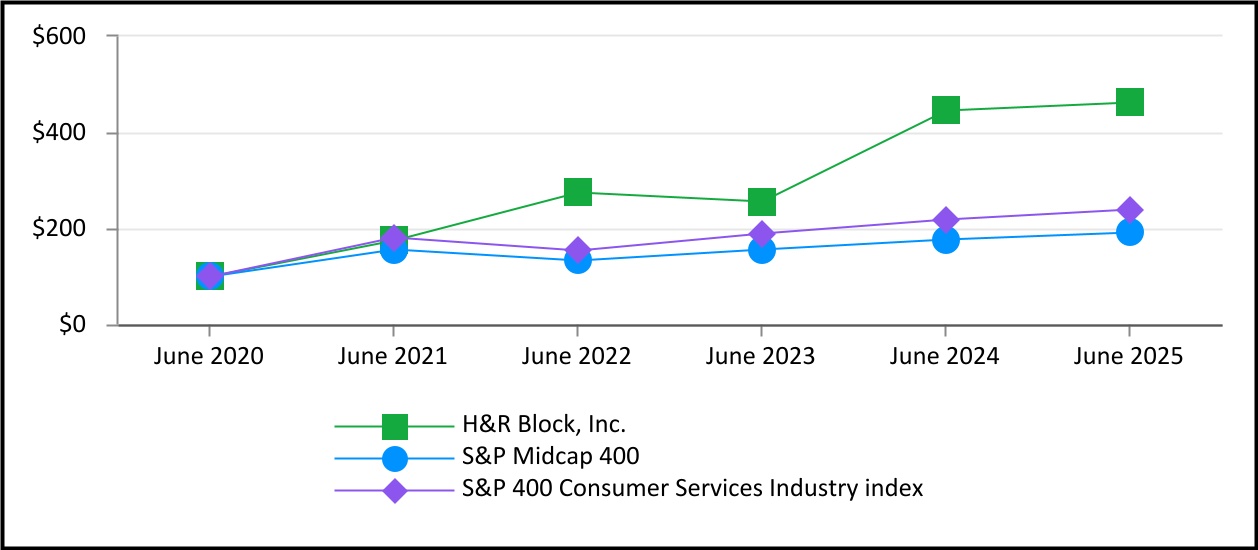
ITEM 6. SELECTED FINANCIAL DATA
Not applicable.
H&R Block, Inc. | 2025 Form 10-K | 23 | ||||
ITEM 7. MANAGEMENT'S DISCUSSION AND ANALYSIS OF FINANCIAL CONDITION AND RESULTS OF OPERATIONS
RESULTS OF OPERATIONS
Our subsidiaries provide assisted and DIY tax preparation solutions through multiple channels (including in-person, online and mobile applications, virtual, and desktop software) and distribute H&R Block-branded services and products, including those of our bank partners, to the general public primarily in the U.S., Canada and Australia. Tax returns are either prepared by H&R Block tax professionals in one of our 6,701 company-owned or 2,013 franchise offices (as of March 31, 2025), virtually or via an online review or prepared and filed by our clients through our DIY tax solutions. We also offer small business solutions through our company-owned and franchise offices (including in-person, online and virtual) and online through Wave. We report a single segment that includes all of our continuing operations.
A summary of our fiscal year 2025 results is as follows:
•Revenue increased $150.6 million, or 4.2%, largely due to increases in U.S. company-owned net average charge and tax return volume coupled with increases in DIY online paid net average charge. These increases were partially offset by lower interest and fee income on Emerald Advance® due to a decrease in EA loans originated.
•Operating expenses increased $128.0 million, or 4.6%, due to higher compensation and benefits, marketing, consulting, technology, and legal costs, partially offset by lower bad debt.
•Pretax income increased $19.1 million, or 2.5%.
•Net income from continuing operations of $609.5 million increased 1.9% from the prior year.
•EBITDA(1) of $976.3 million increased $13.2 million, or 1.4%.
•Diluted earnings per share from continuing operations increased $0.28, or 6.8%, and adjusted diluted earnings per share from continuing operations(1) increased $0.25, or 5.7%.
(1) All non-GAAP measures are results from continuing operations. See "Non-GAAP Financial Information" at the end of this item for a reconciliation of non-GAAP measures.
24 | 2025 Form 10-K | H&R Block, Inc. | ||||
| Consolidated – Financial Results | (in 000s, except per share amounts) | |||||||||||||||||||||||||
| Year ended June 30, | 2025 | 2024 | $ Change | % Change | ||||||||||||||||||||||
| Revenues: | ||||||||||||||||||||||||||
| U.S. tax preparation and related services: | ||||||||||||||||||||||||||
| Assisted tax preparation | $ | 2,413,229 | $ | 2,274,835 | $ | 138,394 | 6.1 | % | ||||||||||||||||||
| Royalties | 192,877 | 204,802 | (11,925) | (5.8) | % | |||||||||||||||||||||
| DIY tax preparation | 383,738 | 349,812 | 33,926 | 9.7 | % | |||||||||||||||||||||
| Refund Transfers | 137,526 | 142,249 | (4,723) | (3.3) | % | |||||||||||||||||||||
| Peace of Mind® Extended Service Plan | 87,326 | 93,087 | (5,761) | (6.2) | % | |||||||||||||||||||||
| Tax Identity Shield® | 29,920 | 33,386 | (3,466) | (10.4) | % | |||||||||||||||||||||
| Other | 58,318 | 51,555 | 6,763 | 13.1 | % | |||||||||||||||||||||
| Total U.S. tax preparation and related services | 3,302,934 | 3,149,726 | 153,208 | 4.9 | % | |||||||||||||||||||||
| Financial services: | ||||||||||||||||||||||||||
Emerald Card® and SpruceSM | 72,888 | 76,093 | (3,205) | (4.2) | % | |||||||||||||||||||||
| Interest and fee income on Emerald Advance® | 28,958 | 40,933 | (11,975) | (29.3) | % | |||||||||||||||||||||
| Total financial services | 101,846 | 117,026 | (15,180) | (13.0) | % | |||||||||||||||||||||
| International | 246,993 | 247,123 | (130) | (0.1) | % | |||||||||||||||||||||
| Wave | 109,222 | 96,472 | 12,750 | 13.2 | % | |||||||||||||||||||||
| Total revenues | $ | 3,760,995 | $ | 3,610,347 | $ | 150,648 | 4.2 | % | ||||||||||||||||||
| Compensation and benefits: | ||||||||||||||||||||||||||
| Field wages | 927,360 | 869,002 | (58,358) | (6.7) | % | |||||||||||||||||||||
| Other wages | 306,999 | 298,819 | (8,180) | (2.7) | % | |||||||||||||||||||||
| Benefits and other compensation | 250,729 | 228,723 | (22,006) | (9.6) | % | |||||||||||||||||||||
| 1,485,088 | 1,396,544 | (88,544) | (6.3) | % | ||||||||||||||||||||||
| Occupancy | 438,868 | 432,461 | (6,407) | (1.5) | % | |||||||||||||||||||||
| Marketing and advertising | 285,800 | 277,747 | (8,053) | (2.9) | % | |||||||||||||||||||||
| Depreciation and amortization | 116,827 | 121,784 | 4,957 | 4.1 | % | |||||||||||||||||||||
| Bad debt | 74,584 | 91,523 | 16,939 | 18.5 | % | |||||||||||||||||||||
| Other | 531,858 | 485,011 | (46,847) | (9.7) | % | |||||||||||||||||||||
| Total operating expenses | 2,933,025 | 2,805,070 | (127,955) | (4.6) | % | |||||||||||||||||||||
| Other income (expense), net | 31,546 | 36,125 | (4,579) | (12.7) | % | |||||||||||||||||||||
| Interest expense on borrowings | (78,113) | (79,080) | 967 | 1.2 | % | |||||||||||||||||||||
| Income from continuing operations before income taxes | 781,403 | 762,322 | 19,081 | 2.5 | % | |||||||||||||||||||||
| Income taxes | 171,953 | 164,359 | (7,594) | (4.6) | % | |||||||||||||||||||||
| Net income from continuing operations | 609,450 | 597,963 | 11,487 | 1.9 | % | |||||||||||||||||||||
| Net loss from discontinued operations | (3,677) | (2,646) | (1,031) | (39.0) | % | |||||||||||||||||||||
| Net income | $ | 605,773 | $ | 595,317 | $ | 10,456 | 1.8 | % | ||||||||||||||||||
| DILUTED EARNINGS PER SHARE: | ||||||||||||||||||||||||||
| Continuing operations | $ | 4.42 | $ | 4.14 | $ | 0.28 | 6.8 | % | ||||||||||||||||||
| Discontinued operations | (0.03) | (0.02) | (0.01) | (50.0) | % | |||||||||||||||||||||
| Consolidated | $ | 4.39 | $ | 4.12 | $ | 0.27 | 6.6 | % | ||||||||||||||||||
Adjusted diluted EPS(1) | $ | 4.66 | $ | 4.41 | $ | 0.25 | 5.7 | % | ||||||||||||||||||
EBITDA(1) | $ | 976,343 | $ | 963,186 | $ | 13,157 | 1.4 | % | ||||||||||||||||||
(1) All non-GAAP measures are results from continuing operations. See "Non-GAAP Financial Information" at the end of this item for a reconciliation of non-GAAP measures.
H&R Block, Inc. | 2025 Form 10-K | 25 | ||||
FISCAL YEAR 2025 COMPARED TO FISCAL YEAR 2024
Revenues increased $150.6 million, or 4.2%, from the prior year. U.S. assisted tax preparation revenues increased $138.4 million, or 6.1%, due to a 5.1% increase in net average charge combined with a 1.0% increase in company-owned tax return volumes in the current year. U.S. royalties revenue decreased $11.9 million, or 5.8%, due to lower franchise tax return volumes, which was primarily driven by franchise acquisitions. During the year we purchased franchise offices, which results in increasing tax preparation revenues and decreasing royalties as the revenues and returns become company-owned after the acquisition. During the year ended June 30, 2025 our total assisted tax return volume, which includes both company-owned and franchise offices, decreased 0.9% from the prior year.
U.S. DIY tax preparation revenues increased $33.9 million, or 9.7%, due to a 9.8% increase in paid net average charge and higher desktop software revenues compared to the prior year.
Interest and fee income on Emerald Advance® decreased $12.0 million, or 29.3%, due to a decrease in EA loans originated during the current year. Wave revenues increased $12.8 million, or 13.2%, due to higher accounting, invoicing and receipts subscriptions and small business payments processing volumes.
Total operating expenses increased $128.0 million, or 4.6%, from the prior year. Field wages increased $58.4 million, or 6.7%, due to higher tax professional wages in the current year primarily resulting from an increase in U.S. assisted tax preparation revenues. Other wages increased $8.2 million, or 2.7%, due to higher corporate wages due to salary increases in the current year. Benefits and other compensation increased $22.0 million, or 9.6%, due to higher employee insurance, severance pay and payroll taxes in the current year.
Marketing and advertising expense increased $8.1 million, or 2.9%, primarily due to higher advertising agency and customer incentive expenses. Bad debt expense decreased $16.9 million, or 18.5%, due to lower EA bad debt rates coupled with a decrease in EA loans originated during the current year.
Other operating expenses increased $46.8 million, or 9.7%. The components of other expenses are as follows:
| (in 000s) | ||||||||||||||||||||||||||
| Year ended June 30, | 2025 | 2024 | $ Change | % Change | ||||||||||||||||||||||
| Consulting and outsourced services | $ | 104,003 | $ | 92,737 | $ | (11,266) | (12.1) | % | ||||||||||||||||||
| Bank partner fees | 32,152 | 28,856 | (3,296) | (11.4) | % | |||||||||||||||||||||
| Client claims and refunds | 27,422 | 25,623 | (1,799) | (7.0) | % | |||||||||||||||||||||
| Employee and travel expenses | 35,646 | 33,473 | (2,173) | (6.5) | % | |||||||||||||||||||||
| Technology-related expenses | 119,241 | 108,694 | (10,547) | (9.7) | % | |||||||||||||||||||||
| Credit card/bank charges | 109,202 | 102,377 | (6,825) | (6.7) | % | |||||||||||||||||||||
| Insurance | 17,225 | 12,075 | (5,150) | (42.7) | % | |||||||||||||||||||||
| Legal fees and settlements | 37,819 | 28,536 | (9,283) | (32.5) | % | |||||||||||||||||||||
| Supplies | 20,777 | 23,090 | 2,313 | 10.0 | % | |||||||||||||||||||||
| Other | 28,371 | 29,550 | 1,179 | 4.0 | % | |||||||||||||||||||||
| $ | 531,858 | $ | 485,011 | $ | (46,847) | (9.7) | % | |||||||||||||||||||
Consulting and outsourced services expense increased $11.3 million, or 12.1%, due to higher Emerald Card® data processing and spend related to various strategic projects. Technology-related expenses increased by $10.5 million, or 9.7%, due to higher cloud-related technology spend. Legal fees and settlements expense increased $9.3 million, primarily due to higher outside counsel spend in the current year.
We recorded income tax expense of $172.0 million in the current year compared to $164.4 million in the prior year. The increase is due to higher pretax income and effective tax rate in the current year. The effective tax rate for the year ended June 30, 2025, and 2024 was 22.0% and 21.6%, respectively. See Item 8, note 9 to the consolidated financial statements for additional discussion.
FISCAL YEAR 2024 COMPARED TO FISCAL YEAR 2023
The comparison of fiscal year 2024 to 2023 has been omitted from this Form 10-K, but can be found in our Form 10-K for the fiscal year ended June 30, 2024, filed on August 15, 2024.
26 | 2025 Form 10-K | H&R Block, Inc. | ||||
FINANCIAL CONDITION
These comments should be read in conjunction with the consolidated balance sheets and consolidated statements of cash flows included in Item 8.
CAPITAL RESOURCES AND LIQUIDITY –
OVERVIEW – Our primary sources of capital and liquidity include cash from operations (including changes in working capital), draws on our CLOC, and issuances of debt. We use our sources of liquidity primarily to fund working capital, service and repay debt, pay dividends, repurchase shares of our common stock, and acquire businesses.
Our operations are highly seasonal and substantially all of our revenues and cash flow are generated during the period from February through April in a typical year. Therefore, we normally require the use of cash to fund losses and working capital needs, periodically resulting in a working capital deficit, from May through January. We typically have relied on available cash balances from the prior tax season and borrowings to meet liquidity needs.
Given the likely availability of a number of liquidity options discussed herein, we believe that in the absence of any unexpected developments, our existing sources of capital as of June 30, 2025 are sufficient to meet our future operating and financing needs.
DISCUSSION OF CONSOLIDATED STATEMENTS OF CASH FLOWS – The following table summarizes our statements of cash flows for fiscal year 2025 and 2024. See Item 8 for the complete consolidated statements of cash flows for these periods.
| (in 000s) | ||||||||||||||
| Year ended June 30, | 2025 | 2024 | ||||||||||||
| Net cash provided by (used in): | ||||||||||||||
| Operating activities | $ | 680,883 | $ | 720,860 | ||||||||||
| Investing activities | (105,373) | (93,858) | ||||||||||||
| Financing activities | (647,443) | (564,311) | ||||||||||||
| Effects of exchange rates on cash | (121) | (2,814) | ||||||||||||
| Net increase (decrease) in cash and cash equivalents, including restricted balances | $ | (72,054) | $ | 59,877 | ||||||||||
Operating Activities. Cash provided by operating activities totaled $680.9 million for the year ended June 30, 2025 compared to $720.9 million in the prior year period. The decrease is primarily due to changes in income tax reserves and accounts payable.
Investing Activities. Cash used in investing activities totaled $105.4 million for the year ended June 30, 2025 compared to $93.9 million for the prior year period. The increase is primarily due to higher capital expenditures, partially offset by lower payments made for business acquisitions in the current year.
Financing Activities. Cash used in financing activities totaled $647.4 million for the year ended June 30, 2025 compared to $564.3 million for the prior year period. The increase is primarily due to higher repurchases of common stock and dividends in the current year.
CASH REQUIREMENTS –
Dividends and Share Repurchase. Returning capital to shareholders in the form of dividends and the repurchase of outstanding shares has historically been a significant component of our capital allocation plan.
We have consistently paid quarterly dividends. Dividends paid totaled $197.3 million and $179.8 million in the years ended June 30, 2025 and 2024, respectively. Although we have historically paid dividends and plan to continue to do so, there can be no assurances that circumstances will not change in the future that could affect our ability or decisions to pay dividends.
H&R Block, Inc. | 2025 Form 10-K | 27 | ||||
On August 15, 2024, the Board of Directors approved a $1.5 billion share repurchase program. The repurchase program does not have an expiration date and replaced the previously existing share repurchase program.
During the year ended June 30, 2025, we repurchased $400.1 million of our common stock at an average price of $61.10 per share, excluding excise taxes in connection with such repurchases. In the prior year, we repurchased $350.1 million of our common stock at an average price of $43.66 per share, excluding excise taxes in connection with such repurchases. Our current share repurchase program has remaining authorization of $1.1 billion and does not have an expiration date.
Share repurchases are subject to prevailing market prices, may be made in open market transactions (some of which may be effectuated under SEC Rule 10b5-1) and remain subject to the discretion of our Board of Directors. The Company may cancel or suspend the repurchase of shares at any time. Any repurchases will be funded primarily through available cash and cash from operations. There can be no assurance that we will repurchase any shares.
The following table summarizes our shares outstanding, shares repurchased, and annual dividends per share:
| (in 000s, except per share amounts) | ||||||||||||||||||||
| Year ended June 30, | 2025 | 2024 | 2023 | |||||||||||||||||
| Shares outstanding | 133,947 | 139,591 | 146,150 | |||||||||||||||||
| Shares repurchased | 6,549 | 8,020 | 14,635 | |||||||||||||||||
| Dividends declared per share | $ | 1.50 | $ | 1.28 | $ | 1.16 | ||||||||||||||
Capital Investment. Capital expenditures totaled $82.0 million and $63.7 million for the years ended June 30, 2025 and 2024, respectively. Our capital expenditures relate primarily to recurring improvements to retail offices, as well as investments in computers, software and related assets. In addition to our capital expenditures, we also made payments to acquire businesses. We acquired franchise and competitor businesses totaling $35.5 million and $43.4 million during the years ended June 30, 2025 and 2024, respectively. See Item 8, note 6 for additional information on our acquisitions.
Contractual Obligations and Commercial Commitments. Effective October 18, 2024, we amended our Program Management Agreement (PMA) with Pathward®, N.A to extend the term of the PMA for two years until June 30, 2027. We are party to many contractual obligations involving commitments to make payments to third parties, which may impact our short-term and long-term liquidity and capital resource needs. Our contractual obligations primarily consist of operating leases, contingent acquisition payments, and long-term debt and related interest payments. See Item 8, note 7, 10, and 11 to the consolidated financial statements for additional information.
FINANCING RESOURCES – During fiscal year 2025, our existing CLOC had capacity of up to $1.5 billion and was scheduled to expire in June 2026. On July 11, 2025, we entered into a Fifth Amended and Restated Credit and Guarantee Agreement, which amended and restated our existing CLOC, extended the scheduled maturity date to July 11, 2030, maintained the aggregate principal amount of $1.5 billion, and revised the interest rate table. Other material terms remain substantially unchanged from the Fourth Amended and Restated Credit and Guarantee Agreement. Proceeds under the CLOC may be used for working capital needs or for other general corporate purposes. We were in compliance with our CLOC covenants as of June 30, 2025. As of June 30, 2025, amounts available to borrow under the CLOC were not limited by the debt-to-EBITDA covenant. We had no balance outstanding under our CLOC as of June 30, 2025.
See Item 8, note 7 to the consolidated financial statements for discussion of our CLOC and Senior Notes, including discussion of the amendment and restatement of our CLOC effective July 11, 2025.
28 | 2025 Form 10-K | H&R Block, Inc. | ||||
The following table provides ratings for debt issued by Block Financial LLC (Block Financial) as of June 30, 2025 and 2024:
| As of | June 30, 2025 | June 30, 2024 | ||||||||||||||||||||||||||||||||||||
| Short-term | Long-term | Outlook | Short-term | Long-term | Outlook | |||||||||||||||||||||||||||||||||
| Moody's | P-3 | Baa3 | Stable | P-3 | Baa3 | Stable | ||||||||||||||||||||||||||||||||
| S&P | A-2 | BBB | Stable | A-2 | BBB | Stable | ||||||||||||||||||||||||||||||||
CASH AND OTHER ASSETS – As of June 30, 2025, we held cash and cash equivalents, excluding restricted amounts, of $983.3 million, including $205.9 million held by our foreign subsidiaries.
Foreign Operations. Seasonal borrowing needs of our Canadian operations are typically funded by our U.S. operations. To mitigate foreign currency risk, we sometimes enter into foreign exchange forward contracts. There were no forward contracts outstanding as of June 30, 2025.
We do not currently intend to repatriate non-borrowed funds held by our foreign subsidiaries in a manner that would trigger a tax liability.
The impact of changes in foreign exchange rates during the period on our international cash balances resulted in a decrease of $0.1 million and $2.8 million during the years ended June 30, 2025 and 2024, respectively.
SUMMARIZED GUARANTOR FINANCIAL STATEMENTS – Block Financial is a 100% owned indirect subsidiary of H&R Block, Inc. Block Financial is the Issuer and H&R Block, Inc. is the full and unconditional Guarantor of our Senior Notes, CLOC and other indebtedness issued from time to time.
The following table presents summarized financial information for H&R Block, Inc. (Guarantor) and Block Financial (Issuer) on a combined basis after intercompany eliminations and excludes investments in and equity earnings in non-guarantor subsidiaries.
| SUMMARIZED BALANCE SHEET | (in 000s) | |||||||
| As of June 30, 2025 | GUARANTOR AND ISSUER | |||||||
| Current assets | $ | 38,254 | ||||||
| Noncurrent assets | 1,836,847 | |||||||
| Current liabilities | 432,139 | |||||||
| Noncurrent liabilities | 1,148,806 | |||||||
| SUMMARIZED STATEMENTS OF OPERATIONS | (in 000s) | |||||||
| Year ended June 30, 2025 | GUARANTOR AND ISSUER | |||||||
| Total revenues | $ | 126,240 | ||||||
| Income from continuing operations before income taxes | 58,596 | |||||||
| Net income from continuing operations | 45,120 | |||||||
| Net income | 41,443 | |||||||
The table above reflects $1.8 billion of non-current intercompany receivables due to the Issuer from non-guarantor subsidiaries.
H&R Block, Inc. | 2025 Form 10-K | 29 | ||||
CRITICAL ACCOUNTING ESTIMATES
We consider the estimates discussed below to be critical to understanding our financial statements, as they require the use of significant judgment and estimation in order to measure, at a specific point in time, matters that are inherently uncertain. Specific methods and assumptions for these critical accounting estimates are described in the following paragraphs. We have reviewed and discussed each of these estimates with the Audit Committee of our Board of Directors. For all of these estimates, we caution that future events rarely develop precisely as forecasted and estimates routinely require adjustment and may require material adjustment.
See Item 8, note 1 to the consolidated financial statements for discussion of our significant accounting policies.
LITIGATION AND OTHER RELATED CONTINGENCIES –
Nature of Estimates Required. We accrue liabilities related to certain legal matters for which we believe it is probable that a loss has been incurred and the amount of such loss can be reasonably estimated. Assessing the likely outcome of pending or threatened litigation or other related loss contingencies, including the amount of potential loss, if any, is highly subjective.
Assumptions and Approach Used. We are subject to pending or threatened litigation and other related loss contingencies, which are described in Item 8, note 12 to the consolidated financial statements. It is our policy to routinely assess the likelihood of any adverse judgments or outcomes related to legal matters, as well as ranges of probable losses. A determination of the amount of the liability required to be accrued, if any, for these contingencies is made after analysis of each known issue and an analysis of historical experience. In cases where we have concluded that a loss is only reasonably possible or remote, or is not reasonably estimable, no liability is accrued.
Sensitivity of Estimate to Change. It is reasonably possible that pending or future litigation and other related loss contingencies may vary from the amounts accrued. Our estimate of the aggregate range of reasonably possible losses includes (1) matters where a liability has been accrued and there is a reasonably possible loss in excess of the amount accrued for that liability, and (2) matters where a liability has not been accrued but we believe a loss is reasonably possible. This aggregate range represents only those losses as to which we are currently able to estimate a reasonably possible loss or range of loss. It does not represent our maximum loss exposure. As of June 30, 2025, we believe the estimate of the aggregate range of reasonably possible losses in excess of amounts accrued, where the range of loss can be estimated, is not material.
However, our judgments on whether a loss is probable, reasonably possible, or remote, and our estimates of probable loss amounts may differ from actual results due to difficulties in predicting changes in or interpretations of, laws, predicting the outcome of court trials, arbitration hearings, settlement discussions and related activity, predicting the outcome of class certification actions, and numerous other uncertainties. Due to the number of claims which are periodically asserted against us, and the magnitude of damages sought in those claims, actual losses in the future may significantly differ from our current estimates.
Our accrued liabilities for litigation and other related contingencies are disclosed in Item 8, note 12 to the consolidated financial statements.
INCOME TAXES – UNCERTAIN TAX POSITIONS –
Nature of Estimates Required. The income tax laws of jurisdictions in which we operate are complex and subject to different interpretations by the taxpayer and applicable government taxing authorities. Income tax returns filed by us are based on our interpretation of these rules. The amount of income taxes we pay is subject to ongoing audits by federal, state and foreign tax authorities, which may result in proposed assessments, including interest or penalties. We accrue a liability for unrecognized tax benefits arising from uncertain tax positions reflecting our judgment as to the ultimate resolution of the applicable issues.
Assumptions and Approach Used. Differences between a tax position taken or expected to be taken in our tax returns and the amount of benefit recorded in our financial statements result in uncertain tax positions. Uncertain tax positions are recorded in the balance sheet as either a liability or reductions to recorded tax assets as applicable. Our uncertain tax positions arise from items such as apportionment of income for state purposes, transfer pricing, and the deductibility of intercompany transactions. We evaluate each uncertain tax position based
30 | 2025 Form 10-K | H&R Block, Inc. | ||||
on its technical merits. For each position, we consider all applicable information including relevant tax laws, the taxing authorities' potential position, our tax return position, and the possible settlement outcomes to determine the amount of liability to record. In making this determination, we assume the tax authority has all relevant information at its disposal.
Sensitivity of Estimate to Change. Our assessment of the technical merits and measurement of tax benefits associated with uncertain tax positions is subject to a high degree of judgment and estimation. Actual results may differ from our current judgments due to a variety of factors, including changes in law, interpretations of law by taxing authorities that differ from our assessments, changes in the jurisdictions in which we operate and results of routine tax examinations. We believe we have adequately provided for any reasonably foreseeable outcomes related to these matters. However, our future results may include favorable or unfavorable adjustments to our estimated tax liabilities in the period the assessments are made or resolved, or when statutes of limitation on potential assessments expire. As a result, our effective tax rate may fluctuate on a quarterly basis.
A schedule of changes in our uncertain tax positions during the last three years is included in Item 8, note 9 to the consolidated financial statements.
GOODWILL –
Nature of Estimates Required. We test goodwill for impairment annually as of February 1 or more frequently if events occur or circumstances change which would, more likely than not, reduce the fair value of a reporting unit below its carrying value. We first assess qualitative factors to determine whether it is more likely than not that the fair value of a reporting unit is less than its carrying value. If, based on a review of qualitative factors, it is more likely than not that the fair value of a reporting unit is less than its carrying value, we perform a quantitative analysis. Our goodwill impairment analysis utilizes both income and market approaches, which includes revenue and expense forecasts, selection of market multiples of comparable publicly traded companies and selection of a discount rate, all of which are highly subjective.
Assumptions and Approach Used. Our goodwill impairment analysis is performed at the reporting unit level. Our valuation methods include a discounted cash flow model for the income approach and the guideline public company method for the market approach. The income approach requires significant management judgment with respect to revenue and expense forecasts and selection of an appropriate discount rate. The market approach requires significant assumptions related to the selection of comparable publicly traded companies and the market multiples. Changes in projections or assumptions could materially affect our estimate of reporting unit fair values. The use of different assumptions could increase or decrease estimated discounted future operating cash flows and could affect our conclusion regarding the existence or amount of potential impairment.
Sensitivity of Estimate to Change. Estimates of fair value may be adversely impacted by declining economic conditions and changes in the industries and markets in which we operate. Additionally, if future operating results of our reporting units are below our current modeled expectations, fair value estimates may decline. Any of these factors could result in future impairments, and those impairments could be significant.
A schedule of changes in our goodwill balances, including any impairment charges, is included in Item 8, note 6 to the consolidated financial statements.
NEW ACCOUNTING PRONOUNCEMENTS
See Item 8, note 1 to the consolidated financial statements for any recently issued accounting pronouncements.
REGULATORY ENVIRONMENT
The federal government, various state, local, provincial and foreign governments, and some self-regulatory organizations have enacted statutes and ordinances, or adopted rules and regulations, regulating many aspects of our business. These aspects include, but are not limited to, commercial income tax return preparation, income tax courses, the electronic filing of income tax returns, the offering of RTs and RAs, privacy and data security, consumer protection, marketing and advertising, artificial intelligence, franchising, antitrust and competition, sales methods, and financial services and products. Regulatory attention in the area of financial services and products may in the future impact our program, our contractual arrangements with our bank partner or other partners, or the offering of financial services and products to our clients. We work to comply with those laws that are
H&R Block, Inc. | 2025 Form 10-K | 31 | ||||
applicable to us or our services or products, and we continue to monitor developments in the regulatory environment in which we operate.
See further discussion of these items in our Item 1A. Risk Factors under "Legal and Regulatory Risks" of this Form 10-K.
From time to time, we receive inquiries from governmental authorities regarding the applicability of laws to our services and products and other matters relating to our business. We cannot predict what effect future laws, changes in interpretations of existing laws or the results of future governmental inquiries with respect to services and products or other matters relating to our business may have on our consolidated financial position, results of operations and cash flows. We have received certain governmental inquiries related to the IRS Free File Program and our DIY tax preparation services. We may also be subject to future inquiries or other proceedings regarding these programs or other aspects of our business. Regulatory inquiries may result in us incurring additional expense, diversion of management's attention, adverse judgments, settlements, fines, penalties, injunctions or other relief. See additional discussion of legal matters in Item 8, note 12 to the consolidated financial statements.
NON-GAAP FINANCIAL INFORMATION
Non-GAAP financial measures should not be considered as a substitute for, or superior to, measures of financial performance prepared in accordance with GAAP. Because these measures are not measures of financial performance under GAAP and are susceptible to varying calculations, they may not be comparable to similarly titled measures for other companies.
We consider our non-GAAP financial measures to be performance measures and a useful metric for management and investors to evaluate and compare the ongoing operating performance of our business. We make adjustments for certain non-GAAP financial measures related to amortization of intangibles from acquisitions and goodwill impairments. We may consider whether other significant items that arise in the future should be excluded from our non-GAAP financial measures.
We measure the performance of our business using a variety of metrics, including earnings before interest, taxes, depreciation and amortization (EBITDA) from continuing operations, adjusted EBITDA from continuing operations, adjusted diluted earnings per share from continuing operations, free cash flow and free cash flow yield. We also use EBITDA from continuing operations and pretax income of continuing operations, each subject to permitted adjustments, as performance metrics in incentive compensation calculations for our employees.
The following is a reconciliation of net income to EBITDA from continuing operations, which is a non-GAAP financial measure:
| (in 000s) | ||||||||||||||
| Year ended | June 30, 2025 | June 30, 2024 | ||||||||||||
| Net income - as reported | $ | 605,773 | $ | 595,317 | ||||||||||
| Discontinued operations, net | 3,677 | 2,646 | ||||||||||||
| Net income from continuing operations - as reported | 609,450 | 597,963 | ||||||||||||
| Add back: | ||||||||||||||
| Income taxes | 171,953 | 164,359 | ||||||||||||
| Interest expense | 78,113 | 79,080 | ||||||||||||
| Depreciation and amortization | 116,827 | 121,784 | ||||||||||||
| 366,893 | 365,223 | |||||||||||||
| EBITDA from continuing operations | $ | 976,343 | $ | 963,186 | ||||||||||
32 | 2025 Form 10-K | H&R Block, Inc. | ||||
The following is a reconciliation of our results from continuing operations to our adjusted results from continuing operations, which is a non-GAAP financial measure:
| (in 000s, except per share amounts) | ||||||||||||||
| Year ended | June 30, 2025 | June 30, 2024 | ||||||||||||
| Net income from continuing operations - as reported | $ | 609,450 | $ | 597,963 | ||||||||||
| Adjustments: | ||||||||||||||
| Amortization of intangibles related to acquisitions (pretax) | 44,673 | 50,835 | ||||||||||||
Tax effect of adjustments(1) | (10,865) | (11,751) | ||||||||||||
| Adjusted net income from continuing operations | $ | 643,258 | $ | 637,047 | ||||||||||
| Diluted earnings per share from continuing operations - as reported | $ | 4.42 | $ | 4.14 | ||||||||||
| Adjustments, net of tax | 0.24 | 0.27 | ||||||||||||
| Adjusted diluted earnings per share from continuing operations | $ | 4.66 | $ | 4.41 | ||||||||||
(1) The tax effect of adjustments is the difference between the tax provision calculation on a GAAP basis and on an adjusted non-GAAP basis.
ITEM 7A. QUANTITATIVE AND QUALITATIVE DISCLOSURES ABOUT MARKET RISK
INTEREST RATE RISK
GENERAL – We have a formal investment policy that strives to minimize the market risk exposure of our cash equivalents, which are primarily affected by credit quality and movements in interest rates. The guidelines in our investment policy focus on managing liquidity and preserving principal and earnings.
Our cash equivalents are primarily held for liquidity purposes and are comprised of high quality, short-term investments, including money market funds and U.S. Treasuries. Because our cash and cash equivalents have a short maturity, our portfolio's market value is relatively insensitive to interest rate changes.
Interest expense on our CLOC borrowings is determined based on short-term interest rates. As our CLOC borrowings are generally seasonal, interest rate risk typically increases during the months of November through March. We had no outstanding balance on our CLOC as of June 30, 2025.
Our long-term debt as of June 30, 2025, consists of fixed-rate Senior Notes; therefore, a change in interest rates would have no impact on consolidated pretax earnings until these notes mature or are refinanced. The interest we pay on our Senior Notes is fixed and is subject to adjustment based upon our credit ratings. See Item 8, note 7 to the consolidated financial statements.
FOREIGN EXCHANGE RATE RISK
Our operations in international markets are exposed to movements in currency exchange rates. The currencies primarily involved are the Canadian dollar and the Australian dollar. We translate revenues and expenses related to these operations at the average of exchange rates in effect during the period. Assets and liabilities of foreign subsidiaries are translated into U.S. dollars at exchange rates at the end of the year. Translation adjustments are recorded as a separate component of other comprehensive income in stockholders' equity. Translation of financial results into U.S. dollars does not presently materially affect, and has not historically materially affected, our consolidated financial results, although such changes do affect the year-to-year comparability of the operating results in U.S. dollars of our international businesses. The impact of changes in foreign exchange rates during the period on our international cash balances resulted in a decrease of $0.1 million and $2.8 million during the years ended June 30, 2025 and 2024, respectively. We estimate a 10% change in foreign exchange rates by itself would impact consolidated pretax income for the years ended June 30, 2025 and 2024 by $4.5 million and $4.3 million, respectively, and cash balances, excluding restricted balances, as of June 30, 2025 and 2024 by $19.7 million and $16.7 million, respectively.
We generally use foreign exchange forward contracts to mitigate foreign currency exchange rate risk for loans we advance to our Canadian operations. We had no forward contracts outstanding at June 30, 2025 or 2024.
H&R Block, Inc. | 2025 Form 10-K | 33 | ||||
ITEM 8. FINANCIAL STATEMENTS AND SUPPLEMENTARY DATA
DISCUSSION OF FINANCIAL RESPONSIBILITY
H&R Block's management is responsible for the integrity and objectivity of the information contained in this document. Management is responsible for the consistency of reporting this information and for ensuring that accounting principles generally accepted in the U.S. are properly applied. In discharging this responsibility, management maintains an extensive program of internal audits and requires members of management to certify financial information within their scope of management. Our system of internal control over financial reporting also includes formal policies and procedures, including a Code of Business Ethics and Conduct that reinforces our commitment to ethical business conduct and is designed to encourage our employees and directors to act with high standards of integrity in all that they do.
The Audit Committee of the Board of Directors, composed solely of independent outside directors, meets periodically with management, the independent auditor and the Vice President, Audit Services (our chief internal auditor) to review matters relating to our financial statements, internal audit activities, internal accounting controls and non-audit services provided by the independent auditors. The independent auditor and the Vice President, Audit Services have full access to the Audit Committee and meet with the committee, both with and without management present, to discuss the scope and results of their audits, including internal controls and financial matters.
Deloitte & Touche LLP audited our consolidated financial statements for the fiscal years 2025 , 2024 and 2023. The audits were conducted in accordance with the standards of the Public Company Accounting Oversight Board (United States).
MANAGEMENT'S REPORT ON INTERNAL CONTROL OVER FINANCIAL REPORTING
Management is responsible for establishing and maintaining adequate internal control over financial reporting, as such term is defined in Exchange Act Rules 12a-15(f). Under the supervision and with the participation of our Chief Executive Officer and Chief Financial Officer, we conducted an evaluation of the effectiveness of our internal control over financial reporting based on the criteria established in "Internal Control - Integrated Framework" issued by the Committee of Sponsoring Organizations of the Treadway Commission (COSO), using the 2013 framework, as of June 30, 2025.
Based on our assessment, our Chief Executive Officer and Chief Financial Officer concluded that as of June 30, 2025, the Company's internal control over financial reporting was effective based on the criteria set forth by COSO, using the 2013 framework. The Company's external auditor, Deloitte & Touche LLP, an independent registered public accounting firm, has issued an audit report on the effectiveness of the Company's internal control over financial reporting.
| /s/ Jeffrey J. Jones II | /s/ Tiffany L. Mason | |||||||
| Jeffrey J. Jones II | Tiffany L. Mason | |||||||
| President and Chief Executive Officer | Chief Financial Officer | |||||||
34 | 2025 Form 10-K | H&R Block, Inc. | ||||
REPORT OF INDEPENDENT REGISTERED PUBLIC ACCOUNTING FIRM
To the Board of Directors and Stockholders of H&R Block, Inc.
Opinion on the Financial Statements
We have audited the accompanying consolidated balance sheets of H&R Block, Inc. and subsidiaries (the "Company") as of June 30, 2025 and 2024, the related consolidated statements of operations and comprehensive income, stockholders' equity, and cash flows, for each of the three years in the period ended June 30, 2025, and the related notes (collectively referred to as the "financial statements"). In our opinion, the financial statements present fairly, in all material respects, the financial position of the Company as of June 30, 2025 and 2024, and the results of its operations and its cash flows for each of the three years in the period ended June 30, 2025, in conformity with accounting principles generally accepted in the United States of America.
We have also audited, in accordance with the standards of the Public Company Accounting Oversight Board (United States) (PCAOB), the Company's internal control over financial reporting as of June 30, 2025, based on criteria established in Internal Control — Integrated Framework (2013) issued by the Committee of Sponsoring Organizations of the Treadway Commission and our report dated August 15, 2025, expressed an unqualified opinion on the Company's internal control over financial reporting.
Basis for Opinion
These financial statements are the responsibility of the Company's management. Our responsibility is to express an opinion on the Company's financial statements based on our audits. We are a public accounting firm registered with the PCAOB and are required to be independent with respect to the Company in accordance with the U.S. federal securities laws and the applicable rules and regulations of the Securities and Exchange Commission and the PCAOB.
We conducted our audits in accordance with the standards of the PCAOB. Those standards require that we plan and perform the audit to obtain reasonable assurance about whether the financial statements are free of material misstatement, whether due to error or fraud. Our audits included performing procedures to assess the risks of material misstatement of the financial statements, whether due to error or fraud, and performing procedures that respond to those risks. Such procedures included examining, on a test basis, evidence regarding the amounts and disclosures in the financial statements. Our audits also included evaluating the accounting principles used and significant estimates made by management, as well as evaluating the overall presentation of the financial statements. We believe that our audits provide a reasonable basis for our opinion.
Critical Audit Matters
The critical audit matters communicated below are matters arising from the current-period audit of the financial statements that were communicated or required to be communicated to the audit committee and that (1) relate to accounts or disclosures that are material to the financial statements and (2) involved our especially challenging, subjective, or complex judgments. The communication of critical audit matters does not alter in any way our opinion on the financial statements, taken as a whole, and we are not, by communicating the critical audit matters below, providing separate opinions on the critical audit matters or on the accounts or disclosures to which they relate.
Income Taxes - Uncertain Tax Positions - Refer to Note 9 to the consolidated financial statements
Critical Audit Matter Description
The Company operates in multiple income tax jurisdictions both within the United States and internationally. Accordingly, management must determine the appropriate allocation of income to each of these jurisdictions based on transfer pricing analyses of comparable companies and predictions of future economic conditions.
H&R Block, Inc. | 2025 Form 10-K | 35 | ||||
Transfer pricing terms and conditions may be scrutinized by local tax authorities during an audit and any resulting changes may impact the mix of earnings in countries with differing statutory tax rates. The Company accrues a liability for unrecognized tax benefits arising from uncertain tax positions reflecting their judgment as to the ultimate resolution of the applicable issues. For each position, management considers all applicable information including relevant tax laws, the taxing authorities’ potential position, management’s tax return position, and the possible settlement outcomes to determine the amount of liability to record.
We identified the Company’s determination of uncertain tax positions measured in accordance with the Company’s transfer pricing policies as a critical audit matter because of the significant judgment in the application of the tax law in applying the arm’s-length standard to intercompany transactions and scrutiny by local tax authorities. The significant level of judgment increases the uncertainty in evaluating the valuation of tax balances, including any uncertain tax positions that relate to the Company’s transfer pricing. As a result, we utilized a high degree of auditor judgment and increased the extent of work performed, including involving our income tax specialists to evaluate whether management’s judgments in interpreting and applying tax laws were appropriate.
How the Critical Audit Matter Was Addressed in the Audit
Our audit procedures related to the Company’s uncertain tax positions for transfer pricing included the following, among others:
•We tested the effectiveness of controls over management’s evaluation and determination of uncertain tax positions. This evaluation includes management’s assessment of tax positions taken by the Company on its tax returns, including transfer pricing terms and conditions, and the related recorded amounts for uncertain tax positions.
•With the assistance of our income tax specialists, we evaluated the Company’s transfer pricing methodologies and performed the following:
◦Evaluated the appropriateness of management’s application of jurisdictional tax regulations in applying the arm’s length standard to intercompany transactions.
◦Evaluated the application of the transfer pricing method to transactions subject to transfer pricing.
◦Tested the application of the transfer pricing policies by legal entity through an independent calculation.
◦Evaluated management’s approach to identifying uncertain tax positions related to changes in the transfer pricing terms and conditions and tested the calculation of the tax positions at the individual legal entity level and at the consolidated level.
Goodwill - Wave Reporting Unit - Refer to Note 6 to the consolidated financial statements
Critical Audit Matter Description
The Company tests goodwill for impairment annually as of February 1 ("measurement date"), or more frequently if events occur or circumstances change which would, more likely than not, reduce the fair value of a reporting unit below its carrying value. The Company determines the fair value of the Wave reporting unit using the income approach ("discounted cash flow model") and the market approach ("guideline public company method"). The determination of the fair value using the discounted cash flow model requires management to make significant estimates and assumptions related to forecasts of future revenues, operating margins, and the discount rate. The determination of the fair value using the guideline public company method requires management to make significant assumptions related to the selection of market multiples of comparable publicly traded companies. The goodwill balance was $783 million as of February 1, 2025, of which $159 million relates to the Wave reporting unit. The estimated fair value of the Wave reporting unit exceeded its carrying value as of the measurement date and, therefore, no impairment was recognized.
36 | 2025 Form 10-K | H&R Block, Inc. | ||||
We identified the Company's goodwill impairment assessment for the Wave reporting unit as of the measurement date as a critical audit matter because of the significant judgments made by management to estimate the fair value of Wave. This required a high degree of auditor judgment and an increased extent of effort, including the need to involve our fair value specialists, when performing audit procedures to evaluate the reasonableness of management’s estimates and assumptions related to forecasts of future revenues and operating margins and selection of market multiples of comparable publicly traded companies and the discount rate.
How the Critical Audit Matter Was Addressed in the Audit
Our audit procedures related to the forecasts of future revenues and operating margins ("forecasts"), selection of market multiples of comparable publicly traded companies, and the discount rate for the Wave reporting unit included the following, among others:
•We tested the effectiveness of the control over management’s evaluation and determination of estimates and assumptions related to the forecast of future revenues and operating margins and selection of market multiples of comparable publicly traded companies and the discount rate.
•We evaluated management’s ability to accurately forecast by comparing actual results to management’s historical forecasts.
•We evaluated the reasonableness of management’s revenue and operating margin forecasts by comparing the forecasts to (1) the Company's historical revenue growth and operating margin rates, (2) internal communications to management and the Board of Directors, (3) forecasted information included in industry reports, applicable market data, and guideline public company information, and (4) underlying analyses detailing business strategies and growth plans.
•We tested the source information underlying the determination of the discount rate.
•With the assistance of our fair value specialists, we performed the following:
◦Evaluated the valuation methodologies
◦Tested the mathematical accuracy of the discount rate calculations
◦Evaluated the market multiples, including comparing the reporting unit’s growth and profitability to the guideline public companies, testing the underlying source information and mathematical accuracy of the calculations, and comparing the multiples selected by management to the guideline companies.
/s/ Deloitte & Touche LLP
August 15, 2025
We have served as the Company's auditor since 2007.
H&R Block, Inc. | 2025 Form 10-K | 37 | ||||
REPORT OF INDEPENDENT REGISTERED PUBLIC ACCOUNTING FIRM
To the Board of Directors and Stockholders of H&R Block, Inc.
Opinion on Internal Control over Financial Reporting
We have audited the internal control over financial reporting of H&R Block, Inc. and subsidiaries (the "Company") as of June 30, 2025, based on criteria established in Internal Control — Integrated Framework (2013) issued by the Committee of Sponsoring Organizations of the Treadway Commission (COSO). In our opinion, the Company maintained, in all material respects, effective internal control over financial reporting as of June 30, 2025, based on criteria established in Internal Control — Integrated Framework (2013) issued by COSO.
We have also audited, in accordance with the standards of the Public Company Accounting Oversight Board (United States) (PCAOB), the consolidated financial statements as of and for the year ended June 30, 2025, of the Company and our report dated August 15, 2025, expressed an unqualified opinion on those financial statements.
Basis for Opinion
The Company's management is responsible for maintaining effective internal control over financial reporting and for its assessment of the effectiveness of internal control over financial reporting, included in the accompanying Management's Report on Internal Control over Financial Reporting. Our responsibility is to express an opinion on the Company's internal control over financial reporting based on our audit. We are a public accounting firm registered with the PCAOB and are required to be independent with respect to the Company in accordance with the U.S. federal securities laws and the applicable rules and regulations of the Securities and Exchange Commission and the PCAOB.
We conducted our audit in accordance with the standards of the PCAOB. Those standards require that we plan and perform the audit to obtain reasonable assurance about whether effective internal control over financial reporting was maintained in all material respects. Our audit included obtaining an understanding of internal control over financial reporting, assessing the risk that a material weakness exists, testing and evaluating the design and operating effectiveness of internal control based on the assessed risk, and performing such other procedures as we considered necessary in the circumstances. We believe that our audit provides a reasonable basis for our opinion.
Definition and Limitations of Internal Control over Financial Reporting
A company's internal control over financial reporting is a process designed to provide reasonable assurance regarding the reliability of financial reporting and the preparation of financial statements for external purposes in accordance with generally accepted accounting principles. A company's internal control over financial reporting includes those policies and procedures that (1) pertain to the maintenance of records that, in reasonable detail, accurately and fairly reflect the transactions and dispositions of the assets of the company; (2) provide reasonable assurance that transactions are recorded as necessary to permit preparation of financial statements in accordance with generally accepted accounting principles, and that receipts and expenditures of the company are being made only in accordance with authorizations of management and directors of the company; and (3) provide reasonable assurance regarding prevention or timely detection of unauthorized acquisition, use, or disposition of the company's assets that could have a material effect on the financial statements.
Because of its inherent limitations, internal control over financial reporting may not prevent or detect misstatements. Also, projections of any evaluation of effectiveness to future periods are subject to the risk that controls may become inadequate because of changes in conditions, or that the degree of compliance with the policies or procedures may deteriorate.
/s/ Deloitte & Touche LLP
Kansas City, Missouri
August 15, 2025
38 | 2025 Form 10-K | H&R Block, Inc. | ||||
| CONSOLIDATED STATEMENTS OF OPERATIONS AND COMPREHENSIVE INCOME | (in 000s, except per share amounts) | |||||||||||||||||||
| Year ended June 30, | 2024 | 2023 | ||||||||||||||||||
| REVENUES: | ||||||||||||||||||||
| Service revenues | $ | $ | $ | |||||||||||||||||
| Royalty, product and other revenues | ||||||||||||||||||||
| OPERATING EXPENSES: | ||||||||||||||||||||
| Costs of revenues | ||||||||||||||||||||
| Selling, general and administrative | ||||||||||||||||||||
| Total operating expenses | ||||||||||||||||||||
| Other income (expense), net | ||||||||||||||||||||
| Interest expense on borrowings | ( | ( | ( | |||||||||||||||||
| Income from continuing operations before income taxes | ||||||||||||||||||||
| Income taxes | ||||||||||||||||||||
| Net income from continuing operations | ||||||||||||||||||||
Net loss from discontinued operations, net of tax benefits of $ | ( | ( | ( | |||||||||||||||||
| NET INCOME | $ | $ | $ | |||||||||||||||||
| BASIC EARNINGS PER SHARE: | ||||||||||||||||||||
| Continuing operations | $ | $ | $ | |||||||||||||||||
| Discontinued operations | ( | ( | ( | |||||||||||||||||
| Consolidated | $ | $ | $ | |||||||||||||||||
| DILUTED EARNINGS PER SHARE: | ||||||||||||||||||||
| Continuing operations | $ | $ | $ | |||||||||||||||||
| Discontinued operations | ( | ( | ( | |||||||||||||||||
| Consolidated | $ | $ | $ | |||||||||||||||||
| COMPREHENSIVE INCOME: | ||||||||||||||||||||
| Net income | $ | $ | $ | |||||||||||||||||
| Change in foreign currency translation adjustments | ( | ( | ||||||||||||||||||
| Other comprehensive income (loss) | ( | ( | ||||||||||||||||||
| Comprehensive income | $ | $ | $ | |||||||||||||||||
See accompanying notes to consolidated financial statements.
H&R Block, Inc. | 2025 Form 10-K | 39 | ||||
| CONSOLIDATED BALANCE SHEETS | (in 000s, except share and per share amounts) | |||||||||||||
| As of | June 30, 2025 | June 30, 2024 | ||||||||||||
| ASSETS | ||||||||||||||
| Cash and cash equivalents | $ | $ | ||||||||||||
| Cash and cash equivalents - restricted | ||||||||||||||
Receivables, less allowance for credit losses of $ | ||||||||||||||
| Prepaid expenses and other current assets | ||||||||||||||
| Total current assets | ||||||||||||||
Property and equipment, at cost, less accumulated depreciation and amortization of $ | ||||||||||||||
| Operating lease right of use asset | ||||||||||||||
| Intangible assets, net | ||||||||||||||
| Goodwill | ||||||||||||||
| Deferred tax assets and income taxes receivable | ||||||||||||||
| Other noncurrent assets | ||||||||||||||
| Total assets | $ | $ | ||||||||||||
| LIABILITIES AND STOCKHOLDERS' EQUITY | ||||||||||||||
| LIABILITIES: | ||||||||||||||
| Accounts payable and accrued expenses | $ | $ | ||||||||||||
| Accrued salaries, wages and payroll taxes | ||||||||||||||
| Accrued income taxes and reserves for uncertain tax positions | ||||||||||||||
| Current portion of long-term debt | — | |||||||||||||
| Operating lease liabilities | ||||||||||||||
| Deferred revenue and other current liabilities | ||||||||||||||
| Total current liabilities | ||||||||||||||
| Long-term debt | ||||||||||||||
| Deferred tax liabilities and reserves for uncertain tax positions | ||||||||||||||
| Operating lease liabilities | ||||||||||||||
| Deferred revenue and other noncurrent liabilities | ||||||||||||||
| Total liabilities | ||||||||||||||
| COMMITMENTS AND CONTINGENCIES | ||||||||||||||
| STOCKHOLDERS' EQUITY: | ||||||||||||||
Common stock, | ||||||||||||||
| Additional paid-in capital | ||||||||||||||
| Accumulated other comprehensive loss | ( | ( | ||||||||||||
| Retained earnings | ||||||||||||||
Less treasury shares, at cost, of | ( | ( | ||||||||||||
| Total stockholders' equity | ||||||||||||||
| Total liabilities and stockholders' equity | $ | $ | ||||||||||||
See accompanying notes to consolidated financial statements.
40 | 2025 Form 10-K | H&R Block, Inc. | ||||
| CONSOLIDATED STATEMENTS OF CASH FLOWS | (in 000s) | |||||||||||||||||||
| Year ended June 30, | 2024 | 2023 | ||||||||||||||||||
| CASH FLOWS FROM OPERATING ACTIVITIES: | ||||||||||||||||||||
| Net income | $ | $ | $ | |||||||||||||||||
| Adjustments to reconcile net income to net cash provided by operating activities: | ||||||||||||||||||||
| Depreciation and amortization | ||||||||||||||||||||
| Provision for credit losses | ||||||||||||||||||||
| Deferred taxes | ( | ( | ||||||||||||||||||
| Stock-based compensation | ||||||||||||||||||||
| Changes in assets and liabilities, net of acquisitions: | ||||||||||||||||||||
| Receivables | ( | ( | ( | |||||||||||||||||
| Prepaid expenses, other current and noncurrent assets | ( | ( | ||||||||||||||||||
| Accounts payable, accrued expenses, salaries, wages and payroll taxes | ( | ( | ( | |||||||||||||||||
| Deferred revenue, other current and noncurrent liabilities | ( | ( | ( | |||||||||||||||||
| Income tax receivables, accrued income taxes and income tax reserves | ( | |||||||||||||||||||
| Other, net | ( | ( | ||||||||||||||||||
| Net cash provided by operating activities | ||||||||||||||||||||
| CASH FLOWS FROM INVESTING ACTIVITIES: | ||||||||||||||||||||
| Capital expenditures | ( | ( | ( | |||||||||||||||||
| Payments made for business acquisitions, net of cash acquired | ( | ( | ( | |||||||||||||||||
| Franchise loans funded | ( | ( | ( | |||||||||||||||||
| Payments from franchisees | ||||||||||||||||||||
| Other, net | ||||||||||||||||||||
| Net cash used in investing activities | ( | ( | ( | |||||||||||||||||
| CASH FLOWS FROM FINANCING ACTIVITIES: | ||||||||||||||||||||
| Repayments of line of credit borrowings | ( | ( | ( | |||||||||||||||||
| Proceeds from line of credit borrowings | ||||||||||||||||||||
| Dividends paid | ( | ( | ( | |||||||||||||||||
| Repurchase of common stock, including shares surrendered | ( | ( | ( | |||||||||||||||||
| Other, net | ( | ( | ( | |||||||||||||||||
| Net cash used in financing activities | ( | ( | ( | |||||||||||||||||
| Effects of exchange rate changes on cash | ( | ( | ( | |||||||||||||||||
| Net increase (decrease) in cash and cash equivalents, including restricted balances | ( | ( | ||||||||||||||||||
| Cash, cash equivalents and restricted cash, beginning of the period | ||||||||||||||||||||
| Cash, cash equivalents and restricted cash, end of the period | $ | $ | $ | |||||||||||||||||
| SUPPLEMENTARY CASH FLOW DATA: | ||||||||||||||||||||
| Income taxes paid (received), net (includes payments for purchased investment tax credits) | $ | $ | $ | ( | ||||||||||||||||
| Interest paid on borrowings | ||||||||||||||||||||
| Accrued additions to property and equipment | ||||||||||||||||||||
| Accrued dividends payable to common shareholders | ||||||||||||||||||||
H&R Block, Inc. | 2025 Form 10-K | 41 | ||||
| CONSOLIDATED STATEMENTS OF STOCKHOLDERS' EQUITY | (amounts in 000s, except per share amounts) | |||||||||||||||||||||||||||||||||||||||||||||||||
| Common Stock | Additional Paid-in Capital | Accumulated Other Comprehensive Income (Loss)(1) | Retained Earnings (Deficit) | Treasury Stock | Total Stockholders’ Equity | |||||||||||||||||||||||||||||||||||||||||||||
| Shares | Amount | Shares | Amount | |||||||||||||||||||||||||||||||||||||||||||||||
| Balances as of July 1, 2022 | $ | $ | $ | ( | $ | ( | $ | ( | $ | |||||||||||||||||||||||||||||||||||||||||
| Net income | — | — | — | — | — | — | ||||||||||||||||||||||||||||||||||||||||||||
| Other comprehensive loss | — | — | — | ( | — | — | — | ( | ||||||||||||||||||||||||||||||||||||||||||
| Stock-based compensation | — | — | — | — | — | — | ||||||||||||||||||||||||||||||||||||||||||||
| Stock-based awards exercised or vested | — | — | ( | — | ( | |||||||||||||||||||||||||||||||||||||||||||||
Acquisition of treasury shares(2) | — | — | — | — | — | ( | ( | ( | ||||||||||||||||||||||||||||||||||||||||||
| Repurchase and retirement of common shares | ( | ( | ( | — | ( | — | — | ( | ||||||||||||||||||||||||||||||||||||||||||
Cash dividends declared - $ | — | — | — | — | ( | — | — | ( | ||||||||||||||||||||||||||||||||||||||||||
| Balances as of June 30, 2023 | $ | $ | $ | ( | $ | ( | ( | $ | ( | $ | ||||||||||||||||||||||||||||||||||||||||
| Net income | — | — | — | — | — | — | ||||||||||||||||||||||||||||||||||||||||||||
| Other comprehensive loss | — | — | — | ( | — | — | — | ( | ||||||||||||||||||||||||||||||||||||||||||
| Stock-based compensation | — | — | — | — | — | — | ||||||||||||||||||||||||||||||||||||||||||||
| Stock-based awards exercised or vested | — | — | ( | — | ( | |||||||||||||||||||||||||||||||||||||||||||||
Acquisition of treasury shares(2) | — | — | — | — | — | ( | ( | ( | ||||||||||||||||||||||||||||||||||||||||||
| Repurchase and retirement of common shares | ( | ( | ( | — | ( | — | — | ( | ||||||||||||||||||||||||||||||||||||||||||
Cash dividends declared - $ | — | — | — | — | ( | — | — | ( | ||||||||||||||||||||||||||||||||||||||||||
| Balances as of June 30, 2024 | $ | $ | $ | ( | $ | ( | $ | ( | $ | |||||||||||||||||||||||||||||||||||||||||
| Net income | — | — | — | — | — | — | ||||||||||||||||||||||||||||||||||||||||||||
| Other comprehensive income | — | — | — | — | — | — | ||||||||||||||||||||||||||||||||||||||||||||
| Stock-based compensation | — | — | — | — | — | — | ||||||||||||||||||||||||||||||||||||||||||||
| Stock-based awards exercised or vested | — | — | ( | — | ( | |||||||||||||||||||||||||||||||||||||||||||||
Acquisition of treasury shares(2) | — | — | — | — | — | ( | ( | ( | ||||||||||||||||||||||||||||||||||||||||||
| Repurchase and retirement of common shares | ( | ( | ( | — | ( | — | — | ( | ||||||||||||||||||||||||||||||||||||||||||
Cash dividends declared - $ | — | — | — | — | ( | — | — | ( | ||||||||||||||||||||||||||||||||||||||||||
| Balances as of June 30, 2025 | $ | $ | $ | ( | $ | ( | $ | ( | $ | |||||||||||||||||||||||||||||||||||||||||
(1) The balance of our accumulated other comprehensive income (loss) consists of foreign currency translation adjustments.
(2) Represents shares swapped or surrendered to us in connection with the vesting or exercise of stock-based awards.
See accompanying notes to consolidated financial statements.
42 | 2025 Form 10-K | H&R Block, Inc. | ||||
NOTES TO CONSOLIDATED FINANCIAL STATEMENTS
NOTE 1: SUMMARY OF SIGNIFICANT ACCOUNTING POLICIES
NATURE OF OPERATIONS – Our subsidiaries provide assisted and do-it-yourself (DIY) tax return preparation solutions through multiple channels (including in-person, online and mobile applications, virtual, and desktop software) and distribute H&R Block-branded services and products, including those of our bank partners, to the general public primarily in the United States (U.S.), Canada and Australia. Tax returns are either prepared by H&R Block tax professionals (in company-owned or franchise offices, virtually or via an online review) or prepared and filed by our clients through our DIY tax solutions. We also offer small business solutions through our company-owned and franchise offices (including in-person, online and virtual) and online through Wave.
"H&R Block," "the Company," "we," "our" and "us" are used interchangeably to refer to H&R Block, Inc., to H&R Block, Inc. and its subsidiaries, or to H&R Block, Inc.'s operating subsidiaries, as appropriate to the context.
PRINCIPLES OF CONSOLIDATION – The consolidated financial statements include the accounts of the Company and our subsidiaries. Intercompany transactions and balances have been eliminated.
DISCONTINUED OPERATIONS – Our discontinued operations include the results of operations of Sand Canyon Corporation, previously known as Option One Mortgage Corporation, which exited its mortgage business in fiscal year 2008.
SEGMENT INFORMATION – We report a single segment that includes all of our continuing operations.
MANAGEMENT ESTIMATES – The preparation of financial statements in conformity with accounting principles generally accepted in the U.S. (GAAP) requires management to make estimates and assumptions that affect the reported amounts of assets and liabilities and disclosure of contingent assets and liabilities at the date of the financial statements and the reported amounts of revenues and expenses during the reporting periods. Significant estimates, assumptions and judgments are applied in the evaluation of contingent losses associated with pending claims and litigation, reserves for uncertain tax positions, and fair value of reporting units. Estimates have been prepared based on the best information available as of each balance sheet date. As such, actual results could differ materially from those estimates.
Outstanding checks in excess of funds on deposit (book overdrafts) included in accounts payable totaled $2.4 million and $2.8 million as of June 30, 2025 and 2024, respectively.
CASH AND CASH EQUIVALENTS – RESTRICTED – Cash and cash equivalents – restricted consists primarily of cash held by our captive insurance subsidiary that is expected to be used to pay claims.
RECEIVABLES AND RELATED ALLOWANCES – Our trade receivables consist primarily of accounts receivable from tax clients for tax return preparation and related fees. The allowance for credit losses for these receivables requires management's judgment regarding collectibility and current economic conditions to establish an amount considered by management to be adequate to cover estimated losses as of the balance sheet date. Losses from tax clients for tax return preparation and related fees are not specifically identified and charged off; instead they are evaluated on a pooled basis. At the end of the fiscal year the outstanding balances on these receivables are evaluated based on collections received and expected collections over subsequent years. We establish an allowance for credit losses at an amount that we believe reflects the receivable at net realizable value. Typically in December of each year we charge-off the receivables to an amount we believe represents the net realizable value.
Our financing receivables consist primarily of participations in H&R Block Emerald Advance® (EA) term loans, loans made to franchisees, and amounts due under H&R Block's Instant Refund® (Instant Refund).
Our accounting policies related to receivables and related allowances are discussed further in note 4.
PROPERTY AND EQUIPMENT – Buildings, equipment and leasehold improvements are initially recorded at cost and are depreciated over the estimated useful life of the assets using the straight-line method. Estimated useful lives are generally 15 to 40 years for buildings, to five years for computers and other equipment, to five
H&R Block, Inc. | 2025 Form 10-K | 43 | ||||
GOODWILL AND INTANGIBLE ASSETS – Goodwill represents costs in excess of fair values assigned to the underlying net assets of acquired businesses. Goodwill is not amortized, but rather is tested for impairment annually as of February 1, or more frequently if indications of potential impairment exist.
Intangible assets, including internally-developed software, with finite lives are amortized over their estimated useful lives and are reviewed for impairment whenever events or changes in circumstances indicate that their carrying amount may not be recoverable. Intangible assets are typically amortized over the estimated useful life of the assets using the straight-line method. Fully amortized intangible assets are retired at the end of their economic useful life.
We first assess qualitative factors to determine whether it is more likely than not that the fair value of a reporting unit is less than its carrying value. If, based on a review of qualitative factors, it is more likely than not that the fair value of a reporting unit is less than its carrying value, we perform a quantitative analysis. If the quantitative analysis indicates the carrying value of a reporting unit exceeds its fair value, we measure any goodwill impairment losses as the amount by which the carrying amount of a reporting unit exceeds its fair value, not to exceed the total amount of goodwill allocated to that reporting unit. See additional discussion in note 6.
LEASES – Operating lease right-of-use (ROU) assets represent our right to use an underlying asset for the lease term and operating lease liabilities represent our obligation to make lease payments arising from the lease. The majority of our lease portfolio consists of retail office space in the U.S., Canada, and Australia. The contract terms for these retail offices generally are from May 1 to April 30, and generally run to five years .
We record operating lease ROU assets and operating lease liabilities based on the discounted future minimum lease payments over the term of the lease. We generally do not include renewal options in the term of the lease. As the rates implicit in our leases are not readily determinable, we use our incremental borrowing rate based on the lease term and geographic location in calculating the discounted future minimum lease payments.
We recognize lease expenses for our operating leases on a straight-line basis. For lease payments that are subject to adjustments based on indexes or rates, the most current index or rate adjustments were included in the measurement of our ROU assets and lease liabilities at commencement of the lease. Variable lease costs, including non-lease components (such as common area maintenance, utilities, insurance, and taxes) and certain index-based changes in lease payments, are expensed as incurred. Our ROU assets are reviewed for impairment whenever events or changes in circumstances indicate that their carrying amount may not be recoverable.
TREASURY SHARES – We record shares of common stock repurchased by us as treasury shares, at cost, resulting in a reduction of stockholders' equity. Periodically, we may retire shares held in treasury as determined by our Board of Directors. We typically reissue treasury shares as part of our stock-based compensation programs. When shares are reissued, we determine the cost using the average cost method.
FAIR VALUE MEASUREMENT – We use the following classification of financial instruments pursuant to the fair value hierarchy methodologies for assets measured at fair value:
▪Level 1 – inputs to the valuation are quoted prices in an active market for identical assets.
▪Level 2 – inputs to the valuation include quoted prices for similar assets in active markets utilizing a third-party pricing service to determine fair value.
▪Level 3 – valuation is based on significant inputs that are unobservable in the market and our own estimates of assumptions that we believe market participants would use in pricing the asset.
44 | 2025 Form 10-K | H&R Block, Inc. | ||||
Assets measured on a recurring basis are initially measured at fair value and are required to be remeasured at fair value in the financial statements at each reporting date.
Fair value estimates, methods and assumptions are set forth below. The fair value was not estimated for assets and liabilities that are not considered financial instruments.
▪Cash and cash equivalents, including restricted – Fair value approximates the carrying amount (Level 1).
▪Receivables, net – short-term – For short-term balances the carrying values reported in the balance sheet approximate fair market value due to the relative short-term nature of the respective instruments (Level 1).
▪Receivables, net – long-term – The carrying values for the long-term portion of loans to franchisees approximate fair market value due to variable interest rates, low historical delinquency rates and franchise territories serving as collateral (Level 1). Long-term EA, Refund Transfer (RT) and Instant Refund receivables are carried at net realizable value which approximates fair value (Level 3). Net realizable value is determined based on historical and projected collection rates.
▪Long-term debt – The fair value of our Senior Notes is based on quotes from multiple banks (Level 2). See note 7 for fair value.
▪Contingent consideration – Fair value approximates the carrying amount (Level 3). See note 10 for the carrying amount.
REVENUE RECOGNITION – Revenue is recognized when a contract has been established with a customer and when we satisfy the performance obligations by the transfer of a service or product to the customer. Revenue is the amount of consideration we expect to receive for our services and products and excludes sales taxes. The majority of our services and products have multiple performance obligations. We have certain services for which, the various performance obligations are generally provided simultaneously at a point in time, and revenue is recognized at that time. We have certain services and products where we have multiple performance obligations that are provided at various points in time. For these services and products, we allocate the transaction price to the various performance obligations based on relative standalone selling prices and recognize the revenue when the respective performance obligations have been satisfied. We have determined that our contracts do not contain a significant financing component.
Service revenues consist of assisted and online tax preparation revenues, fees for electronic filing, revenues from RTs, Emerald Card®, SpruceSM, Peace of Mind® (POM), Tax Identity Shield® (TIS) and Wave.
Assisted tax preparation. Services include tax preparation and electronic filing or printing of the completed tax return. Revenues from tax preparation and printing for clients that choose to print and mail their returns, are recognized when a completed return is accepted by the customer. Revenues for electronic filing are recognized when the return is electronically filed.
Royalties. Revenues are based on contractual percentages of franchise gross receipts and are generally recorded in the period in which the services are provided by the franchisee to the customer.
DIY tax preparation. Revenues include fees for online and desktop tax preparation software and for electronic filing or printing. Revenues for online software and printing for clients that choose to print and mail their returns, are recognized when the customer uses the software to complete a return. Revenues for desktop software are recognized when the software is sold to the end user. Revenues for electronic filing are recognized when the return is electronically filed.
Refund Transfer. Revenues are recognized when the Internal Revenue Service (IRS) filing acknowledgment is received and the bank account is established at our bank partner, PathwardTM, N.A. (Pathward), a wholly-owned subsidiary of Pathward Financial, Inc.
Emerald Card® and SpruceSM. Revenues consist of interchange income from the use of debit cards and fees paid by cardholders. Interchange income is a fee paid by merchants to our bank partner through the card networks. Revenues associated with Emerald Card® and SpruceSM are recognized based on authorization of cardholder transactions.
Peace of Mind® Extended Service Plan. Revenues are initially deferred and recognized over the term of the plan, based on the historical pattern of actual claims paid, as claims paid represent the transfer of POM services to the customer. The plan is effective for the life of the tax return, which can be up to six years; however, the majority
H&R Block, Inc. | 2025 Form 10-K | 45 | ||||
of claims are incurred in years two and three after the sale of POM. POM has multiple performance obligations where we represent our clients if they are audited by a taxing authority, and assume the cost, subject to certain limits, of additional taxes owed by a client resulting from errors attributable to H&R Block. Incremental wages are also deferred and recognized over the term of the plan, in conjunction with the revenues earned.
Tax Identity Shield®. Revenues are initially deferred and are recognized as the various services are provided to the client, either by us or a third party, throughout the term of the contract, which generally ends on April 30th of the following year. TIS has multiple performance obligations where we provide clients assistance in helping protect their tax identity and access to services to help restore their tax identity, if necessary. Protection services include a daily scan of the dark web for personal information, a monthly scan for the client's social security number in credit header data, notifying clients if their information is detected on a tax return filed through H&R Block, and obtaining additional IRS identity protections when eligible.
Interest and fee income on Emerald Advance®. Interest income is recorded over the life of the loan and late fees are recorded when the loan becomes 15 days past due.
Wave®. Revenues primarily consist of fees received to process payment transactions and are generally calculated as a percentage of the transaction amounts processed. Revenues are recognized upon authorization of the transaction.
EMPLOYEE BENEFIT PLANS – We have a 401(k) defined contribution plan in the U.S., and similar plans internationally, covering eligible full-time and seasonal employees following the completion of an eligibility period. Employer contributions to these plans are discretionary and totaled $28.9 million, $25.7 million and $25.6 million for continuing operations in fiscal years 2025, 2024 and 2023, respectively.
NEW ACCOUNTING PRONOUNCEMENTS – In November 2023, the Financial Accounting Standards Board (FASB) issued Accounting Standards Update No. 2023-07 (ASU 2023-07), “Segment Reporting (Topic 280): Improvements to Reportable Segment Disclosures,” which requires companies to disclose significant segment expenses that are regularly provided to the chief operating decision maker. We adopted ASU 2023-07 during the year ended June 30, 2025, and retrospectively applied to all periods presented. The requirements of this ASU are disclosure-related and did not have an impact on our statement of operations or balance sheet. See note 13.
In December 2023, the FASB issued Accounting Standards Update No. 2023-09 (ASU 2023-09), “Income Taxes (Topic 740): Improvements to Income Tax Disclosures,” which requires companies to consistently categorize and disclose more detailed information about the income tax rate reconciliation and income taxes paid. The new disclosures include specific categories in the rate reconciliation, income taxes paid by federal, state, and foreign jurisdiction, and disaggregated pretax income and income tax expense between domestic and foreign jurisdictions. ASU 2023-09 will be effective for annual periods beginning in fiscal year 2026 and will be applied on a prospective basis with the option to apply the standard retrospectively.
46 | 2025 Form 10-K | H&R Block, Inc. | ||||
NOTE 2: REVENUE RECOGNITION
The majority of our revenues are from our U.S. tax services business. The following table disaggregates our U.S. revenues by major service line, with revenues from our international tax services businesses and from Wave included as separate lines:
| (in 000s) | ||||||||||||||||||||
| Year ended June 30, | 2025 | 2024 | 2023 | |||||||||||||||||
| Revenues: | ||||||||||||||||||||
| U.S. assisted tax preparation | $ | $ | $ | 2,167,138 | ||||||||||||||||
| U.S. royalties | 210,631 | |||||||||||||||||||
| U.S. DIY tax preparation | 314,758 | |||||||||||||||||||
| Refund Transfers | 143,310 | |||||||||||||||||||
| Peace of Mind® Extended Service Plan | 95,181 | |||||||||||||||||||
| Tax Identity Shield® | 38,265 | |||||||||||||||||||
Emerald Card® and SpruceSM | 84,651 | |||||||||||||||||||
| Interest and fee income on Emerald Advance® | 47,554 | |||||||||||||||||||
| International | 235,131 | |||||||||||||||||||
| Wave | 90,314 | |||||||||||||||||||
| Other | 45,252 | |||||||||||||||||||
| Total revenues | $ | $ | $ | 3,472,185 | ||||||||||||||||
Changes in the balances of deferred revenue and wages for POM are as follows:
| (in 000s) | ||||||||||||||||||||||||||
| POM | Deferred Revenue | Deferred Wages | ||||||||||||||||||||||||
| Year ended June 30, | 2025 | 2024 | 2025 | 2024 | ||||||||||||||||||||||
| Balance, beginning of the year | $ | $ | $ | $ | ||||||||||||||||||||||
| Amounts deferred | ||||||||||||||||||||||||||
| Amounts recognized on previous deferrals | ( | ( | ( | ( | ||||||||||||||||||||||
| Balance, end of the year | $ | $ | $ | $ | ||||||||||||||||||||||
As of June 30, 2025, deferred revenue related to POM was $149.3 million. We expect that $87.4 million will be recognized over the next twelve months, while the remaining balance will be recognized over the following five years . POM deferred revenues are included in deferred revenue and other liabilities in the consolidated balance sheets. POM deferred wages are included in prepaid expenses and other current assets and other noncurrent assets.
As of June 30, 2025 and 2024, TIS deferred revenue was $22.6 million and $21.4 million, respectively. The related liabilities are included in deferred revenue and other current liabilities in the consolidated balance sheets. All deferred revenue related to TIS as of June 30, 2025 will be recognized by April 2026 .
A significant portion of our accounts receivable balances arise from services and products that we provide to our customers, with the exception of those related to EAs which arise from purchased participation interests with our bank partner. The majority of our receivables are related to RTs. Generally the prices of our services and products are fixed and determinable at the time of sale. For RTs, we record a receivable for our fees which is then collected at the time the IRS issues the client’s refund. Our receivables from customers are generally collected on a periodic basis during and subsequent to the tax season. See note 4 for our accounts receivable balances.
NOTE 3: EARNINGS PER SHARE
Basic and diluted earnings per share is computed using the two-class method. The two-class method is an earnings allocation formula that determines net income per share for each class of common stock and participating security according to dividends declared and participation rights in undistributed earnings. Per share amounts are computed by dividing net income from continuing operations attributable to common shareholders by the weighted average shares outstanding during each period.
H&R Block, Inc. | 2025 Form 10-K | 47 | ||||
The computations of basic and diluted earnings per share from continuing operations are as follows:
| (in 000s, except per share amounts) | ||||||||||||||||||||
| Year ended June 30, | 2025 | 2024 | 2023 | |||||||||||||||||
| Net income from continuing operations attributable to shareholders | $ | $ | $ | |||||||||||||||||
| Amounts allocated to participating securities | ( | ( | ( | |||||||||||||||||
| Net income from continuing operations attributable to common shareholders | $ | $ | $ | |||||||||||||||||
| Basic weighted average common shares | ||||||||||||||||||||
| Potential dilutive shares | ||||||||||||||||||||
| Dilutive weighted average common shares | ||||||||||||||||||||
| Earnings per share from continuing operations attributable to common shareholders: | ||||||||||||||||||||
| Basic | $ | $ | $ | |||||||||||||||||
| Diluted | ||||||||||||||||||||
Diluted earnings per share excludes the impact of shares of common stock issuable upon the lapse of certain restrictions or the exercise of options to purchase 0.3 million, 0.1 million and 0.6 million shares of stock for fiscal years 2025, 2024 and 2023, respectively, as the effect would be antidilutive.
NOTE 4: RECEIVABLES
Receivables, net of their related allowance, consist of the following:
| (in 000s) | ||||||||||||||||||||||||||
| As of | June 30, 2025 | June 30, 2024 | ||||||||||||||||||||||||
| Short-term | Long-term | Short-term | Long-term | |||||||||||||||||||||||
| Loans to franchisees | $ | $ | $ | $ | ||||||||||||||||||||||
| Receivables for U.S. assisted and DIY tax preparation and related fees | ||||||||||||||||||||||||||
H&R Block's Instant Refund® receivables | ||||||||||||||||||||||||||
Emerald Advance® | ||||||||||||||||||||||||||
| Software receivables from retailers | ||||||||||||||||||||||||||
| Royalties and other receivables from franchisees | ||||||||||||||||||||||||||
| Wave payment processing receivables | ||||||||||||||||||||||||||
| Other | ||||||||||||||||||||||||||
| $ | $ | $ | $ | |||||||||||||||||||||||
Balances presented above as short-term are included in receivables, while the long-term portions are included in other noncurrent assets in the consolidated balance sheets.
Loans to Franchisees. Franchisee loan balances consist of term loans made primarily to finance the purchase of franchises and short-term lines of credit primarily for the purpose of funding seasonal working capital needs. Loans with a principal balance more than 90 days past due or on non-accrual status were $3.1 million and $1.1 million as of June 30, 2025 and June 30, 2024, respectively.
The credit quality of these receivables is assessed at origination at an individual franchisee level. Payment history is monitored on a regular basis. Based upon our internal analysis and underwriting activities, we believe all loans to franchisees are of similar credit quality. Loans are evaluated for collectibility when they become delinquent or more than 90 days past due. Amounts deemed to be uncollectible are written off to bad debt expense and bad debt related to these loans has typically been immaterial. Additionally, the franchise territory serves as additional protection in the event a franchisee defaults on the loan, as we may revoke franchise rights, write off the remaining balance of the loan and refranchise the territory or begin operating it as company-owned.
48 | 2025 Form 10-K | H&R Block, Inc. | ||||
H&R Block's Instant Refund®. Our Canadian operations advance refunds due to certain clients from the Canada Revenue Agency (CRA), in exchange for a fee. The total fee we charge for this service is mandated by legislation which is administered by the CRA. The client assigns to us the full amount of the tax refund to be issued by the CRA and the refund is then sent by the CRA directly to us. The amount we advance to clients under this program is the amount of their estimated refund, less our fees, any amounts expected to be withheld by the CRA for amounts the client may owe to government authorities and any amounts owed to us from prior years. The CRA system for tracking amounts due to various government agencies also indicates if the client has already filed a return, does not exist in CRA records, or is bankrupt. This serves to greatly reduce the amounts of uncollectible receivables and the risk of fraudulent returns. H&R Block's Instant Refund® amounts are generally received from the CRA within 60 days of filing the client's return, with the remaining balance collectible from the client.
Credit losses from these receivables are not specifically identified and charged off; instead we review the credit quality of these receivables on a pooled basis, segregated by the tax return year of origination with older years being deemed more unlikely to be repaid. At the end of the fiscal year, the outstanding balances on these receivables are evaluated based on collections received and expected collections over subsequent tax seasons. We establish an allowance for credit losses at an amount that we believe reflects the receivable at net realizable value. In December of each year we charge-off the receivables to an amount we believe represents the net realizable value.
Balances and amounts on non-accrual status, classified as impaired, or more than 60 days past due, by tax return year of origination, as of June 30, 2025 are as follows:
| (in 000s) | ||||||||||||||
| Tax return year of origination | Balance | More Than 60 Days Past Due | ||||||||||||
| 2024 | $ | $ | ||||||||||||
| 2023 and prior | ||||||||||||||
| $ | ||||||||||||||
| Allowance | ( | |||||||||||||
| Net balance | $ | |||||||||||||
H&R Block Emerald Advance®. EA term loans are offered by our bank partner to clients, in November and December, in amounts of $350 to $1,300. EA term loans are interest bearing with principal and interest due in full on March 31, late fees assessed as of April 14, and any amounts unpaid are placed on non-accrual status as of April 30. We purchase participation interests in their loans, as discussed further in note 10.
Credit losses from EAs are not specifically identified and charged off; instead we review the credit quality of our purchased participation interest in EA receivables on a pooled basis, which are segregated by the fiscal year of origination with older years being deemed more unlikely to be repaid. At the end of the fiscal year, the outstanding balances on these receivables are evaluated based on collections received and expected collections over subsequent years. We establish an allowance for credit losses at an amount that we believe reflects the receivable at net realizable value. In December of each year, we charge-off the receivables and the related allowance for EA term loans to an amount we believe represents the net realizable value.
Balances and amounts on non-accrual status, classified as impaired, or more than 60 days past due, by fiscal year of origination as of June 30, 2025, are as follows:
| (in 000s) | ||||||||||||||
| Fiscal year of origination | Balance | Non-Accrual | ||||||||||||
| 2025 | $ | $ | ||||||||||||
| 2024 and prior | ||||||||||||||
| $ | ||||||||||||||
| Allowance | ( | |||||||||||||
| Net balance | $ | |||||||||||||
H&R Block, Inc. | 2025 Form 10-K | 49 | ||||
Allowance for Credit Losses. Activity in the allowance for credit losses for EAs and all other short-term and long-term receivables for the years ended June 30, 2025, 2024 and 2023 is as follows:
| (in 000s) | ||||||||||||||||||||
| EAs | All Other | Total | ||||||||||||||||||
| Balances as of July 1, 2022 | $ | $ | $ | |||||||||||||||||
| Provision for credit losses | ||||||||||||||||||||
| Charge-offs, recoveries and other | ( | ( | ( | |||||||||||||||||
| Balances as of June 30, 2023 | ||||||||||||||||||||
| Provision for credit losses | ||||||||||||||||||||
| Charge-offs, recoveries and other | ( | ( | ( | |||||||||||||||||
| Balances as of June 30, 2024 | ||||||||||||||||||||
| Provision for credit losses | ||||||||||||||||||||
| Charge-offs, recoveries and other | ( | ( | ( | |||||||||||||||||
| Balances as of June 30, 2025 | $ | $ | $ | |||||||||||||||||
For the year ended June 30, 2025, there were $33.5 million of gross charge-offs related to EAs which were originated in fiscal year 2024.
NOTE 5: PROPERTY AND EQUIPMENT
The components of property and equipment, net of accumulated depreciation and amortization, are as follows:
| (in 000s) | ||||||||||||||
| As of | June 30, 2025 | June 30, 2024 | ||||||||||||
| Buildings | $ | $ | ||||||||||||
| Computers and other equipment | ||||||||||||||
| Leasehold improvements | ||||||||||||||
| Purchased software | ||||||||||||||
| Land and other non-depreciable assets | ||||||||||||||
| $ | $ | |||||||||||||
Depreciation expense of property and equipment from continuing operations for fiscal years 2025, 2024 and 2023 was $69.1 million, $60.7 million and $58.5 million, respectively.
The carrying value of long-lived assets held outside the U.S., which is comprised of property and equipment, totaled $20.9 million and $20.0 million as of June 30, 2025 and 2024 respectively.
NOTE 6: GOODWILL AND INTANGIBLE ASSETS
Changes in the carrying amount of goodwill for the periods ended June 30, 2025 and 2024 are as follows:
| (in 000s) | ||||||||||||||||||||
| Goodwill | Accumulated Impairment Losses | Net | ||||||||||||||||||
| Balances as of July 1, 2023 | $ | $ | ( | $ | ||||||||||||||||
Acquisitions(1) | — | |||||||||||||||||||
| Disposals and foreign currency changes, net | ( | — | ( | |||||||||||||||||
| Impairments | — | |||||||||||||||||||
| Balances as of June 30, 2024 | ( | |||||||||||||||||||
Acquisitions(1) | — | |||||||||||||||||||
| Disposals and foreign currency changes, net | — | |||||||||||||||||||
| Impairments | — | |||||||||||||||||||
| Balances as of June 30, 2025 | $ | $ | ( | $ | ||||||||||||||||
50 | 2025 Form 10-K | H&R Block, Inc. | ||||
We test goodwill for impairment annually as of February 1, or more frequently if events occur or circumstances change which would, more likely than not, reduce the fair value of a reporting unit below its carrying value.
Components of intangible assets are as follows:
| (in 000s) | ||||||||||||||||||||
| Gross Carrying Amount | Accumulated Amortization | Net | ||||||||||||||||||
June 30, 2025: | ||||||||||||||||||||
| Reacquired franchise rights | $ | $ | ( | $ | ||||||||||||||||
| Customer relationships | ( | |||||||||||||||||||
| Internally-developed software | ( | |||||||||||||||||||
| Noncompete agreements | ( | |||||||||||||||||||
| Purchased technology | ( | |||||||||||||||||||
| Trade name | ( | |||||||||||||||||||
| $ | $ | ( | $ | |||||||||||||||||
June 30, 2024: | ||||||||||||||||||||
| Reacquired franchise rights | $ | $ | ( | $ | ||||||||||||||||
| Customer relationships | ( | |||||||||||||||||||
| Internally-developed software | ( | |||||||||||||||||||
| Noncompete agreements | ( | |||||||||||||||||||
| Purchased technology | ( | |||||||||||||||||||
| Trade name | ( | |||||||||||||||||||
| $ | $ | ( | $ | |||||||||||||||||
Amortization of intangible assets from continuing operations for the fiscal years ended June 30, 2025, 2024 and 2023 was $47.7 million, $61.1 million and $72.0 million, respectively. Estimated amortization of intangible assets for fiscal years 2026 , 2027, 2028, 2029 and 2030 is $42.0 million, $35.3 million, $27.0 million, $18.4 million and $8.8 million, respectively.
We made payments to acquire businesses totaling $35.5 million, $43.4 million and $48.2 million during the fiscal years ended June 30, 2025, 2024 and 2023, respectively. The amounts and weighted-average lives of assets acquired during fiscal year 2025, including amounts capitalized related to internally-developed software, are as follows:
| (dollars in 000s) | ||||||||||||||
| Amount | Weighted-Average Life (in years) | |||||||||||||
| Customer relationships | $ | |||||||||||||
| Reacquired franchise rights | ||||||||||||||
| Internally-developed software | ||||||||||||||
| Noncompete agreements | ||||||||||||||
| Total | $ | |||||||||||||
H&R Block, Inc. | 2025 Form 10-K | 51 | ||||
NOTE 7: LONG-TERM DEBT
The components of long-term debt are as follows:
| (in 000s) | ||||||||||||||
| As of | June 30, 2025 | June 30, 2024 | ||||||||||||
Senior Notes, | $ | $ | ||||||||||||
Senior Notes, | ||||||||||||||
Senior Notes, | ||||||||||||||
| Debt issuance costs and discounts | ( | ( | ||||||||||||
| Total long-term debt | ||||||||||||||
| Less: Current portion | ( | |||||||||||||
| Long-term portion | $ | $ | ||||||||||||
| Estimated fair value of long-term debt | $ | $ | ||||||||||||
(1) The Senior Notes are not redeemable by the bondholders prior to maturity, although we have the right to redeem some or all of these notes at any time, at specified redemption prices. The interest rates on our Senior Notes are subject to adjustment based upon our credit ratings.
Our unsecured committed line of credit (CLOC) provides for an unsecured senior revolving credit facility in the aggregate principal amount of $1.5 billion, which includes a $175.0 million sublimit for swingline loans and a $50.0 million sublimit for standby letters of credit. We may request increases in the aggregate principal amount of the revolving credit facility of up to $500.0 million, subject to obtaining commitments from lenders and meeting certain other conditions. Our CLOC includes an annual facility fee, which will vary depending on our then current credit ratings and was scheduled to expire on June 11, 2026. On July 11, 2025, we entered into a Fifth Amended and Restated Credit and Guarantee Agreement, which amended and restated our existing CLOC, extended the maturity date to July 11, 2030, maintained the aggregate principal amount of $1.5 billion, and revised the interest rate table. Other material terms remain substantially unchanged from our existing CLOC.
The CLOC is subject to various conditions, triggers, events or occurrences that could result in earlier termination and contains customary representations, warranties, covenants and events of default, including, without limitation: (1) a covenant requiring the Company to maintain a debt-to-EBITDA ratio, as defined by the CLOC agreement, calculated on a consolidated basis of no greater than (a) 3.50 to 1.00 as of the last day of each fiscal quarter ending on March 31, June 30, and September 30 of each year and (b) 4.50 to 1.00 as of the last day of each fiscal quarter ending on December 31 of each year; (2) a covenant requiring us to maintain an interest coverage ratio (EBITDA-to-interest expense) calculated on a consolidated basis of not less than 2.50 to 1.00 as of the last date of any fiscal quarter; and (3) covenants restricting our ability to incur certain additional debt, incur liens, merge or consolidate with other companies, sell or dispose of assets (including equity interests), liquidate or dissolve, engage in certain transactions with affiliates or enter into certain restrictive agreements. The CLOC includes provisions for an equity cure which could potentially allow us to independently cure certain defaults. Proceeds under the CLOC may be used for working capital needs or for other general corporate purposes. We were in compliance with these requirements as of June 30, 2025.
We had no outstanding balance under our CLOC as of June 30, 2025 and amounts available to borrow were not limited by the debt-to-EBITDA covenant as of June 30, 2025.
OTHER INFORMATION – The aggregate payments required to retire long-term debt are $350.0 million in fiscal year 2026, $500.0 million in fiscal year 2029 and $650.0 million in fiscal year 2031.
NOTE 8: STOCK-BASED COMPENSATION
We have a stock-based Long Term Incentive Plan (Plan), under which we can grant stock options, restricted shares, performance-based share units, restricted share units, deferred stock units and other forms of equity to employees, non-employee directors and consultants. Stock-based compensation expense and related tax items are as follows:
52 | 2025 Form 10-K | H&R Block, Inc. | ||||
| (in 000s) | ||||||||||||||||||||
| Year ended June 30, | 2025 | 2024 | 2023 | |||||||||||||||||
| Stock-based compensation expense | $ | $ | $ | |||||||||||||||||
| Tax benefit | ||||||||||||||||||||
| Realized tax benefit | ||||||||||||||||||||
As of June 30, 2025, we had 8.4 million shares reserved for future awards under our Plan. We issue treasury shares to satisfy the exercise or vesting of stock-based awards and believe we have adequate treasury shares available for future issuances.
We measure the fair value of restricted share units (other than performance-based share units) based on the closing price of our common stock on the grant date. We measure the fair value of performance-based share units based on the Monte Carlo valuation model, taking into account, as necessary, those provisions of the performance-based share units that are characterized as market conditions. We generally expense the grant-date fair value, net of estimated forfeitures, over the vesting period on a straight-line basis.
Options and restricted share units (other than performance-based share units) granted to employees typically vest pro-rata based upon service over a three-year period with a portion vesting each year. Performance-based share units granted to employees typically cliff vest at the end of a three-year period based upon satisfaction of both service-based and performance-based requirements. The number of performance-based share units that ultimately vest can range from zero up to 200 percent of the number granted, based on the form of the award, which can vary by year of grant. The performance metrics for these awards typically consist of earnings before interest, taxes, depreciation and amortization (EBITDA), total shareholder return or our stock price. Deferred stock units granted to non-employee directors vest when they are granted and are settled six months after the director separates from service as a director of the Company, except in the case of death.
All share units granted to employees and non-employee directors receive cumulative dividend equivalents to the extent of the units ultimately vesting at the time of distribution. Options granted under our Plan have a maximum contractual term of ten years .
| (shares in 000s) | ||||||||||||||||||||||||||
Restricted Share Units and Deferred Stock Units | Performance-Based Share Units | |||||||||||||||||||||||||
| Shares | Weighted-Average Grant Date Fair Value | Shares | Weighted-Average Grant Date Fair Value | |||||||||||||||||||||||
| Outstanding, beginning of the year | $ | $ | ||||||||||||||||||||||||
Granted(1) | ||||||||||||||||||||||||||
| Released | ( | ( | ||||||||||||||||||||||||
| Forfeited | ( | ( | ||||||||||||||||||||||||
| Outstanding, end of the year | $ | $ | ||||||||||||||||||||||||
(1) Includes adjustments for performance achievement and dividend equivalents.
The total fair value of shares vesting during fiscal years 2025, 2024 and 2023 was $46.3 million, $39.1 million and $33.6 million, respectively. As of June 30, 2025, we had $41.3 million of total unrecognized compensation cost related to these shares. This cost is expected to be recognized over a weighted-average period of two years .
When valuing our performance-based share units on the grant date, we typically estimate the expected volatility using historical volatility for H&R Block, Inc. and selected comparable companies. The dividend yield is calculated based on the current dividend and the market price of our common stock on the grant date. The risk-free interest rate is based on the U.S. Treasury zero-coupon yield curve in effect on the grant date. Both expected volatility and the risk-free interest rate are based on a period that approximates the expected term. The following assumptions were used to value performance-based share units using the Monte Carlo valuation model during the periods:
H&R Block, Inc. | 2025 Form 10-K | 53 | ||||
| Year ended June 30, | 2025 | 2024 | 2023 | |||||||||||||||||
| Expected volatility | 10.17% - 157.11% | |||||||||||||||||||
| Expected term | ||||||||||||||||||||
Dividend yield (1) | ||||||||||||||||||||
| Risk-free interest rate | % | 3.43% | ||||||||||||||||||
| Weighted-average fair value | $ | $ | $ | |||||||||||||||||
(1)The valuation model assumes that dividends are reinvested by the Company on a continuous basis.
NOTE 9: INCOME TAXES
We file a consolidated federal income tax return in the U.S. with the IRS and file tax returns in various state, local, and foreign jurisdictions. Tax returns are typically examined and either settled upon completion of the examination or through the appeals process. With respect to federal, state and local jurisdictions and countries outside of the U.S., we are typically subject to examination for three to six years after the income tax returns have been filed. On November 7, 2022, the IRS commenced their examination of our 2020 tax return and related carryback claims to tax years 2015 through 2018. Our U.S. federal income tax returns for tax years 2021, 2019, and 2014 and prior are closed. Although the outcome of tax audits is always uncertain, we believe that adequate amounts of tax, interest, and penalties have been provided for in the accompanying consolidated financial statements for any adjustments that might be incurred due to federal, state, local or foreign audits.
The components of income from continuing operations upon which domestic and foreign income taxes have been provided are as follows:
| (in 000s) | ||||||||||||||||||||
| Year ended June 30, | 2025 | 2024 | 2023 | |||||||||||||||||
| Domestic | $ | $ | $ | |||||||||||||||||
| Foreign | ||||||||||||||||||||
| $ | $ | $ | ||||||||||||||||||
We operate in multiple income tax jurisdictions both within the U.S. and internationally. Accordingly, management must determine the appropriate allocation of income to each of these jurisdictions based on transfer pricing analyses of comparable companies and predictions of future economic conditions. Although these intercompany transactions reflect arm’s length terms and the proper transfer pricing documentation is in place, transfer pricing terms and conditions may be scrutinized by local tax authorities during an audit and any resulting changes may impact our mix of earnings in countries with differing statutory tax rates.
54 | 2025 Form 10-K | H&R Block, Inc. | ||||
The reconciliation between the statutory U.S. federal tax rate and our effective tax rate from continuing operations is as follows:
| Year ended June 30, | 2025 | 2024 | 2023 | |||||||||||||||||
| U.S. statutory tax rate | % | % | % | |||||||||||||||||
| Change in tax rate resulting from: | ||||||||||||||||||||
| State income taxes, net of federal income tax benefit | % | % | % | |||||||||||||||||
| Earnings taxed in foreign jurisdictions | ( | % | ( | % | ( | % | ||||||||||||||
| Permanent differences | % | % | % | |||||||||||||||||
| Uncertain tax positions | % | ( | % | ( | % | |||||||||||||||
| U.S. tax on income from foreign affiliates | % | % | % | |||||||||||||||||
| Federal income tax credits | ( | % | ( | % | ( | % | ||||||||||||||
| Foreign investment recapture | % | % | % | |||||||||||||||||
| Change in valuation allowance - domestic | % | % | ( | % | ||||||||||||||||
| Change in valuation allowance - foreign | % | ( | % | % | ||||||||||||||||
| Other | ( | % | ( | % | ( | % | ||||||||||||||
| Effective tax rate | % | % | % | |||||||||||||||||
| (in 000s) | ||||||||||||||||||||
| Year ended June 30, | 2025 | 2024 | 2023 | |||||||||||||||||
| Current: | ||||||||||||||||||||
| Federal | $ | $ | $ | |||||||||||||||||
| State | ||||||||||||||||||||
| Foreign | ||||||||||||||||||||
| Deferred: | ||||||||||||||||||||
| Federal | ( | ( | ||||||||||||||||||
| State | ( | ( | ||||||||||||||||||
| Foreign | ( | |||||||||||||||||||
| ( | ( | |||||||||||||||||||
| Total income taxes for continuing operations | $ | $ | $ | |||||||||||||||||
H&R Block, Inc. | 2025 Form 10-K | 55 | ||||
In the United States, on July 4, 2025, H.R. 1 was signed into law. Among other provisions, the legislation reinstates immediate expensing for domestic research and experimental expenditures, extends 100% bonus depreciation for qualified property placed in service beginning January 20, 2025, and makes certain other provisions of the Tax Cuts and Jobs Act permanent. We are evaluating the impacts of this legislation and will reflect its impact in our financial statements in fiscal year 2026. At this time, we are unable to reasonably estimate the financial impact of these changes.
We account for income taxes under the asset and liability method, which requires us to record deferred income tax assets and liabilities for future tax consequences attributable to differences between the financial statement carrying value of existing assets and liabilities and their respective tax basis. Deferred taxes are determined separately for each tax-paying component within each tax jurisdiction based on provisions of enacted tax law. The effect of a change in tax rates on deferred tax assets and liabilities is recognized in income in the period that includes the enactment date.
We record a valuation allowance to reduce our deferred tax assets to the estimated amount that we believe is more likely than not to be realized. Determination of a valuation allowance for deferred tax assets requires that we make judgments about future matters that are not certain, including projections of future taxable income and evaluating potential tax-planning strategies.
The significant components of deferred tax assets and liabilities are reflected in the following table:
| (in 000s) | ||||||||||||||
| As of | June 30, 2025 | June 30, 2024 | ||||||||||||
| Deferred tax assets: | ||||||||||||||
| Deferred revenue | ||||||||||||||
| Allowance for credit losses | ||||||||||||||
| Deferred and stock-based compensation | ||||||||||||||
| Net operating loss carry-forward | ||||||||||||||
| Lease liabilities | ||||||||||||||
| Federal tax benefits related to state unrecognized tax benefits | ||||||||||||||
| Internally developed software | 15,063 | |||||||||||||
| Intangibles - intellectual property | ||||||||||||||
| Other | 22,121 | 6,056 | ||||||||||||
| Valuation allowance | ( | ( | ||||||||||||
| Total deferred tax assets | ||||||||||||||
| Deferred tax liabilities: | ||||||||||||||
| Prepaid expenses and other | ( | ( | ||||||||||||
| Lease right of use assets | ( | ( | ||||||||||||
| Intangibles | ( | ( | ||||||||||||
| Total deferred tax liabilities | ( | ( | ||||||||||||
| Net deferred tax assets | $ | $ | ||||||||||||
A reconciliation of the deferred tax assets and liabilities and the corresponding amounts reported in the consolidated balance sheets is as follows:
| (in 000s) | ||||||||||||||
| As of | June 30, 2025 | June 30, 2024 | ||||||||||||
| Deferred income tax assets | $ | $ | ||||||||||||
| Deferred tax liabilities | ||||||||||||||
| Net deferred tax asset | $ | $ | ||||||||||||
56 | 2025 Form 10-K | H&R Block, Inc. | ||||
Changes in our valuation allowance for fiscal years 2025, 2024 and 2023 are as follows:
| (in 000s) | ||||||||||||||||||||
| Year ended June 30, | 2025 | 2024 | 2023 | |||||||||||||||||
| Balance, beginning of the year | $ | $ | 57,566 | $ | 55,172 | |||||||||||||||
| Additions charged to costs and expenses | 6,438 | |||||||||||||||||||
| Deductions | ( | ( | (4,044) | |||||||||||||||||
| Balance, end of the year | $ | $ | $ | 57,566 | ||||||||||||||||
Our valuation allowance on deferred tax assets has a net increase of $2.0 million during the current period. The $4.2 million of additions charged to costs is primarily related to foreign tax credits that we do not expect to utilize in future years. The increase is offset by a $2.2 million decrease to our valuation allowance balance for adjustments related to certain domestic and foreign net operating losses utilized in the current fiscal year and changes in future projections of net operating loss utilization.
Certain of our subsidiaries file stand-alone returns in various state, local and foreign jurisdictions, and others join in filing consolidated or combined returns in such jurisdictions. As of June 30, 2025, we had net operating losses of $38.9 million in various states and foreign jurisdictions. The amount of state and foreign net operating losses varies by taxing jurisdiction. We maintain a valuation allowance of $4.3 million on state net operating losses and $5.5 million on foreign net operating losses for the portion of such loses that, more likely than not, will not be realized. Of the total net operating loss deferred tax assets, $29.1 million are more likely than not to be realized. Net operating loss deferred tax assets of $10.4 million will expire in varying amounts during fiscal years 2026 through 2045 and the remaining $28.5 million have no expiration.
We do not currently intend to repatriate non-borrowed funds held by our foreign subsidiaries in a manner that would trigger a tax liability; therefore, no provision has been made for income taxes that might be payable upon remittance of such earnings. The amount of unrecognized tax liability on these foreign earnings, net of expected foreign tax credits, is immaterial as of June 30, 2025.
Changes in unrecognized tax benefits for fiscal years 2025, 2024 and 2023 are as follows:
| (in 000s) | ||||||||||||||||||||
| Year ended June 30, | 2025 | 2024 | 2023 | |||||||||||||||||
| Balance, beginning of the year | $ | $ | $ | |||||||||||||||||
| Additions based on tax positions related to prior years | ||||||||||||||||||||
| Reductions based on tax positions related to prior years | ( | |||||||||||||||||||
| Additions based on tax positions related to the current year | ||||||||||||||||||||
| Reductions related to settlements with tax authorities | ( | ( | ( | |||||||||||||||||
| Expiration of statute of limitations | ( | ( | ( | |||||||||||||||||
| Balance, end of the year | $ | $ | $ | |||||||||||||||||
Included in the total gross unrecognized tax benefit ending balance as of June 30, 2025, 2024 and 2023 are $232.8 million, $207.5 million and $209.0 million respectively, which if recognized, would impact our effective tax rate. Increases from prior year are primarily related to additions based on current year tax positions offset by expirations of statute of limitations and settlements with taxing authorities.
We believe it is reasonably possible that the balance of unrecognized tax benefits could decrease by approximately $152.0 million within the next twelve months. The anticipated decrease is due to the expiration of statutes of limitations, anticipated closure of various tax matters currently under examination, and settlements with tax authorities. For such matters where a change in the balance of unrecognized tax benefits is not yet deemed reasonably possible, no estimate has been included.
Interest and penalties, if any, accrued on the unrecognized tax benefits are reflected in income tax expense. The total gross interest recorded to income tax expense for periods ending June 30, 2025, 2024 and 2023 totaled $1.4 million, $14.1 million and $10.1 million, respectively. The total penalties, if any, recorded for the same periods
H&R Block, Inc. | 2025 Form 10-K | 57 | ||||
NOTE 10: COMMITMENTS AND CONTINGENCIES
Our U.S. and Canadian businesses offer our 100% accuracy guarantee. Assisted tax returns are covered by our 100% accuracy guarantee, whereby we will reimburse a client for penalties and interest attributable to an H&R Block error on a return. DIY tax returns are covered by our 100% accuracy guarantee, whereby we will reimburse a client (up to a maximum of $10,000 in the U.S), if our software makes an arithmetic error that results in payment of penalties and/or interest to the respective taxing authority that a client would otherwise not have been required to pay. Our liability related to estimated losses under the 100% accuracy guarantee was $11.4 million and $14.1 million as of June 30, 2025 and 2024, respectively. The short-term and long-term portions of this liability are included in deferred revenue and other liabilities in the consolidated balance sheets.
Liabilities related to acquisitions for (1) estimated contingent consideration based on expected financial performance of the acquired business and economic conditions at the time of acquisition and (2) estimated accrued compensation related to continued employment of key employees were $29.6 million and $26.9 million as of June 30, 2025 and 2024, respectively, with amounts recorded in deferred revenue and other liabilities. These liabilities will be settled within the next ten years. Should actual results differ from our estimates, future payments made will differ from the above estimate and any differences will be recorded in results from continuing operations.
We have contractual commitments to fund certain franchises with approved short-term lines of credit for the purpose of meeting their seasonal working capital needs. Our total obligation under these lines of credit was $0.4 million as of June 30, 2025, and net of amounts drawn and outstanding, our remaining commitment to fund totaled $0.2 million.
We are self-insured for certain risks, including employer provided medical benefits, workers' compensation, property, general liability, tax errors and omissions, and claims related to POM. These programs maintain various self-insured retentions and commercial insurance is purchased in excess of the self-insured retentions for all but POM in company-owned offices and employer provided medical benefits. We accrue estimated losses for self-insured retentions using actuarial models and assumptions based on historical loss experience.
We have a deferred compensation plan that permits certain employees to defer portions of their compensation and accrue income on the deferred amounts. Included in deferred revenue and other liabilities is $9.0 million and $10.1 million as of June 30, 2025 and 2024, respectively, reflecting our obligation under this plan.
Emerald Advance® term loans are originated by Pathward® N.A. (Pathward). We purchase participation interests, at par, in all EAs originated by Pathward in accordance with our participation agreement. Our participation interest varies by jurisdiction. During fiscal year 2025, our purchased participation interests represented 87% of total EA volume originated by Pathward. See note 4 for additional information about these balances.
Refund Advance loans are originated by Pathward and offered to certain assisted U.S. tax preparation clients, based on client eligibility as determined by Pathward. We pay fees primarily based on loan size and customer type. We have provided a guarantee up to $18.0 million related to certain loans to clients prior to the IRS accepting electronic filing. We accrued an estimated liability of $2.2 million at June 30, 2025 related to this guarantee. As of June 30, 2024 we had $1.4 million accrued under the Refund Advance guarantee agreement, and we paid $2.6 million, net of recoveries, related to that guarantee during the fiscal year ended June 30, 2025.
We offer POM to U.S. and Canadian clients, whereby we (1) represent our clients if they are audited by a taxing authority, and (2) assume the cost, subject to certain limits, of additional taxes owed by a client resulting from errors attributable to H&R Block. The additional taxes paid under POM have a cumulative limit of $6,000 for U.S. clients and $3,000 CAD for Canadian clients with respect to the federal, state/provincial and local tax returns we prepared for applicable clients during the taxable year protected by POM. A loss on POM would be recognized if the sum of expected costs for services exceeded unearned revenue.
58 | 2025 Form 10-K | H&R Block, Inc. | ||||
NOTE 11: LEASES
Our lease costs and other information related to operating leases consisted of the following:
| (dollars in 000s) | ||||||||||||||||||||
| Year ended June 30, | 2025 | 2024 | 2023 | |||||||||||||||||
| Operating lease costs | $ | $ | $ | |||||||||||||||||
| Variable lease costs | ||||||||||||||||||||
| Subrental income | ( | ( | ( | |||||||||||||||||
| Total lease costs | $ | $ | $ | |||||||||||||||||
| Cash paid for operating lease costs | $ | $ | $ | |||||||||||||||||
| New operating right of use assets and related lease liabilities | $ | $ | $ | |||||||||||||||||
| Weighted-average remaining operating lease term (years) | ||||||||||||||||||||
| Weighted-average operating lease discount rate | ||||||||||||||||||||
Aggregate operating lease maturities as of June 30, 2025 are as follows:
| (in 000s) | ||||||||
| 2026 | $ | |||||||
| 2027 | ||||||||
| 2028 | ||||||||
| 2029 | ||||||||
| 2030 | ||||||||
| 2031 and thereafter | ||||||||
| Total future undiscounted operating lease payments | ||||||||
| Less imputed interest | ( | |||||||
| Total operating lease liabilities | $ | |||||||
NOTE 12: LITIGATION AND OTHER RELATED CONTINGENCIES
We are a respondent in numerous litigation and arbitration matters, arising both in the ordinary course of business and otherwise, including as described below. The matters described below are not all of the lawsuits or arbitrations to which we are subject. In some of the matters, very large or indeterminate amounts, including punitive damages, may be sought. Various jurisdictions and arbitration forums permit considerable variation in the assertion of monetary damages or other relief. The jurisdictions or forums may permit claimants not to specify the monetary damages sought or may permit claimants to state only that the amount sought is sufficient to invoke the jurisdiction or forum. In addition, the jurisdictions or forums may permit claimants to allege monetary damages in amounts well exceeding reasonably possible verdicts in the jurisdiction or forum for similar matters. We believe that the monetary relief which may be specified in a lawsuit or arbitration matter bears little relevance to its merits or disposition value due to this variability in pleadings and our experience in handling and resolving numerous claims over an extended period of time.
The outcome of a matter and the amount or range of potential loss at particular points in time may be difficult to ascertain. Among other things, uncertainties can include how fact finders will evaluate documentary evidence and the credibility and effectiveness of witness testimony, and how courts and arbitrators will apply the law. Disposition valuations are also subject to the uncertainty of how opposing parties and their counsel will view the relevant evidence, circumstances, and applicable law.
In addition to litigation and arbitration matters, we are also subject to other loss contingencies arising out of our business activities, including as described below.
We accrue liabilities for litigation, arbitration, and other related loss contingencies and any related settlements when it is probable that a loss has been incurred and the amount of the loss can be reasonably estimated. If a range of loss is estimated, and some amount within that range appears to be a better estimate than any other
H&R Block, Inc. | 2025 Form 10-K | 59 | ||||
amount within that range, then that amount is accrued. If no amount within the range can be identified as a better estimate than any other amount, we accrue the minimum amount in the range.
For such matters where a loss is believed to be reasonably possible, but not probable, or the loss cannot be reasonably estimated, no accrual has been made. It is possible that such matters could require us to pay damages or make other expenditures or accrue liabilities in amounts that could not be reasonably estimated as of June 30, 2025. While the potential future liabilities could be material in the particular quarterly or annual periods in which they are recorded, based on information currently known, we do not believe any such liabilities are likely to have a material adverse effect on our business and our consolidated financial position, results of operations, and cash flows. As of June 30, 2025 and 2024 our total accrued liabilities were $6.2 million and $7.2 million, respectively.
Our estimate of the aggregate range of reasonably possible losses includes (1) matters where a liability has been accrued and there is a reasonably possible loss in excess of the amount accrued for that liability, and (2) matters where a liability has not been accrued but we believe a loss is reasonably possible. This aggregate range only represents those losses as to which we are currently able to estimate a reasonably possible loss or range of loss. It does not represent our maximum loss exposure.
Matters for which we are not currently able to estimate the reasonably possible loss or range of loss are not included in this range. We are often unable to estimate the possible loss or range of loss until developments in such matters have provided sufficient information to support an assessment of the reasonably possible loss or range of loss, such as precise information about the amount of damages or other remedies being asserted, the defenses to the claims being asserted, discovery from other parties and investigation of factual allegations, rulings by courts or arbitrators on motions or appeals, analyses by experts, or the status or terms of any settlement negotiations.
The estimated range of reasonably possible loss is based upon currently available information and is subject to significant judgment and a variety of assumptions, as well as known and unknown uncertainties. The matters underlying the estimated range will change from time to time, and actual results may vary significantly from the current estimate. As of June 30, 2025, we believe the estimate of the aggregate range of reasonably possible losses in excess of amounts accrued, where the range of loss can be estimated, is not material.
At the end of each reporting period, we review relevant information with respect to litigation, arbitration and other related loss contingencies and update our accruals, disclosures, and estimates of reasonably possible loss or range of loss based on such reviews. Costs incurred with defending matters are expensed as incurred. Any receivable for insurance recoveries is recorded separately from the corresponding liability, and only if recovery is determined to be probable and reasonably estimable.
We believe we have meritorious defenses to the claims asserted in the various matters described in this note, and we intend to defend them vigorously. The amounts claimed in the matters are substantial, however, and there can be no assurances as to their outcomes. In the event of unfavorable outcomes, it could require modifications to our operations; in addition, the amounts that may be required to be paid to discharge or settle the matters could be substantial and could have a material adverse impact on our business and our consolidated financial position, results of operations, and cash flows.
We have received and are responding to certain governmental inquiries, class actions, and mass arbitrations relating to the IRS Free File Program and other aspects of our DIY tax preparation services, including the use of pixels. An accrual related to these matters is included in our loss contingency accrual.
We are from time to time a party to litigation, arbitration, and other loss contingencies not discussed herein arising out of our business operations. These matters may include actions by state attorneys general, other state regulators, federal regulators, individual claimants, and cases in which claimants seek to represent others who may be similarly situated.
While we cannot provide assurance that we will ultimately prevail in each instance, we believe the amount, if any, we are required to pay to discharge or settle these other matters will not have a material adverse impact on our business and our consolidated financial position, results of operations, and cash flows.
60 | 2025 Form 10-K | H&R Block, Inc. | ||||
NOTE 13: SEGMENT INFORMATION
We provide assisted and DIY tax preparation solutions through multiple channels (including in-person, online and mobile applications, virtual, and desktop software) and distribute H&R Block-branded services and products, including those of our bank partners, to the general public primarily in the U.S., Canada and Australia. We report a single segment that includes all of our continuing operations. The majority of our revenues are from our U.S. tax services business.
The Company's Chief Operating Decision Maker (CODM) is our chief executive officer, who regularly reviews consolidated financial information to evaluate financial performance and allocate resources. Specifically, the CODM uses revenues, operating expenses, net income and EBITDA at a consolidated level, as key financial metrics in deciding how to reinvest to grow the business through our strategic imperatives of Block Experience, Financial Products and Small Business. These financial metrics are used by the CODM to make operating decisions and identify growth opportunities. The measure of segment assets is total consolidated assets as presented on the consolidated balance sheet.
H&R Block, Inc. | 2025 Form 10-K | 61 | ||||
The following table presents the significant revenue and expense categories included in the segment's net income from continuing operations as regularly provided to the CODM on a consolidated basis and then reconciled to net income for the years ended June 30, 2025 , 2024 and 2023:
| Consolidated – Financial Results | (in 000s, except per share amounts) | |||||||||||||||||||
| Year ended June 30, | 2025 | 2024 | 2023 | |||||||||||||||||
| Revenues: | ||||||||||||||||||||
| U.S. tax preparation and related services: | ||||||||||||||||||||
| Assisted tax preparation | $ | $ | $ | 2,167,138 | ||||||||||||||||
| Royalties | 210,631 | |||||||||||||||||||
| DIY tax preparation | 314,758 | |||||||||||||||||||
| Refund Transfers | 143,310 | |||||||||||||||||||
| Peace of Mind® Extended Service Plan | 95,181 | |||||||||||||||||||
| Tax Identity Shield® | 38,265 | |||||||||||||||||||
Emerald Card® and SpruceSM | 84,651 | |||||||||||||||||||
| Interest and fee income on Emerald Advance® | 47,554 | |||||||||||||||||||
| International | 235,131 | |||||||||||||||||||
| Wave | 90,314 | |||||||||||||||||||
| Other | 45,252 | |||||||||||||||||||
| Total revenues | $ | $ | $ | 3,472,185 | ||||||||||||||||
| Compensation and benefits: | ||||||||||||||||||||
| Field wages | 927,360 | 869,002 | 841,742 | |||||||||||||||||
| Other wages | 306,999 | 298,819 | 273,850 | |||||||||||||||||
| Benefits and other compensation | 250,729 | 228,723 | 220,530 | |||||||||||||||||
| 1,485,088 | 1,396,544 | 1,336,122 | ||||||||||||||||||
| Occupancy | 438,868 | 432,461 | 428,167 | |||||||||||||||||
| Marketing and advertising | ||||||||||||||||||||
| Depreciation and amortization | 116,827 | 121,784 | 130,501 | |||||||||||||||||
| Bad debt | 74,584 | 91,523 | 60,401 | |||||||||||||||||
| Other | 531,858 | 485,011 | 482,041 | |||||||||||||||||
| Total operating expenses | 2,933,025 | 2,805,070 | 2,723,487 | |||||||||||||||||
| Other income (expense), net | 31,546 | 36,125 | 35,492 | |||||||||||||||||
| Interest expense on borrowings | (78,113) | (79,080) | (72,978) | |||||||||||||||||
| Income from continuing operations before income taxes | 781,403 | 762,322 | 711,212 | |||||||||||||||||
| Income taxes | 171,953 | 164,359 | 149,412 | |||||||||||||||||
| Segment net income from continuing operations | $ | 609,450 | $ | 597,963 | $ | 561,800 | ||||||||||||||
| Reconciliation of segment profit: | ||||||||||||||||||||
| Reconciling items: | ||||||||||||||||||||
| Net loss from discontinued operations | ( | (2,646) | (8,100) | |||||||||||||||||
| Net income | $ | 605,773 | $ | 595,317 | $ | 553,700 | ||||||||||||||
ITEM 9. CHANGES IN AND DISAGREEMENTS WITH ACCOUNTANTS ON ACCOUNTING AND FINANCIAL DISCLOSURE
There were no disagreements or reportable events requiring disclosure pursuant to Item 304(b) of Regulation S-K.
ITEM 9A. CONTROLS AND PROCEDURES
(a) EVALUATION OF DISCLOSURE CONTROLS AND PROCEDURES – We have established disclosure controls and procedures (Disclosure Controls) to ensure that information required to be disclosed in the Company's reports filed under the Securities Exchange Act of 1934, as amended, is recorded, processed, summarized and reported within the time periods specified in the U.S. Securities and Exchange Commission's rules and forms. Disclosure Controls
62 | 2025 Form 10-K | H&R Block, Inc. | ||||
are also designed to ensure that such information is accumulated and communicated to management, including the Chief Executive Officer and Chief Financial Officer, as appropriate, to allow timely decisions regarding required disclosure. Our Disclosure Controls were designed to provide reasonable assurance that the controls and procedures would meet their objectives. Our management, including the Chief Executive Officer and Chief Financial Officer, does not expect that our Disclosure Controls will prevent all error and all fraud. A control system, no matter how well designed and operated, can provide only reasonable assurance of achieving the designed control objectives and management is required to apply its judgment in evaluating the cost-benefit relationship of possible controls and procedures. Because of the inherent limitations in all control systems, no evaluation of controls can provide absolute assurance that all control issues and instances of fraud, if any, within the Company have been detected. These inherent limitations include the realities that judgments in decision-making can be faulty and that breakdowns can occur because of simple error or mistake. Additionally, controls can be circumvented by the individual acts of some persons, by collusions of two or more people or by management override of the control. Because of the inherent limitations in a cost-effective, maturing control system, misstatements due to error or fraud may occur and not be detected.
As of the end of the period covered by this Form 10-K, management, under the supervision and with the participation of our Chief Executive Officer and Chief Financial Officer, evaluated the effectiveness of the design and operations of our Disclosure Controls. Based on this evaluation, our Chief Executive Officer and Chief Financial Officer have concluded our Disclosure Controls were effective as of the end of the period covered by this Annual Report on Form 10-K.
(b) MANAGEMENT'S REPORT ON INTERNAL CONTROL OVER FINANCIAL REPORTING – Management is responsible for establishing and maintaining adequate internal control over financial reporting for the Company, as such term is defined in Exchange Act Rules 13a-15(f). Under the supervision and with the participation of our Chief Executive Officer and Chief Financial Officer, we conducted an evaluation of the effectiveness of our internal control over financial reporting as of June 30, 2025 based on the criteria established in "Internal Control – Integrated Framework" issued by the Committee of Sponsoring Organizations of the Treadway Commission (COSO), using the 2013 framework.
Based on our assessment, our Chief Executive Officer and Chief Financial Officer concluded that, as of June 30, 2025, the Company's internal control over financial reporting was effective based on the criteria set forth by COSO.
The Company's external auditors that audited the consolidated financial statements included in Item 8, Deloitte & Touche LLP, an independent registered public accounting firm, have issued an audit report on the effectiveness of the Company's internal control over financial reporting. This report appears near the beginning of Item 8.
(c) CHANGES IN INTERNAL CONTROL OVER FINANCIAL REPORTING – During the quarter ended June 30, 2025, there were no changes that materially affected, or are reasonably likely to materially affect, our internal control over financial reporting.
ITEM 9B. OTHER INFORMATION
During the three months ended June 30, 2025, no director or officer of the Company adopted terminated
PART III
ITEM 10. DIRECTORS, EXECUTIVE OFFICERS AND CORPORATE GOVERNANCE
Information about our executive officers is included under the caption "Information About Our Executive Officers" in Item 1 of this report on Form 10-K.
The following information appearing in our definitive proxy statement, to be filed no later than 120 days after June 30, 2025, is incorporated herein by reference:
▪Information appearing under the heading "Proposal 1 – Election of Directors";
H&R Block, Inc. | 2025 Form 10-K | 63 | ||||
▪Information appearing under the heading "Delinquent Section 16(a) Reports" (if applicable);
▪Information appearing under the heading "Board of Directors' Meetings and Committees" regarding identification of the Audit Committee and Audit Committee financial experts;
▪Information appearing under the heading “Other Executive Compensation Practices and Policies” regarding the Company’s Insider Trading Policy.
We have adopted a Code of Business Ethics and Conduct that applies to our directors, officers and employees, including our Chief Executive Officer, Chief Financial Officer, Chief Accounting Officer and persons performing similar functions. A copy of the Code of Business Ethics and Conduct is available on our website at www.hrblock.com. We intend to provide information on our website regarding amendments to, or waivers under, the Code of Business Ethics and Conduct.
ITEM 11. EXECUTIVE COMPENSATION
The information called for by this item is contained in our definitive proxy statement to be filed pursuant to Regulation 14A not later than 120 days after June 30, 2025, in the sections entitled "Director Compensation," "Director Compensation Table," "Compensation Discussion and Analysis," "Compensation Committee Report," "Compensation Committee Interlocks and Insider Participation," "Risk Assessment in Compensation Programs," and "Executive Compensation," and is incorporated herein by reference.
ITEM 12. SECURITY OWNERSHIP OF CERTAIN BENEFICIAL OWNERS AND MANAGEMENT AND RELATED STOCKHOLDER MATTERS
The information called for by this item is contained in our definitive proxy statement to be filed pursuant to Regulation 14A not later than 120 days after June 30, 2025, in the sections entitled "Equity Compensation Plans" and "Information Regarding Security Holders," and is incorporated herein by reference.
ITEM 13. CERTAIN RELATIONSHIPS AND RELATED TRANSACTIONS, AND DIRECTOR INDEPENDENCE
The information called for by this item is contained in our definitive proxy statement to be filed pursuant to Regulation 14A not later than 120 days after June 30, 2025, in the sections entitled "Employment Agreements, Change in Control and Other Arrangements," "Review of Related Person Transactions," and "Corporate Governance," and is incorporated herein by reference.
ITEM 14. PRINCIPAL ACCOUNTANT FEES AND SERVICES
The information called for by this item relating to our principal accountant, Deloitte & Touche LLP (PCAOB ID No. 34 ) is contained in our definitive proxy statement to be filed pursuant to Regulation 14A not later than 120 days after June 30, 2025, in the section entitled "Audit Fees," and is incorporated herein by reference.
64 | 2025 Form 10-K | H&R Block, Inc. | ||||
PART IV
ITEM 15. EXHIBIT INDEX
The following exhibits are numbered in accordance with the Exhibit Table of Item 601 of Regulation S-K:
| 3.1 | ||||||||
| 3.2 | ||||||||
| 4.1 | ||||||||
| 4.2 | ||||||||
| 4.3 | ||||||||
| 4.4 | ||||||||
| 4.5 | ||||||||
| 4.6 | ||||||||
| 4.7 | ||||||||
| 4.8 | ||||||||
| 4.9 | ||||||||
| 4.10 | ||||||||
| 4.11 | ||||||||
| 4.12 | ||||||||
| 10.1 | * | |||||||
| 10.2 | * | |||||||
| 10.3 | * | |||||||
H&R Block, Inc. | 2025 Form 10-K | 65 | ||||
| 10.4 | * | |||||||
| 10.5 | * | |||||||
| 10.6 | * | |||||||
| 10.7 | * | |||||||
| 10.8 | * | |||||||
| 10.9 | * | |||||||
| 10.10 | * | |||||||
| 10.11 | * | |||||||
| 10.12 | * | |||||||
| 10.13 | * | |||||||
| 10.14 | * | |||||||
| 10.15 | * | |||||||
| 10.16 | * | |||||||
| 10.17 | * | |||||||
| 10.18 | * | |||||||
| 10.19 | * | |||||||
| 10.20 | * | |||||||
| 10.21 | * | |||||||
| 10.22 | * | |||||||
| 10.25 | ||||||||
66 | 2025 Form 10-K | H&R Block, Inc. | ||||
| 10.26 | ||||||||
| 10.27 | ||||||||
| 10.28 | ||||||||
| 10.29 | ||||||||
| 10.30 | ||||||||
| 10.31 | ||||||||
| 10.32 | ||||||||
| 19.1 | ||||||||
| 21 | ||||||||
| 22 | ||||||||
| 23 | ||||||||
| 31.1 | ||||||||
| 31.2 | ||||||||
| 32.1 | ** | |||||||
| 32.2 | ** | |||||||
| 97 | ||||||||
| 101.INS | XBRL Instance Document- the instance document does not appear in the Interactive Data File because its XBRL tags are embedded within the Inline XBRL document | |||||||
| 101.SCH | XBRL Taxonomy Extension Schema | |||||||
| 101.CAL | XBRL Extension Calculation Linkbase | |||||||
| 101.LAB | XBRL Taxonomy Extension Label Linkbase | |||||||
| 101.PRE | XBRL Taxonomy Extension Presentation Linkbase | |||||||
| 101.DEF | XBRL Taxonomy Extension Definition Linkbase | |||||||
| 104 | Cover Page Interactive Data File (formatted as Inline XBRL and contained in Exhibit 101) | |||||||
* Indicates management contracts, compensatory plans or arrangements.
** Furnished, not filed.
H&R Block, Inc. | 2025 Form 10-K | 67 | ||||
SIGNATURES
Pursuant to the requirements of Section 13 or 15(d) of the Securities Exchange Act of 1934, the registrant has duly caused this report to be signed on its behalf by the undersigned, thereunto duly authorized.
| H&R BLOCK, INC. | ||
| /s/ Jeffrey J. Jones II | ||
| Jeffrey J. Jones II | ||
| President and Chief Executive Officer | ||
| August 15, 2025 | ||
Pursuant to the requirements of the Securities Exchange Act of 1934, this report has been signed below by the following persons on behalf of the registrant and in the capacities and on the date indicated on August 15, 2025.
| /s/ Jeffrey J. Jones II | /s/ Tiffany L. Mason | /s/ Kellie J. Logerwell | ||||||||||||
| Jeffrey J. Jones II | Tiffany L. Mason | Kellie J. Logerwell | ||||||||||||
| President, Chief Executive Officer | Chief Financial Officer | Chief Accounting Officer | ||||||||||||
| and Director | (principal financial officer) | (principal accounting officer) | ||||||||||||
| (principal executive officer) | ||||||||||||||
| /s/ Richard A. Johnson | /s/ Sean H. Cohan | /s/ Robert A. Gerard | ||||||||||||
| Richard A. Johnson | Sean H. Cohan | Robert A. Gerard | ||||||||||||
| Director, Chairman of the Board | Director | Director | ||||||||||||
| /s/ Anuradha Gupta | /s/ Mia F. Mends | /s/ Victoria J. Reich | ||||||||||||
| Anuradha Gupta | Mia F. Mends | Victoria J. Reich | ||||||||||||
| Director | Director | Director | ||||||||||||
| /s/ Matthew E. Winter | ||||||||||||||
| Matthew E. Winter | ||||||||||||||
| Director | ||||||||||||||
68 | 2025 Form 10-K | H&R Block, Inc. | ||||
Exhibit 4.12
DESCRIPTION OF CAPITAL STOCK
The following is a brief description of the common stock, without par value, of H&R Block, Inc., a Missouri corporation (the “Company,” “we,” “us,” or “our”), which is the only security of the Company registered pursuant to Section 12 of the Securities Exchange Act of 1934, as amended (the “Exchange Act”). The brief description is based upon our amended and restated articles of incorporation, amended and restated bylaws, and provisions of applicable law. The following description does not purport to be complete and is subject to, and qualified in its entirety by, the full text of our amended and restated articles of incorporation (our “articles”) and amended and restated bylaws (our “bylaws”), which we have filed as exhibits to our most recent Annual Report on Form 10-K and are incorporated by reference herein.
GENERAL
The Company’s authorized capital stock consists of 800,000,000 shares of common stock, without par value, and 6,000,000 shares of preferred stock, without par value, 1,200,000 shares of which have been designated as Participating Preferred Stock, and 500,000 shares of which have been designated as Delayed Convertible Preferred Stock.
COMMON STOCK
Voting Rights
The holders of our common stock are entitled to one vote per share on any matter to be voted upon by shareholders. The holders of common stock are not entitled to cumulative voting rights with respect to the election of directors, which means that the holders of a majority of the shares voted can elect all of the directors then standing for election.
Dividends
The holders of our common stock are entitled to such dividends as our Board of Directors may declare from time to time from legally available funds, subject to limitations under Missouri law and the preferential rights of the holders of any outstanding shares of preferred stock.
Liquidation
Upon any voluntary or involuntary liquidation, dissolution or winding up of our affairs, the holders of our common stock are entitled to share, on a pro rata basis, in all assets remaining after payment to creditors and subject to prior distribution rights granted to the holders of any outstanding shares of preferred stock.
No Preemptive or Similar Rights
Our common stock is not entitled to preemptive rights, conversion or other rights to subscribe for additional securities and there are no redemption or sinking fund provisions applicable to our common stock.
Fully Paid and Non-assessable
All of the outstanding shares of common stock are fully paid and non-assessable.
1
PREFERRED STOCK
Our Board of Directors is authorized, without any further action by our shareholders, but subject to the limitations imposed by The General and Business Corporation Law of Missouri (the “MGBCL”), to issue up to 6,000,000 shares of preferred stock in one or more classes or series. Our Board of Directors may fix the rights, preferences and privileges of the preferred stock, along with any limitations or restrictions, including voting rights, dividend rights, conversion rights, redemption privileges, and liquidation preferences of each class or series of preferred stock. The preferred stock could have voting or conversion rights that could adversely affect the voting power or other rights of holders of our common stock. Also, the issuance of preferred stock could decrease the amount of earnings and assets available for distribution to holders of our common stock.
CERTAIN EFFECTS OF AUTHORIZED BUT UNISSUED STOCK
We may issue additional shares of common stock or preferred stock without shareholder approval, subject to applicable rules of the New York Stock Exchange and Missouri law, for a variety of corporate purposes, including future public or private offerings to raise capital, corporate acquisitions, and employee benefit plans and equity grants. The existence of unissued and unreserved common stock and preferred stock may enable us to issue shares to persons who are friendly to current management, which could discourage an attempt to obtain control of the Company by means of a proxy contest, tender offer, merger, or otherwise.
ANTI-TAKEOVER EFFECTS OF PROVISIONS OF OUR ARTICLES AND BYLAWS
The following is a brief description of the provisions in our articles and bylaws that could have an effect of delaying, deferring, or preventing a change in control of the Company.
Size of Board
Our articles and bylaws provide that the number of directors shall not be less than seven nor more than twelve, the exact number of which to be fixed by a resolution adopted by the affirmative vote of a majority of our whole Board of Directors.
Director Vacancies
Our articles and bylaws provide that any vacancies on our Board of Directors and newly created directorships will be filled by the affirmative vote of a majority of the remaining directors, although less than a quorum, or by a sole remaining director.
Advance Notice for Shareholder Proposals and Nominations
Our bylaws contain provisions requiring advance notice be delivered to the Company of any business to be brought by a shareholder before an annual meeting and providing for procedures to be followed by shareholders in nominating persons for election to our Board of Directors, including shareholder nominees to be included in our proxy statement. A shareholder must give notice no later than the 90th day nor earlier than the 120th days before the one-year anniversary of the date on which we held our annual meeting of shareholders the previous year. The notice must contain the information required by our bylaws, and the shareholder(s) and nominee(s) must comply with the information and other requirements required by our bylaws.
2
No Cumulative Voting
Our bylaws do not provide for cumulative voting for our directors. The absence of cumulative voting may make it more difficult for shareholders owning less than a majority of our common stock to elect any directors to our Board.
Limitations on Liability of Directors; Indemnification of Directors and Officers
Missouri law authorizes corporations to limit the personal liability of directors to corporations and shareholders for monetary damages for breaches of directors’ fiduciary duties. Our articles and bylaws limit, to the fullest extent permitted by Missouri law, the liability of our directors to us or our shareholders for monetary damages for any breach of fiduciary duty as a director; provided that the foregoing does not eliminate or limit the liability of a director who has not met the applicable standard of conduct set forth in Sections 351.355.1 or 351.355.2 of the MGBCL.
Subject to certain limitations, our bylaws provide that our directors and officers must be indemnified and other persons may be indemnified and provide for the advancement to them of expenses incurred in connection with actual or threatened proceedings and claims arising out of their status as our director or officer, or if serving at our request, to the fullest extent permitted by Missouri law. In addition, Missouri law expressly authorizes us to purchase and maintain directors’ and officers’ insurance providing indemnification for our directors, officers, employees or agents or if serving at the request of such persons. We believe that these indemnification provisions and insurance are useful to attract and retain qualified directors, officers, employees and other agents.
The limitation of liability and indemnification provisions in our articles and bylaws may discourage shareholders from bringing a lawsuit against directors for breach of their fiduciary duty. These provisions may also have the effect of reducing the likelihood of derivative litigation against directors, officers, employees and other agents, even though such an action, if successful, might otherwise benefit us and our shareholders. In addition, your investment may be adversely affected to the extent we pay the costs of settlement and damage awards against directors, officers, employees, and other agents pursuant to these indemnification provisions.
Approval of Transactions with Related Parties
Our articles require the approval of the holders of not less than a majority of our issued and outstanding shares of capital stock entitled to vote on a matter to approve certain transactions with any shareholder owning 15% or more of our outstanding shares of capital stock at the time of approval of the transaction (a “Related Person”). The covered transactions include a merger, sale of 20% or more of the fair market value of our assets, issuance of securities, a reclassification that increases the voting power of the Related Person, any liquidation or dissolution, or any agreement to do the foregoing. Approval by a majority is not required in certain circumstances, including if the transaction has been approved by two-thirds of our directors who were also directors prior to the time that the Related Person became a Related Person or who subsequently became a director whose election was approved by a vote of a majority of such directors or if the transaction is a merger and the consideration is at a specified level.
MISSOURI STATUTORY PROVISIONS
3
Missouri law also contains certain provisions which may have an anti-takeover effect and otherwise discourage third parties from effecting transactions with us, including those discussed below.
Limitations on Shareholder Action by Written Consent
The MGBCL provides that any action by written consent of shareholders in lieu of a meeting must be unanimous.
Business Combination Statute
The MGBCL contains a “business combination statute” which restricts certain “business combinations” between us and an “interested shareholder,” or affiliates or associates of the interested shareholder, for a period of five years after the date of the transaction in which the person becomes an interested shareholder, unless either such transaction or the interested shareholder’s acquisition of stock is approved by our board on or before the date the interested shareholder obtains such status.
The statute also prohibits business combinations after the five-year period following the transaction in which the person becomes an interested shareholder unless the business combination or purchase of stock prior to becoming an interested shareholder is approved by our board prior to the date the interested shareholder obtains such status. The statute provides that, after the expiration of such five-year period, business combinations are prohibited unless:
•the holders of a majority of the outstanding voting stock, other than the stock owned by the interested shareholder, approve the business combination; or
•the business combination satisfies certain detailed fairness and procedural requirements.
A “business combination” for this purpose includes a merger or consolidation, some sales, leases, exchanges, pledges and similar dispositions of corporate assets or stock, the liquidation or dissolution of the corporation by the interested shareholder or any of its affiliates or associates, any reclassifications, recapitalizations or other transactions that increase the proportionate voting power of the interested shareholder, and the receipt of any benefit of any loans, advances or other financial assistance, or tax advantages by the corporation where such benefit is not proportional to the other shareholders of the corporation. An “interested shareholder” for this purpose generally means any person, other than the corporation or its subsidiaries, who, together with its, his, or her affiliates and associates, owns or controls, or by agreement or other understanding has the right to own or control in the future, 20% or more of the outstanding shares of the corporation’s voting stock, including affiliates or associates of such corporation who possessed such ownership or control, or right of ownership or control, within the five-year period prior to the date of the transaction at issue.
A Missouri corporation may opt out of coverage by the business combination statute by including a provision to that effect in its articles of incorporation. We have not done so.
The business combination statute may make it more difficult for a 20% beneficial owner to effect other transactions with us and may encourage persons that seek to acquire us to negotiate with our board prior to acquiring a 20% interest. It is possible that such a provision could make it more difficult to accomplish a transaction which shareholders may otherwise deem to be in their best interest.
Control Share Acquisition Statute
4
The MGBCL also has a “control share acquisition statute.” This statute may limit the rights of a shareholder to vote some or all of his shares. A shareholder whose acquisition of shares results in that shareholder having voting power, when added to the shares previously held by such shareholder, except the shares owned or controlled for more than ten years prior to the date of the control share acquisition, to exercise or direct the exercise of more than a specified percentage of our outstanding stock (beginning at 20%) will lose the right to vote some or all of his shares in excess of such percentage unless the shareholders approve the acquisition of such shares.
In order for the shareholders to grant approval, the acquiring shareholder must meet certain disclosure requirements specified in the statute. In addition, a majority of the outstanding voting shares, as determined before the acquisition, must approve the acquisition. Furthermore, a majority of the outstanding voting shares, as determined after the acquisition, but excluding shares held by (i) the acquiring shareholder or a member of a group of acquiring shareholders, (ii) employee directors or (iii) officers appointed by the board of directors, must approve the acquisition. If the acquisition is approved, the statute grants certain rights to dissenting shareholders.
Not all acquisitions of shares constitute control share acquisitions. The following acquisitions generally do not constitute control share acquisitions: (a) good faith gifts; (b) transfers in accordance with wills or the laws of descent and distribution; (c) purchases made in connection with an issuance by us; (d) purchases by any compensation or benefit plan; (e) the conversion of debt securities; (f) purchases from holders of shares representing two-thirds of our voting power; provided such holders act simultaneously; (g) satisfaction of a pledge or other security interest created in good faith; (h) mergers involving us which satisfy the other requirements of the MGBCL; (i) transactions with a person who owned a majority of our voting power within the prior year; or (j) purchases from a person who previously satisfied the requirements of the control share statute, so long as the acquiring person does not have voting power after the ownership in a different ownership range than the selling shareholder prior to the sale.
A Missouri corporation may opt out of coverage by the control share acquisition statute by including a provision to that effect in its governing corporate documents. We have not done so.
Take-Over Bid Disclosure Statute
The MGBCL’s “take-over bid disclosure statute” requires that, under some circumstances, including inapplicability of disclosure required by the Exchange Act, before making a tender offer that would result in the offeror owning or acquiring control of more than 5% of our outstanding stock, except for transactions by dealers in the ordinary course of business, an exchange for other securities that does not constitute a public offering under the Securities Act and is made in good faith, transactions with not more than 50 shareholder offerees made in good faith, and transactions by a shareholder who owns or controls a majority of our outstanding stock prior to such tender offer, the offeror must file certain disclosure materials with the Commissioner of the Securities Division of the Missouri Secretary of State.
Other Constituency Considerations
The MGBCL also contains a statute pursuant to which a board of directors, when exercising its business judgment concerning any “acquisition proposal,” may consider the following factors, among others: (a) the consideration being offered in the acquisition proposal in relation to the board’s estimate of: (i) the current value of the corporation in a freely negotiated sale of either the corporation by
5
merger, consolidation or otherwise, or all or substantially all of the corporation’s assets; (ii) the current value of the corporation if orderly liquidated; (iii) the future value of the corporation over a period of years as an independent entity discounted to current value; (b) then existing political, economic and other factors bearing on security prices generally or the current market value of the corporation’s securities in particular; (c) whether the acquisition proposal might violate federal, state or local laws; (d) social, legal and economic effects on employees, suppliers, customers and others having similar relationships with the corporation, and the communities in which the corporation conducts its businesses; (e) the financial condition and earning prospects of the person making the acquisition proposal including the person’s ability to service its debt and other existing or likely financial obligations; and (f) the competence, experience and integrity of the person making the acquisition proposal.
An “acquisition proposal” for this purpose includes any proposal of any person: (a) for a tender offer, exchange offer or other comparable offer for any equity securities of the corporation; (b) to merge or consolidate the corporation with another corporation; or (c) to purchase or otherwise acquire all or a substantial part of the assets of the corporation.
Our bylaws include a provision permitting our Board of Directors to consider non-price factors, such as those listed above, in connection with considering a tender offer for our stock.
LISTING
Our common stock is traded on the New York Stock Exchange under the symbol “HRB.”
TRANSFER AGENT AND REGISTRAR
The transfer agent and registrar for our common stock is Equiniti Trust Company d/b/a EQ Shareowner Services.
6
H&R BLOCK SEVERANCE PLAN
(Amended and Restated May 5, 2025)
The H&R Block Severance Plan (the “Plan”) is a welfare benefit plan established by H&R Block Management, LLC to provide severance pay and benefits to certain employees of designated affiliates of H&R Block, Inc. to compensate for the involuntary loss of employment, subject to the terms and conditions set forth herein. The affiliates of H&R Block, Inc. whose employees are covered by the Plan are identified in Exhibit A and are collectively referred to in this Plan as the “Company”.
This document constitutes both the plan document and the summary plan description for the Plan. The Plan is an “employee welfare benefit plan” within the meaning of Section 3(1) of Employee Retirement Income Security Act of 1974, as amended (“ERISA”). Your ERISA rights are described at the end of this document. This document is provided to you as required by ERISA. You should read all parts of this description carefully so that you will not only understand the ways in which the Plan may benefit you but also certain exclusions to coverage and limitations on the receipt of severance benefits which may apply to you. The Plan, as restated in this document, is effective as of May 5, 2025. Capitalized terms have the meanings assigned in this document.
This Plan supersedes and replaces any and all existing or prior severance or retention incentive plans, programs, policies or practices maintained by the Company or its predecessors for the employees covered by this Plan.
1.ELIGIBILITY AND PARTICIPATION
(a)Eligibility to Participate. In general, you will be an “Eligible Employee” for purposes of the Plan if you satisfy all of the following conditions:
1.You are actively employed by the Company in a regular (non-seasonal) position on a full or part-time basis;
2.You do not fall under the Executive Severance Plan;
3.You regularly work at least 20 hours per week;
4.You experience a Qualifying Termination; and
5.You are not excluded from participation under Section 1(b) below.
For purposes of determining Plan eligibility, the following definitions will apply:
•a “Qualifying Termination” is any involuntary termination of employment except for terminations resulting from: (1) your refusal to accept an offer of a Comparable Position with the Company following the elimination of your position, (2) your refusal to accept an offer of a Comparable Position with any entity that acquires the
1
Company, (3) a change to your position to a lower compensation rate or grade, including reclassification of your position from regular to seasonal, (4) your termination for Cause, or (5) the Company’s non-renewal of any employment contract with you.
•A “Comparable Position” means a regular or seasonal position where your new primary work location is within fifty (50) miles of your prior primary work location and your new compensation rate (salary or hourly rate plus target bonus) is at least ninety (90%) of your prior compensation rate (salary or hourly rate plus target bonus).
•A termination for “Cause” includes any of the following: (1) your misconduct that may reasonably result in harm to the reputation of the Company or an affiliate; (2) your commission of an act of dishonesty or breach of trust resulting or intending to result in your material personal gain at the expense of the Company or an affiliate; (3) your commission of an act that is materially and demonstrably detrimental to the good will of the Company or an affiliate and that constitutes gross negligence or willful misconduct by you in the performance of the your duties; (4) your violation of the policies or procedures of the Company (e.g., the H&R Block Code of Business Ethics & Conduct); (5) your disobedience, insubordination or failure to perform your employment duties; (6) your conviction of, or entrance of a plea of guilty or no contest, to a misdemeanor (involving an act of moral turpitude) or a felony; (7) your inability, or the inability of the Company or any affiliate, to participate, in whole or in part, in any activity subject to governmental regulation as the result of any act or omission on your part; (8) your termination for poor performance; or (9) any other grounds for your termination of employment that the Plan Administrator classifies as “for Cause” in its sole discretion.
(b)Exclusions from Eligibility. You will not be eligible for a Severance Benefit under the Plan if:
1.You do not satisfy all of the eligibility criteria in Section 1(a) above;
2.You are classified by the Company as a seasonal, temporary, or inactive employee, or you are normally employed by the Company for less than twenty (20) hours per week;
3.You fail to properly execute, or you revoke, a separation agreement and release provided to you by the Plan Administrator (“Severance and Release Agreement”);
4.You voluntarily terminate employment prior to the termination date specified by the Company in your Severance and Release Agreement (your “Termination Date”) unless the Plan Administrator determines in its sole discretion that earlier voluntary termination or retirement is in the best interests of the Company;
5.You are terminated for Cause;
6.Your termination is the result of your dying or becoming permanently disabled (as defined by the Company’s long-term disability plan, as in effect from time to time);
2
7.You either continue employment with the Company or one of its subsidiaries or affiliates or are offered and decline an offer for Comparable Employment; or
8.You are covered by any other severance pay policy, plan or, arrangement or by a written agreement signed by you and an authorized representative of the Company providing for severance or notice pay or providing for a specified term of employment.
(c)Commencement of Participation. If you are an Eligible Employee, you will become a Participant in the Plan when your Severance and Release Agreement becomes effective and irrevocable by its terms (the “Release Date”).
2.SEVERANCE BENEFITS
(a)Severance Benefits. If you meet the eligibility criteria and become a Participant as described above, you will be eligible to receive some or all of the severance benefits described below. The amount of severance benefits you will receive under the Plan generally will be determined in accordance with the guidelines set forth below (the sum total of your Plan benefits are referred to as your “Severance Benefit”). In general, your Severance Benefit may be comprised of some or all of the following, as outlined in more detail in your Severance and Release Agreement: (1) a Cash Component, (2) a COBRA Subsidy Component, (3) an STI Component, (4) an Equity Replacement Component; (5) an Outplacement Component, and/or (6) a Technology Component.
1.Cash Component. The Cash Component of your Severance Benefit is determined by multiplying your Weekly Pay by your Severance Period. Your “Severance Period” is the number of weeks equal to your Years of Service multiplied by two (e.g., if you have completed ten Years of Service, your Severance Period would be twenty weeks), subject to minimum and maximum amounts by pay grade as set forth in the table below:
| Pay Band | Minimum Severance Period | Maximum Severance Period | ||||||
| Grade 600 to 690 | 26 weeks | 52 weeks | ||||||
| Grade 500 to 590 | 13 weeks | |||||||
| Grade 100 to 490 | 6 weeks | |||||||
For purposes of this Plan, your “Weekly Pay” will be determined as follows:
•Salaried Employees: The Eligible Employee’s current annual salary divided by fifty-two (52).
•Hourly-Paid Employees: The Eligible Employee’s current hourly rate multiplied by the number of hours the Eligible Employee is regularly scheduled to work per week, and then adding the Eligible Employee’s Average Incentive Compensation Amount
3
(if any) divided by fifty-two. The “Average Incentive Compensation Amount” is equal to the average of the Eligible Employee’s incentive compensation earnings for the two prior calendar years (determined as of each January 1) or, for an Eligible Employee with less than two years of incentive compensation earnings, the average of the total incentive compensation earned. For the avoidance of doubt, incentive compensation earnings refers to payments made pursuant to non-discretionary incentive compensation plan and does not include Short-Term Incentive payments.
2.For purposes of this Plan, a “Year of Service” means each twelve (12) consecutive month period of employment with the Company during which you completed one thousand or more Hours of Service, beginning on your most recent date of hire with the Company. You will be credited with a prorated Year of Service for the year during which your Termination Date occurs. For purposes of service determinations, an “Hour of Service” means each hour for which you were compensated by the Company for services rendered as a regular full or part-time employee. The Plan provides for both a minimum and a maximum number of Years of Service, and these limits apply regardless of your actual number of Years of Service.
If you have been rehired by the Company after having previously received any severance or benefits based on your service with the Company, any service taken into account when determining those benefits will not be credited as Years of Service under this Plan.
3.COBRA Subsidy Component. To the extent specified in your Severance and Release Agreement, your Severance Benefit may also include an additional payment intended to assist with any premiums for the continuation of group health coverage (medical, dental and vision) under the Company’s group health plan (the “COBRA Subsidy Component”) for the duration of your Severance Period. The amount of your COBRA Subsidy Component, if any, is equal to (1) the number of full or partial months in your Severance Period, multiplied by (2) the employer portion of the monthly premium for the group health coverage in effect for you, your spouse, and/or eligible dependents on your Termination Date, disregarding any federal legislation that requires the cost of coverage to be subsidized or that otherwise reduces the cost of such coverage. The maximum period for which the COBRA Subsidy Component will be payable is twelve (12) months.
Any COBRA Subsidy Component will be aggregated and paid with the Cash Component of your Severance Benefit. The COBRA Subsidy Component will be payable whether or not you elect to enroll in COBRA continuation coverage through the Company’s group health plan. You understand that it is your responsibility to make a timely election to continue your coverage (and, if applicable, coverage for your spouse and/or dependent children) under COBRA in accordance with the administrative policies and procedures adopted by the Company, and that you fail to make such a timely election, you will have waived your right to continuation coverage under COBRA.
4.STI Component. As specified in your Severance and Release Agreement, your Severance Benefit will include an additional payment equal to (1) your target annual incentive under the Company’s short-term incentive plan in effect for the year in which your Termination Date occurs divided by fifty-two, and multiplied by (2) your Severance Period. For example an associate who has been with the Company for ten years with an annual incentive
4
target of $1,750 could receive an STI Component payment of $673.08 ($1,750 / 52 = $33.65 x 20 = $673.08 STI Component).
5.The STI Component is in lieu of any payment under the STI plan. The STI Component will be aggregated and paid with the Cash Component of your Severance Benefit.
6.Equity Settlement Component: To the extent specified in your Severance and Release Agreement, at the discretion of the Company, your Severance Benefit may include an additional payment equal to the “Settlement Value” of any outstanding unvested restricted share unit (“RSU”) awards you hold on your Termination Date that are within six (6) months of the applicable vesting date. Any Settlement Value for your outstanding RSU awards will be determined as follows: (1) the number of outstanding unvested RSUs as of your Termination Date that would have become vested within six months of that date had your employment not ended, multiplied by (2) the closing price for one share of the Company’s common stock the Friday prior to your Notification Date. If the stock market is closed on that Friday, the last trading day before that Friday will be used.
Your RSU awards, stock option awards, Market Stock Unit awards, or other equity awards that are outstanding on your Termination Date will either be forfeited or earned based on the terms of the applicable equity plan(s) and related individual award agreement(s).
7.The Equity Settlement Component, if any, will be aggregated and paid with the Cash Component of your Severance Benefit.
8.Outplacement Component: As specified in your Severance and Release Agreement, your Severance Benefit will include career transition counseling or outplacement services. Details of your counseling or outplacement benefits will be as set forth in your Severance and Release Agreement. All career transition and outplacement benefits available under the Plan will be provided “in kind” beginning on or after the Release Date through an outplacement vendor chosen by the Company and will not be subject to liquidation or conversion into cash in any event.
9.Technology Component. As specified in your Severance and Release Agreement, your Severance Benefit will include an additional payment equal to $1,000 as a technology allowance. The Technology Compenent will be aggregated and paid with the Cash Component of your Severance Benefit. As part of your Severance Benefit, you will be permitted to retain any Company-issued mobile device following your Termination Date, subject to your return of any forms or other documentation specified by the Plan Administrator to complete the transfer of this mobile device to you. You may be required to temporarily surrender or provide access to any such device to the Company for removal of applications and/or proprietary or confidential Company or client information or data. You will be responsible for the costs of maintaining and operating any mobile device you are allowed to retain. (Unlike the other Severance Benefits, your decision to retain your Company-issued mobile device is not dependent upon your properly executing, and declining to revoke the execution of, your Severance and Release Agreement.)
(b)Payment of Severance Benefits. If you meet the eligibility criteria and satisfy the conditions outlined above, the Cash, COBRA Subsidy, STI Components, and/or Equity Replacement Components of your Severance Benefit under this Plan will be paid to you in a single lump sum, net of applicable withholdings, on the first executable regularly-scheduled pay date occurring on or after the Release Date or as soon as administratively reasonable thereafter,
5
provided that all conditions for receipt of benefits under this Plan have been satisfied on or prior to such payment date.
3.FAILURE TO EXECUTE A RELEASE
All Severance Benefits available under the Plan, with the exception of retaining any Company-issued mobile telephone, are in consideration of your execution of the Severance and Release Agreement in the form provided by the Plan Administrator. If you do not properly execute such a Severance and Release Agreement on or before the deadline specified therein, or if you timely revoke your execution, you will not be entitled to any of the benefits of this Plan. If you fail to comply with the terms of the Release, the Company reserves the right to withhold and terminate any unpaid Plan benefits (with the exception of legally-mandated benefits and retaining any Company-issued mobile telephone) and to require you to repay any amounts you may have previously received under the Plan.
4.TERMINATION AND REPAYMENT OF SEVERANCE BENEFITS
Your right to any benefit under this Plan is subject to and is expressly conditioned upon your agreement to abide by the restrictive covenants in your Severance and Release Agreement. If you violate the terms of your Severance and Release Agreement, you will be obligated to return any amounts or benefits received under this Plan within ten (10) business days of any written demand for repayment by the Company or the Plan Administrator.
6
5.OTHER IMPORTANT INFORMATION
(a)Plan Administration. The Company (or its delegate) will serve as the Plan Administrator. The Plan Administrator is the “named fiduciary” of the Plan for purposes of ERISA and will be subject to the fiduciary standards of ERISA when acting in such capacity. As the Plan Administrator, the Company has full discretionary authority to administer and interpret the Plan, including discretionary authority to determine eligibility for participation and for benefits under the Plan, the amount of benefits (if any) payable per participant, and to construe vague and/or ambiguous terms. When making a determination or calculation, the Plan Administrator shall, in its sole and absolute discretion, be entitled to rely upon information furnished by employees or other individuals or entities acting on their behalf. The Plan Administrator may delegate any or all of its administrative duties to a Company executive. Any such delegation will carry with it the full discretionary authority of the Plan Administrator to carry out the delegated duties. Any determination by the Plan Administrator or its delegate will be final and conclusive upon all persons and shall be given the maximum possible deference allowed by law. The Company will indemnify and hold harmless any person to whom it delegates its responsibilities as Plan Administrator; provided, however, such person does not act with gross negligence or willful misconduct.
(b)Non-Assignability. In no event may any current or former employee of the Company sell, transfer, anticipate, assign or otherwise dispose of any right or interest under the Plan. At no time will any such right or interest be subject to the claims of creditors nor liable to attachment, execution or other legal process. Any attempt to assign or attach any right or interest under the Plan shall be void and without effect.
(c)Coordination With Mandated and Other Benefits. Any advance notice or benefits provided under this Plan will, to the fullest extent permitted by law, be considered to be in satisfaction of, rather than in addition to, any federal, state, local, or contractual requirement (including advance notice requirements included in individual employee agreements and requirements under the Worker Adjustment and Retraining Notification Act (“WARN”) and similar state or local statutes) to provide advance notice or severance-type benefits. To the extent that notice or benefits provided under this Plan cannot be considered in satisfaction of any such requirements, the amount of notice and benefits under this Plan will be reduced by the amount of notice and benefits that are required to be given by federal, state or local law or applicable contractual requirements.
(d)Claims Procedure. Any employee or other person who believes he or she is entitled to any payment under the Plan may submit a claim in writing to the Plan Administrator. If the claim is denied (in full or in part), the claimant shall be provided a written or electronic response from the Plan Administrator. The Plan Administrator’s response shall include the following information:
1.The specific reason(s) for the denial;
2.Reference to the specific Plan provision(s) upon which the denial was based;
3.A description of any additional or material information that is necessary for the appeal of the denied claim to be successful, and an explanation of why this information is necessary;
7
4.A description of any voluntary appeal procedures available under the Plan and your right to receive information about them;
5.An explanation of the review procedure summarized below, including the time limits applicable to the review procedures and the claimant’s rights to submit written comments and have them considered, the claimant’s right to review (upon request and at no charge) relevant documents and other information; and
6.A statement that the claimant has a right to bring a civil action under ERISA Section 502(a) following a denial of an appeal of the claim.
If the Plan Administrator relied on an internal rule, guideline, protocol, or other similar criterion in denying the claim, then the Plan Administrator either will provide the claimant with a copy of the criterion or will notify the claimant that it relied on such a criterion and inform the claimant that he or she may request a copy of the criterion free of charge.
The denial notice shall be furnished to the claimant no later than ninety (90) days after receipt of the claim by the Plan Administrator, unless the Plan Administrator determines that special circumstances require an extension of time for processing the claim. If the Plan Administrator determines than an extension of time for processing is required, then notice of the extension shall be furnished to the claimant prior to the termination of the initial ninety (90) day period. In no event shall such extension exceed a period of ninety (90) days from the end of such initial period. The notice shall inform the claimant of the following:
1.The special circumstances requiring the extension of time;
2.The date by which the claimant can expect a decision;
3.The standards for determining the claimant’s entitlement to benefits;
4.The unresolved issue(s) that prevent a decision on the claim; and
5.A description of any additional information that the claimant needs to submit.
(e)Appeal Procedure. If the claimant’s claim is denied, the claimant (or his or her authorized representative) may apply in writing to the Plan Administrator for a review of the decision denying the claim. The Plan Administrator shall afford the claimant a full and fair review of the decision denying the claim and, if so requested, shall:
1.Provide the claimant with the opportunity to submit written comments, documents, records, and other information relating to the claim for benefits;
2.Provide that the claimant shall be provided, upon request and free of charge, reasonable access to, and copies of all documents, records and other information (other than documents, records and other information that is legally privileged) relevant to the claimant’s claim for benefits; and
8
3.Provide for a review that takes into account all comments, documents, records and other information submitted by the claimant relating to the claim, without regard to whether such information was submitted or considered in the initial benefit determination.
If the claim is subsequently also denied by the Plan Administrator, in whole or in part, then the claimant shall be furnished with a denial notice that shall contain the following:
(1)Specific reason(s) for the denial;
(2)Reference to the specific Plan provision(s) on which the denial is based; and
(3)An explanation of the Plan’s review procedures and the time limits applicable to such procedures including a statement of the claimant’s right to bring a civil action under ERISA Section 502(a) following the denial on review.
The decision on review shall be issued within sixty (60) days following the request for review. The period for decision may, however, be extended up to one hundred and twenty (120) days after such receipt if the Plan Administrator determines that special circumstances require extension. In the case of an extension, notice of the extension shall be furnished to the claimant (or his or her authorized representative) prior to the expiration of the initial sixty (60) day period. In no event shall such extension exceed a period of sixty (60) days from the end of such initial period. The extension notice shall indicate the special circumstances requiring the extension of time and the date by which the Plan Administrator expects to render the benefits determination.
(f)Limitations on Claims. No legal action for benefits under the Plan may be brought until: (i) the claimant has submitted a written application for benefits in accordance with specified procedures; (ii) the claimant has been notified that the application is denied (or the application is deemed denied due to the Plan Administrator’s failure to act on it within the established time period); (iii) the claimant has filed a written request for a review of the application and (iv) the claimant has been notified in writing that the Plan Administrator has denied the appeal (or the appeal is deemed to be denied due to the Plan Administrator's failure to take any action on the claim within the time prescribed above). No legal action may be brought more than one (1) year after the date of the final claim denial. This one-year statute of limitations on suits for all severance benefits available under the Plan shall apply in any forum where any such suit may be initiated.
(g)Tax Administration. All payments made or benefits provided under the Plan shall be subject to withholding for any applicable taxes or other amounts which federal, state or local law requires the Company to withhold. The Company’s determination of the type and amount of taxes to be withheld from any payment or benefit shall be final and binding on all persons having or claiming to have an interest in this Plan.
(h)No Right to Employment. This Plan does not provide you with any right to continue employment with the Company or affect the right of you or the Company to terminate your employment at any time, with or without Cause; provided that nothing herein shall adversely affect any rights under a written employment agreement executed by the parties thereto.
9
(i)Source of Payments. All severance benefits will be paid in cash from the general funds of the Company; no separate fund will be established under the Plan; and the Plan will have no assets. No right of any person to receive any payment under the Plan will be any greater than the right of any other general unsecured creditor of the Company.
(j)No Vested Rights. No Eligible Employee shall have any vested rights under the Plan. An Eligible Employee whose employment is terminated prior to the amendment or termination of the Plan shall not have his or her Severance Benefit reduced by reason of such amendment or termination. Nothing in the Plan shall be construed as giving to an employee a right to receive any benefit other than the benefits specifically provided under the terms of the Plan. Nothing in the Plan shall limit the company from being able to discharge, demote, downgrade, transfer, relocate, or in any other manner treat or deal with any person in its employ, without regard to the effect such treatment or dealing may have upon such person as someone who might otherwise have become (or remained) a Participant in the Plan, which right is hereby reserved. No benefits shall be deemed to accrue under the Plan at any time except the time at which they become payable under the Plan, and no right to a benefit under the Plan shall vest prior to the Eligible Employee’s Termination Date.
(k)Effect on Other Plans. As of your Termination Date, you will cease to actively participate in any Company-sponsored employee benefit plans and programs. Except as otherwise required by applicable law and/or the applicable plan or program terms, your Severance Benefit will not be taken into account for purposes of any other Company-sponsored employee benefit plan or program. Your rights under any such benefit plan or program are governed solely by the terms of such plans and programs, and you should review those terms to understand your rights (if any) under them in connection with your Qualifying Termination.
(l)The effect of your Qualifying Termination and any subsequent rehire by the Company on any outstanding or future awards you may have or receive under the Company’s 2003 Long-Term Executive Compensation Plan, 2013 Long Term Incentive Plan, 2018 Long Term Incentive Plan, or other equity compensation plan or program that may subsequently be maintained by the Company will be determined exclusively by the terms and conditions of the applicable plan(s) and any related award agreements or notices based on the relevant facts and circumstances.
(m)Inability to Make Payment. If the Plan Administrator is unable to make payments to you because it is unable to locate your whereabouts after reasonable efforts have been made, any payments due shall be forfeited six (6) months after the date any such payment first may have been due, except to the minimum extent necessary to maintain adequate consideration for your commitments set forth in your Severance and Release Agreement, as determined by the Plan Administrator in its sole discretion. The Plan Administrator may make whatever arrangements for the eventual disposition of such residual amount as it deems appropriate.
(n)Recovery of Excess Payments. If any benefit under the Plan is erroneously paid to you, you are required refund any such overpayment within thirty (30) days of a written notice of overpayment from the Plan Administrator or its designee.
(o)Amendment and Termination of the Plan. The Company reserves the right to amend, modify or terminate the Plan at any time, without advance notice. Any action of the Company in amending or terminating the Plan will be taken in a non-fiduciary capacity. The terms of the Plan cannot be amended or changed by any verbal agreement, representation, proposal or other communication not formally memorialized by the Company as an amendment
10
in accordance with this Section 5(n). No communications in connection with the Plan made by an employee shall be effective unless duly executed on an appropriate form provided or approved by, and filed with, the Plan Administrator, except that the Plan Administrator will accept questions from employees regarding the administration of the Plan. Any termination or amendment of the Plan may be made effective immediately with respect to any benefits not yet paid, whether or not prior notice of such amendment or termination has been given to affected employees. In the event of an Internal Revenue Service or Department of Labor ruling which has the effect of reclassifying the Plan as an “employee pension benefit plan” as defined in ERISA Section 3(2)(A), the Plan will be automatically terminated effective at the date of such ruling.
(p)ERISA and Tax Limitations. Notwithstanding any provision in the Plan to the contrary: (i) no payments made pursuant to the Plan are contingent, either directly or indirectly, upon your retirement; (ii) in no event shall the amount of a Severance Benefit payable under the Plan exceed two (2) times your annual compensation paid during the year immediately preceding your Termination Date; and (iii) under no circumstances will any severance benefits under the Plan be payable to you more than twenty-four (24) months following your Termination Date. These limitations are intended to ensure that the Plan is regarded as an “employee welfare benefit plan” for purposes of ERISA and to avoid the application of Code Section 409A of the Internal Revenue Code of 1986, as amended (the “Code”) to the Plan or the severance payments or benefits it provides.
The Plan and the Severance Benefits it provides are intended to be exempt from Code Section 409A in accordance with Sections 1.409A-1(b)(9)(iii) and (vi) of the Treasury Regulations and shall be administered and interpreted in accordance with this intention. The Company, in its sole discretion may amend or modify the Plan in any manner to provide for the application and effects of Code Section 409A, its related Treasury regulations, and any related regulatory or administrative guidance issued by the Internal Revenue Service.
If you are deemed on your Termination Date to be a “specified employee” within the meaning of that term under Code Section 409A(a)(2)(B), then with regard to any payment that is considered deferred compensation under Code Section 409A payable on account of your “separation from service,” such payment or benefit shall be made or provided at the date which is the earlier of (i) the expiration of the six (6) month period measured from the date of such “separation from service,” and (ii) the date of your death (the “Delay Period”). Upon the expiration of the Delay Period, all payments and benefits delayed pursuant to this section (whether they would have otherwise been payable in a single sum or in installments in the absence of such delay) shall be paid or reimbursed to you in a lump sum, and any remaining payments and benefits due under the Plan shall be paid or provided in accordance with the normal payment dates specified for them herein. The determination of whether you are a “specified employee” for purposes of Code Section 409A(a)(2)(B)(i) as of your Termination Date shall made by the Company in accordance with the terms of Code Section 409A and the applicable guidance thereunder (including without limitation Treasury Regulation Section 1.409A-1(i) and any successor provision thereto). For the avoidance of doubt, no portion of any of the amounts payable upon your termination will be subject to the foregoing delay if and to the extent that such amounts (i) constitute a “short term deferral” within the meaning of Section 1.409A-1(a)(4) of the Treasury Regulations, or (ii) (A) are being paid due to your “involuntary separation from service” (within the meaning of Section 1.409A-1(n) of the Treasury Regulations); (B) do not exceed two times the lesser of (1) your
11
annualized compensation from the Company for the calendar year prior to the calendar year in which your termination occurs, or (2) the maximum amount that may be taken into account under a qualified plan pursuant to Code Section 401(a)(17) for the year in which your termination occurs; and (C) the payment is required under the Plan to be paid no later than the last day of the second (2nd) calendar year following the calendar year during which your termination occurs.
For purposes of the application of Treasury Regulation § 1.409A-1(b)(4) (or any successor provision), each payment in a series of payments will be deemed to be a separate payment. To the extent an expense or in-kind benefit provided pursuant to the Plan constitutes a “deferral of compensation” within the meaning of Code Section 409A, (1) the expenses will be reimbursed to you as promptly as practical and in any event not later than the last day of the calendar year after the calendar year in which the expenses are incurred, (2) the amount of expenses eligible for reimbursement or in-kind benefits provided during any calendar year will not affect the amount of expenses eligible for reimbursement or in-kind benefits provided in any other calendar year, and (3) the right to payment or reimbursement or in-kind benefits hereunder may not be liquidated or exchanged for any other benefit.
(q)Payments to Deceased Participants. If payment of Severance Pay is owed to a Participant who dies prior to receipt of Severance Benefits under the Plan, payment will be made to his or her surviving spouse, if any, or to his or her estate in accordance with applicable state law.
(r)Controlling Law. This Plan is governed by ERISA and, to the extent applicable, the laws of the State of Missouri. This Plan is not intended to be funded for purposes of ERISA.
12
6.ADDITIONAL PLAN INFORMATION
| Plan Name: | H&R Block Severance Plan | ||||
| Type of Plan: | Unfunded welfare benefit plan | ||||
| Plan Sponsor: | H&R Block Management, LLC | ||||
| Identification Numbers: | EIN: 43-1632589 PLAN: 509 | ||||
| Plan Year: | January 1 – December 31 | ||||
| Plan Administrator: | H&R Block Management, LLC One H&R Block Way Kansas City, Missouri 64105 Attn: Plan Administrator, H&R Block Severance Plan (816) 854-3000 | ||||
| Agent for Service of Legal Process: | H&R Block Management, LLC One H&R Block Way Kansas City, Missouri 64105 Attn: Corporate Secretary | ||||
| Funding Mechanism: | Severance benefits are paid out of the Company’s general assets. | ||||
13
IN WITNESS WHEREOF, H&R Block Management, LLC, for itself and its designated affiliates has caused its duly authorized officer to execute this H&R Block Severance Plan this 5th day of May, 2025.
H&R Block Management, LLC, a Missouri limited liability company
By: /s/ Tiffany S. Monroe
Name: Tiffany S. Monroe
Title: Chief People and Culture Officer
14
STATEMENT OF ERISA RIGHTS
The Employee Retirement Income Security Act of 1974 (“ERISA”) was enacted to help assure that all employer-sponsored group benefits programs conform to standards set by Congress. The H&R Block Severance Plan is covered by ERISA and an employee who is a participant in this Plan is entitled to certain rights and protections. ERISA provides that all Plan participants shall be entitled to examine, without charge, at the Company’s business office, all Plan documents and copies of all documents filed by the Plan with the U.S. Department of Labor, such as detailed annual reports and to obtain copies of all Plan documents and other Plan information, if applicable, upon written request to the Company. The Company may make a reasonable charge for the copies. The Company is required by law to furnish each participant with a copy of the summary annual report, if applicable.
In addition to creating rights for Plan participants, ERISA also sets forth certain duties for the people who are responsible for the operation of the Plan. The people who operate the Plan are called “fiduciaries” of the Plan. They have a duty to operate the Plan prudently and in the best interests of you and other Plan participants and beneficiaries. No one, including your employer, or any other person, may fire you or otherwise discriminate against you to prevent you from either obtaining any Plan benefit or exercising your rights under ERISA. However, neither the existence of the Plan nor this summary plan description constitutes an employment contract or affects the right of the Company to lawfully terminate your employment.
If your claim for a Plan benefit is denied in whole or in part, you must receive a written explanation of the reasons for the denial. You have the right to have the Plan Administrator review and reconsider your claim.
Under ERISA, there are steps you can take to enforce the above rights. For instance, if you request materials from the Plan and do not receive them within thirty (30) days, you may file suit in a federal court. In such a case, the court may require the Plan Administrator to provide the materials and pay you up to $110 per day until you receive the materials (unless the materials were not sent because of reasons beyond the control of the Plan Administrator). If you have a claim for benefits which is denied or ignored, in whole or in part, you may file suit in a state or federal court. If it should happen that Plan fiduciaries do not fulfill their responsibilities under ERISA, or if you are discriminated against for asserting your rights, you may seek assistance from the U.S. Department of Labor, or you may file suit in a federal court. The court will decide who should pay court costs and legal fees. If you are successful, the court may order the person you have sued to pay these costs and fees. If you lose, the court may order you to pay these costs and fees (for example, if the court finds your claim is frivolous).
If you have any questions about the Plan, you should contact the Plan Administrator. If you have any questions about this statement or about your rights under ERISA, or if you need assistance in obtaining documents from the Company, you should contact the nearest office of the Employee Benefits Security Administration, U.S. Department of Labor, listed in your telephone directory or the Division of Technical Assistance and Inquiries, Employee Benefits Security Administration, U.S. Department of Labor, 200 Constitution Avenue N.W., Washington, D.C. 20210. You may also obtain certain publications about your rights and responsibilities under ERISA by calling the publications hotline of the Employee Benefits Security Administration.
15
H&R BLOCK SEVERANCE PLAN
EXHIBIT A
PARTICIPATING AFFILIATES
Effective May 5, 2025
H&R Block Management, LLC
H&R Block Enterprises LLC
HRB Green Resources LLC
HRB International Management LLC
HRB Professional Resources LLC
HRB Resources LLC
HRB Technology LLC
46276271.2
Exhibit A - 1
Exhibit 10.21
H&R BLOCK, INC.
2018 LONG TERM INCENTIVE PLAN
RESTRICTED SHARE UNITS
AWARD AGREEMENT
This Award Agreement is entered into by and between H&R Block, Inc., a Missouri corporation (“H&R Block”), and [Participant Name] (“Participant”).
WHEREAS, H&R Block provides certain incentive awards (“Awards”) to key employees of subsidiaries of H&R Block under the H&R Block, Inc. 2018 Long Term Incentive Plan (the “Plan”);
WHEREAS, Participant has been selected by the Board, the Compensation Committee, or the Chief Executive Officer of H&R Block to receive an Award under the Plan; and
WHEREAS, receipt of this Award is conditioned upon Participant’s execution of this Award Agreement within 180 days of [Grant Date], wherein Participant agrees to abide by certain terms and conditions authorized by the Compensation Committee of the Board.
NOW THEREFORE, in consideration of the parties’ promises and agreements set forth in this Award Agreement, the sufficiency of which the parties hereby acknowledge,
IT IS AGREED AS FOLLOWS:
1.Restricted Share Units.
1.1 Grant of Units. As of [Grant Date] (the “Grant Date”), H&R Block hereby awards [Number of Units Granted] Restricted Share Units (the “Units”) to Participant, as evidenced by this Award Agreement.
1.2 Vesting Conditions. In order to become vested in any or all of the Units, Participant must remain continuously employed with a Company entity through the applicable Vesting Date as set forth in Section 1.4. Except as otherwise provided in this Award Agreement, or absent a written agreement to the contrary, if Participant’s employment with Company terminates before a Vesting Date, for any reason other than those set forth in Section 1.5, then all unvested Units then held by Participant, if any, shall be forfeited by Participant, and Participant shall have no right to receive Common Stock in respect thereof.
1.3 No Shareholder Privileges; Dividend Equivalents.
(a) Neither Participant nor any person claiming under or through him or her shall be, or have any of the rights or privileges of, a shareholder of H&R Block (including the right to vote shares or to receive dividends) with respect to any of the Common Stock issuable pursuant to this Award Agreement, unless and until such shares of Common Stock shall have been duly issued and delivered to Participant as a result of the vesting of Units.
(b) Notwithstanding Section 1.3(a), dividend equivalents will accrue and vest proportionally as the Units vest, and will be paid as additional whole shares of Common Stock (unless the Committee in its discretion determines to pay the value of the accrued dividend equivalents in cash), net of withholding, upon the date shares of Common Stock are delivered for vested Units pursuant to Section 1.4. Dividend equivalents will apply to all cash dividends (excluding dividends for which an adjustment to the Award was or will be made pursuant to
RSU – FY26 Standard (2018 Plan)
Section 4.3) and will be deemed reinvested in shares of Common Stock based on the Closing Price of the Common Stock on the trading day immediately preceding the ex-dividend date applicable to such dividend. Future dividend equivalents will apply to the shares of Common Stock relating to the reinvested dividend equivalents for each dividend record date that occurs before actual delivery of the shares. Notwithstanding the foregoing, the Committee retains discretion at any time, upon notice to Participant, to revise whether, and in what manner, dividend equivalents will be deemed reinvested with respect to any future dividends.
1.4 Vesting Dates and Delivery of Common Stock.
(a) Vesting Dates. Subject to Section 1.2, the Units shall vest on the dates noted below (each, a “Vesting Date”), in accordance with the following schedule:
| Vesting Date | Percent of Units Subject to Vesting on Such Vesting Date | ||||
| First Anniversary of the Grant Date | 33 1/3% | ||||
| Second Anniversary of the Grant Date | 33 1/3% | ||||
| Third Anniversary of the Grant Date | 33 1/3% | ||||
If the percentage of the aggregate number of shares of Common Stock subject to this Restricted Share Unit scheduled to vest on a Vesting Date is not a whole number of shares, then the number vesting on such Vesting Date shall be rounded up or down to the nearest whole number of shares for each Vesting Date in accordance with the administrative systems established by Company’s third-party stock plan administrator, except that the amount vesting on the final Vesting Date shall be such that 100% (and for the avoidance of doubt, no more than 100%) of the aggregate number of shares of Common Stock subject to this Restricted Share Unit shall be cumulatively vested as of the final Vesting Date.
(b) Delivery of Common Stock. As soon as administratively practicable (while remaining compliant with Section 4.14) following each Vesting Date, Company shall transfer shares of Common Stock equal to the number of Units then vesting under this Award Agreement, plus any shares attributable to vested dividend equivalents, less any shares withheld for tax withholding purposes pursuant to Section 4.7, into a brokerage account established for Participant at a financial institution the Committee shall select at its discretion (the “Financial Institution”) or delivered to Participant in certificate form, such method to be selected by the Committee in its discretion. Participant agrees to complete, before a Vesting Date, any documentation for Company or the Financial Institution which is necessary to effect the transfer of shares of Common Stock to the Financial Institution.
1.5 Acceleration of Vesting. Notwithstanding Section 1.4(a), the Units held by Participant vest on the occurrence of any of the following events:
(a) Termination Related to Change in Control. Upon Participant’s Qualifying CIC Separation, 100% of all outstanding Units granted under this Award Agreement shall immediately vest upon the later of the date of the Change in Control and Participant’s Last Day of Employment.
(b) Termination Related to Death or Disability. Upon Participant’s Termination of Employment due to death or Disability at least one year after the Grant Date, 100% of all
2
outstanding Units granted under this Award Agreement shall immediately vest upon Participant’s Last Day of Employment.
(c) Termination Related to Retirement. Upon Participant’s Termination of Employment due to Retirement at least one year after the Grant Date, a pro-rata portion of the Units granted under this Award Agreement shall immediately vest upon Participant’s Last Day of Employment. The pro-rata portion of Units shall be equal to a percentage based upon the number of whole months of service completed between the Grant Date and Participant’s Last Day of Employment divided by thirty-six (36), minus the number of Units already vested pursuant to Section 1.4.
(d) Other Termination of Employment. All unvested Units shall be forfeited upon occurrence of Participant’s Termination of Employment that is not described in subsection (a), (b) or (c).
As soon as administratively practicable (while remaining compliant with Section 4.14) following the accelerated vesting date pursuant to this Section 1.5, Company shall transfer shares of Common Stock equal to the number of Units that become vested, plus any shares attributable to vested dividend equivalents, less any shares withheld for tax withholding purposes pursuant to Section 4.7, directly into a brokerage account established for Participant at the Financial Institution or delivered to Participant in certificate form, such method to be selected by the Committee in its discretion. Any fractional share eligible to be transferred to Participant shall be rounded up to the next whole share. Participant agrees to complete any documentation with Company or the Financial Institution that is necessary to affect the transfer of shares of Common Stock to the Financial Institution before the delivery of such shares will occur. Notwithstanding the foregoing, delivery of shares of Common Stock will be delayed, if applicable under the circumstances, to the extent provided under Section 4.14 (Compliance with Section 409A).
2.Covenants.
2.1 Consideration for Award under the Plan. Participant acknowledges that Participant’s agreement to this Section 2 is a key consideration for the Award made under this Award Agreement. Participant hereby agrees to abide by the covenants set forth in Sections 2.2, 2.3, 2.4, 2.5, 2.6, and 2.7. Participant acknowledges that Participant’s agreement to the terms of this Award do not constitute a term and condition of employment, that the Award is provided as a discretionary option for Participant to consider participating in to align Participant’s interests with those of the shareholders, and that Participant is free to decline the Award with no adverse consequence to Participant’s continued employment.
2.2 Covenant Against Competition. During the period of Participant’s employment and for two (2) years after his or her Last Day of Employment, Participant acknowledges and agrees he or she will not, directly or indirectly, establish or engage in, be employed by, or act as an officer, director, or consultant to, any of the following located in those geographic markets where Participant has had direct and substantial involvement in Company’s operations: (a) any entity that engages in any business competitive with the business activities of Company including, without limitation, its assisted and digital (including software) tax services businesses (“Prohibited Companies”); (b) any financial institution or business where any of Participant’s duties or activities would relate to or assist in providing services or products to one or more of the Prohibited Companies for use in connection with products, services or assistance being
3
provided to customers; or (c) any financial institution or business whose primary purpose is to provide services or products to one or more of the Prohibited Companies for use in connection with products, services or assistance being provided to customers. Without limiting clause (c), any financial institution or business whose profits or revenues from the provision of services or products to the Prohibited Companies exceeds 25% of total profits or revenues, as the case may be, shall be deemed to be covered by clause (c). For Participants whose primary place of employment as of the Last Day of Employment is in Arizona, Oregon, or Utah, the post-employment restrictions in this Section 2.2 shall be limited to one (1) year following Participant’s Last Day of Employment. The post-employment restrictions in this Section 2.2 shall not apply if Participant’s primary place of employment as of the Last Day of Employment is in California, Colorado, the District of Columbia, Maine, Massachusetts, Minnesota, Nebraska, North Dakota, Oklahoma, Virginia, Washington, or any state prohibiting such non-competition provisions as above. If Participant’s primary place of employment as of the Last Day of Employment is in Wyoming, the post-employment restrictions in this Section 2.2 shall not apply unless Participant is an executive or management level employee of Company, or an employee who constitutes professional staff to executive or management personnel of Company. Notwithstanding the foregoing, if Participant has a standalone agreement with Company and such agreement includes covenants against competition or non-solicitation of customers, the scope, but not the duration, of such covenants shall apply solely for purposes of Sections 2.2 and 2.4, but shall have no other effect on this Award Agreement. All other covenants contained in this Section 2 shall apply to Participant notwithstanding any covenants or other terms contained in any other agreement.
2.3 Covenant Against Solicitation of Employees. Participant acknowledges and agrees that, during the period of Participant’s employment and for one (1) year after his or her Last Day of Employment, Participant will not directly or indirectly: (a) recruit, solicit, or otherwise induce any employee of Company to leave the employment of Company or to become an employee of or otherwise be associated with Participant or any company or business with which Participant is or may become associated; or (b) hire any employee of Company as an employee or otherwise in any company or business with which Participant is or may become associated. The post-employment restrictions in this Section 2.3 shall not apply if Participant’s primary place of employment as of the Last Day of Employment is in California or North Dakota or any state where such restriction is prohibited. If Participant is a Washington based employee, then the post-employment restriction on Section 2.3(a) shall be limited so that it only prohibits solicitation of Company employee to leave (terminate) employment with the Company in order to go to work for a competing business enterprise, and post-employment restriction in Section 2.3(b) shall not apply. The post-employment restrictions in Section 2.3(b) shall not apply if Participant’s primary place of employment as of the Last Day of Employment is in any state where such restriction is prohibited.
2.4 Covenant Against Solicitation of Customers. During the period of Participant’s employment and for two (2) years after his or her Last Day of Employment, Participant acknowledges and agrees that he or she will not, directly or indirectly, solicit or enter into any arrangement with any person or entity which is, at the time of the solicitation, an established customer of Company for purposes of engaging in any business transaction of the nature performed by Company, or contemplated to be performed by Company, provided that this Section 2.4 will only apply to customers for whom Participant personally provided services
4
while employed by Company or customers about whom or which Participant acquired confidential information while employed by Company. For Participants whose primary place of employment as of the Last Day of Employment is in Arizona, the post-employment restrictions in this Section 2.4 shall be limited to one (1) year following Participant’s Last Day of Employment. The post-employment restrictions in this Section 2.4 shall be limited if Participant is a Washington based employee so that it only prohibits Participant from soliciting a current customer to cease or reduce the extent to which the customer is doing business with the Company. The post-employment restrictions in this Section 2.4 shall not apply if Participant’s primary place of employment as of the Last Day of Employment is in California, Colorado, North Dakota, or any state where such restriction is prohibited.
2.5 Covenant Against Disclosure of Confidential Information. Participant acknowledges and agrees: (a) that “Confidential Business Information” means an item of information or compilation of information related to Company’s business and of value to it that Participant first acquires or learns as a consequence of employment or other association with Company, if (i) Company has not authorized public disclosure of it and (ii) it is not readily available through lawful and proper means to the public or other persons outside Company who are not obligated to keep it confidential; (b) Confidential Business Information shall be presumed to include non-public information in the following categories: Company’s client lists and information, developments, systems, designs, software, databases, marketing plans, product information, business and financial information and plans, strategies, forecasts, new products and services, financial statements, budgets, projections, prices, and acquisition and disposition plans, regardless of whether any court determines that such information constitutes a trade secret as defined by applicable law; and (c) that (i) Company has spent many years developing its business and clients, and is engaged in a continuous program of developing its business and clients, (ii) Company’s methods of operation are unique within the industry, (iii) Participant’s position creates a relationship of confidence and trust between Participant and Company with respect to Company’s Confidential Business Information, and (iv) Participant’s disclosure of Confidential Business Information could substantially injure Company’s present and planned business.
Therefore, Participant agrees that at all times, Participant shall keep in strictest confidence and trust all Confidential Business Information. During this period, Participant shall not use or disclose any Confidential Business Information without the written consent of Company, except as may be necessary in the ordinary course of performing duties as an employee of Company or as may be required by law. If, and only if, the controlling state law applicable to Participant requires a time limit to be placed on restrictions concerning the post-employment use of Confidential Information for the restriction to be enforceable, then this restriction on my use of Confidential Information that is not a trade secret will expire three (3) years after the Last Day of Employment.
To the extent that any Confidential Business Information satisfies the legal definition of “trade secret,” and for so long as such information remains a trade secret, Participant shall keep in strictest confidence such trade secret and not use or disclose any such trade secret without the written consent of Company, except as may be necessary in the ordinary course of performing duties as an employee of Company or as may be required by law. Participant acknowledges that trade secrets include, but are not limited to, Company’s client lists and all information identifying its clients, and all information pertaining to Company’s business development,
5
marketing plans, product information, business and financial information and plans, and strategies.
Notwithstanding any other provision of this Award Agreement, nothing herein prevents Participant from opposing or reporting to an appropriate law-enforcement agency (such as but not limited to the Department of Labor, Occupational Safety & Health Administration, Equal Employment Opportunity Commission, or Securities and Exchange Commission) an event that Participant reasonably and in good faith believes is a violation of law, or from cooperating in an investigation conducted by such a government agency, or limits or affects Participant’s right to disclose or discuss sexual harassment or sexual assault disputes, or workplace health and safety hazards, or prohibits Participant from testifying, providing evidence, or responding to a subpoena or discovery request in a legal proceeding (judicial, administrative, or arbitral). Notwithstanding Participant's agreement to keep in confidence and trust any Confidential Business Information and not to use or disclose any Confidential Business Information, Participant, as provided by the Federal Defend Trade Secrets Act (DTSA), will not be held criminally or civilly liable under any federal or state trade secret law for the disclosure of Confidential Business Information made: (x) in confidence to a federal, state, or local government official, either directly or indirectly, or to an attorney, and solely for the purpose of reporting or investigating a suspected violation of law; or (y) in a complaint or other document filed in a lawsuit or other proceeding, if such filing is made under seal. In California, nothing in this Award Agreement shall be construed to prohibit Participant from disclosing information about illegal or unlawful acts in the workplace, such as harassment or discrimination or any other conduct that Participant has reason to believe is unlawful; in Oregon, nothing in this Award Agreement prevents Participant from disclosing or discussing conduct that constitutes discrimination prohibited by Oregon law (Discrimination because of race, color, religion, sex, sexual orientation, gender identity, national origin, marital status, age or expunged juvenile record prohibited), including conduct that constitutes sexual assault, or Oregon’s law prohibiting discrimination against person for service in uniformed service prohibited), where such occurred between employees or between an employer and an employee in the workplace or at a work-related event that is off the employment premises and coordinated by or through the employer, or between an employer and an employee off the employment premises; in Washington, nothing in this Award Agreement prohibits disclosure or discussion of conduct Participant reasonably believes to be illegal discrimination, illegal harassment, illegal retaliation, a wage and hour violation, or sexual assault, or that is recognized as against a clear mandate of public policy, or disclosing the existence of a settlement involving any such event or conduct. Nothing in the foregoing shall be construed to prohibit the use of this Agreement to protect trade secrets, proprietary information, or confidential information that does not involve illegal or unlawful acts in the workplace. The conduct that is protected under this paragraph is referred to in this Award Agreement as “Protected Conduct.”
2.6 Covenant Regarding Company Property. Participant acknowledges and agrees that as between Participant and Company, all Confidential Business Information is the sole and exclusive property of Company and/or Company’s nominee(s) or assign(s). Participant hereby assigns and agrees to assign to Company any rights Participant may have or may acquire in such Confidential Business Information.
In the event that Participant conceives or develops, in whole or in part, any inventions, discoveries, ideas, concepts, strategies, plans, processes, systems, products, services, know-how,
6
technology, software, website content, writings, expressions, designs, artwork, graphics, names, logos or other proprietary developments while employed by Company that (a) directly or indirectly relate in any way to or arise out of Participant’s job responsibilities or the performance of the duties or assigned tasks of Participant with Company; or (b) directly or indirectly relate or pertain in any way to the existing or reasonably anticipated business, products, services, or other activities of Company; or (c) were otherwise conceived or developed, in whole or in part, using Company time or materials or based upon Confidential Business Information (collectively, the “Developments”), all right, title, and interest in and to the Developments including, without limitation, all patent, copyright, trademark, trade secret and other proprietary rights therein shall become the sole and exclusive property of Company and/or Company’s nominee(s) or assign(s).
Participant acknowledges that any Developments subject to copyright protection shall be considered “works-for-hire” on behalf of Company as such term is defined under the copyright laws of the United States. All right, title and interest in such Developments or components thereof shall automatically vest in Company and Company shall be the author and exclusive owner thereof including, without limitation, all copyrights (and renewals and extensions thereof), merchandising and allied, ancillary and subsidiary rights therein. To the extent that any of the Developments, or any portion thereof, may not qualify as a work-for-hire or for copyright protection, Participant hereby irrevocably assigns and agrees to assign in the future all right, title, and interest in and to the Developments to Company or Company’s nominee(s) or assign(s), including, without limitation, all patent, copyright, trademark, trade secret and any and all other proprietary rights therein.
Participant will keep and maintain adequate and current written records of the conception and development of Developments in the form of notes, sketches, drawings, reports or other documents relating thereto, which records shall be and shall remain the sole and exclusive property of Company and shall be available to Company at all times.
Participant further agrees to execute and deliver all documents and do all acts that Company shall deem necessary or desirable to secure to Company or its nominee(s) or assignee(s) the entire right, title and interest in and to the Confidential Business Information and Developments, at Company’s expense. Participant further agrees to cooperate with Company as reasonably necessary to maintain or enforce Company’s rights in the Confidential Business Information and Developments.
In the event Participant’s employment terminates, Participant shall promptly deliver to Company the originals and all copies of all Confidential Business Information, Developments and other materials and property of any nature belonging to Company and obtained during the course of, or as a result of, Participant’s employment with a Company entity. In addition, upon such termination, Participant shall not remove from the premises of Company any of its documents or property.
2.7 Non-Disparagement. Participant agrees, that after his or her Last Day of Employment, Participant will not disparage Company or any of its directors, officers, executives, employees, agents or other Company representatives (“Related Parties”), or make or solicit any comments to the media or others that may be considered derogatory or detrimental to the good business name or reputation of Company or Related Parties. This clause will only apply if Participant is a supervisor or management level employee of the Company, and it will have no application to any communications with the Equal Employment Opportunity Commission or any
7
state or local agency responsible for investigation and enforcement of laws applicable to the Company, and nothing herein shall be construed to prohibit any conduct that is Protected Conduct as described in Section 2.5.
2.8 Forfeiture of Rights. Notwithstanding anything herein to the contrary, if Participant violates any provisions of this Section 2, Participant shall forfeit all rights to payments or benefits under the Plan. All unvested Units shall terminate and be incapable of vesting.
2.9 Remedies. Notwithstanding anything herein to the contrary, if Participant violates any provisions of this Section 2, whether before, on or after any settlement of an Award under the Plan, then Participant shall promptly pay to Company an amount equal to the aggregate Amount of Gain Realized by Participant on all Common Stock received pursuant to this Award Agreement after a date commencing one (1) year before Participant’s Last Day of Employment. Participant shall pay Company within three (3) business days after the date of any written demand by Company to Participant. The restrictions in this Section 2.9 shall not apply if Participant’s primary place of employment as of the Last Day of Employment is in California.
2.10 Remedies Payable. Participant shall pay the amounts described in Section 2.9 in cash or as otherwise determined by Company.
2.11 Remedies without Prejudice. The remedies provided in this Section 2 shall be without prejudice to the rights of Company to recover any losses resulting from the applicable conduct of Participant, and shall be in addition to any other remedies Company may have, at law or in equity, resulting from such conduct.
2.12 Survival. Participant’s obligations in this Section 2 shall survive and continue beyond settlement of all Awards under the Plan and any termination or expiration of this Award Agreement for any reason.
2.13 Tolling. The restricted period for each of the covenants in this Award Agreement shall be tolled during (a) any period(s) of violation that occur during the original restricted period; and (b) any period(s) of time required by litigation to enforce the covenant (other than any periods during which Participant is enjoined from engaging in the prohibited activity and is in compliance with such order of enjoinment) provided that the litigation is filed within one year following the end of the two-year period immediately following the cessation of employment; and, this tolling clause will not be applied where its application would make the restriction to which it applies void, illegal, or unenforceable under controlling law.
3.3. Non-Transferability of Award. This Award (including all rights, privileges and benefits conferred under such Award) shall not be transferred, assigned, pledged, or hypothecated in any way (whether by operation of law or otherwise) and shall not be subject to sale under execution, attachment or similar process. Upon any attempt to transfer, assign, pledge, hypothecate, or otherwise dispose of this Award, or of any right or privilege conferred hereby, contrary to the provisions hereof, or upon any attempted sale under any execution, attachment, or similar process upon the rights and privileges hereby granted, then and in any such event this Award and the rights and privileges hereby granted shall immediately become null and void.
8
4.Miscellaneous.
4.1 No Employment Contract. This Award Agreement does not confer on Participant any right to continued employment for any period of time, and is not an employment contract.
4.2 Clawback. If a restatement of H&R Block’s financial results occurs and (a) the vesting or the Amount of Gain Realized with respect to any portion of this Award, or (b) the vesting or issuance of performance-based Shares pursuant to any other award granted under the Plan or any other company-sponsored equity compensation plan, or (c) any other cash compensation received by Participant pursuant to a Company-sponsored incentive plan, would not have occurred, been paid or would have been reduced if the results represented by the restatement were known as of the time of the original issuance of the financial results, Participant may be required to reimburse Company for the Amount of Gain Realized related to this Award. The Committee has sole discretion to make all determinations that may be made pursuant to this section, including the amount of reimbursement. In addition, Participant acknowledges and agrees that this Award, and all other awards granted under the Plan or any other Company-sponsored incentive plan, shall also be subject to any clawback or other compensation recoupment policy as may be adopted and/or modified by the Company and in effect from time-to-time (the “Clawback Policy”) and, by accepting this Award, Participant agrees to be bound by any such Clawback Policy; provided, that the Committee determines Participant is subject to such Clawback Policy.
4.3 Adjustment of the Units. If any merger, reorganization, consolidation, recapitalization, dividend or distribution (whether in cash, shares or other property, other than a regular cash dividend), stock split, reverse stock split, spin-off or similar transaction or other change in corporate structure affects the Common Stock or the value thereof, the Committee shall make such adjustments and other substitutions to this Award Agreement as the Committee determines necessary or appropriate to prevent dilution or enlargement of benefits or potential benefits intended to be made available under this Award Agreement, in a manner the Committee deems equitable or appropriate, taking into consideration the accounting and tax consequences, including such adjustments in the aggregate number, class and kind of securities that may be delivered under the Plan, and in the number, class, kind and price of securities subject to the Award Agreement (including, if the Committee deems appropriate, the substitution of awards denominated in the shares of another company).
4.4 Merger, Consolidation, Reorganization, Liquidation, etc. If H&R Block shall become a party to any corporate merger, consolidation, major acquisition of property for stock, reorganization, or liquidation, all Plan awards outstanding on the effective date of the consummation of the transaction shall be treated in the manner the Committee, in its discretion, deems equitable and appropriate after taking into consideration relevant facts, including the accounting and tax consequences. Such treatment need not treat all Awards (or all portions of an Award) in an identical manner. Such treatment may include, but is not limited to, the substitution of new Awards, or for any Awards then outstanding, the assumption of any such Awards or the cancellation of such Awards for a payment to Participant in cash or other property in an amount equitably determined by the Committee (and, for the avoidance of doubt, such cancellation may be without any payment to Participant in the event the Committee determines that the intrinsic value of the Award is zero or negative). Any such arrangements shall be binding upon
9
Participant and any action taken under this Section 4.4 shall either preserve an Award’s status as exempt from Code Section 409A or comply with Code Section 409A.
4.5 Interpretation and Regulations. The Committee shall have the full power and authority provided under Section 4.2 of the Plan and provided by delegation by the Board, subject to the terms of the Plan, and subject to such orders or resolutions not inconsistent with the provisions of the Plan as may from time to time be adopted by the Board. Such power and authority shall include, but not be limited to, the power and authority to: (a) interpret and administer the Plan, the Award Agreement, and any instrument or agreement entered into under or in connection with the Plan; (b) correct any defect, supply any omission or reconcile any inconsistency in the Plan or the Award Agreement in the manner and to the extent that the Committee shall deem desirable to carry it into effect; (c) establish such rules and regulations and appoint such agents as it shall deem appropriate for the proper administration of the Plan and Award; (d) make any other determination and take any other action that the Committee deems necessary or desirable for the administration of the Plan and Award; (e) determine whether, to what extent and under what circumstances the Award shall be canceled or suspended; and (f) determine, for purposes of the Plan and this Award Agreement, (i) the date and circumstances that constitute a cessation or termination of employment, (ii) whether such cessation or termination is the result of Retirement, death, Disability, termination without Cause or any other reason, and (iii) what constitutes continuous employment with respect to vesting under this Award Agreement. Notwithstanding the foregoing, leaves of absence approved by the Committee or transfers of employment among the subsidiaries of H&R Block shall not be considered an interruption of continuous employment under the Plan, unless otherwise required by Code Section 409A.
4.6 Reservation of Rights. If at any time Company determines that qualification or registration of the Units or any shares of Common Stock subject to the Units under any federal, state or other applicable securities law, or the consent or approval of any governmental regulatory authority, is necessary or desirable as a condition of executing an Award or providing a benefit under the Plan, then such action may not be taken, in whole or in part, unless and until such qualification, registration, consent or approval shall have been effected or obtained free of any conditions Company deems unacceptable.
4.7 Withholding of Taxes. Company shall make the delivery of shares of Common Stock pursuant to this Award Agreement net of all federal, state, local or foreign taxes paid or withheld as a result of the delivery of shares of Common Stock. The number of shares of Common Stock withheld shall be based on the Fair Market Value of such shares on the vesting date and a tax withholding rate for Participant that will not cause an adverse accounting consequence or cost to Company. Participant acknowledges that Participant may be required by the Company to take specified actions in order to enable the Company to be permitted to withhold at a rate higher than the required tax withholding rates upon any distribution of shares of Common Stock, including, but not limited to, terminating any outstanding additional withholding elections in effect prior to such delivery of shares of Common Stock. Participant agrees to take any such actions as may be required by the Company.
4.8 Reasonableness of Restrictions, Severability and Court Modification. Participant and Company agree that the restrictions contained in this Award Agreement are reasonable, but, should any provision of this Award Agreement be determined by a court of competent
10
jurisdiction to be invalid, illegal or otherwise unenforceable or unreasonable in scope, the validity, legality and enforceability of the other provisions of this Award Agreement will not be affected thereby, and the provision found invalid, illegal, or otherwise unenforceable or unreasonable will be considered by Company and Participant to be amended as to scope of protection, time or geographic area (or any one of them, as the case may be) in whatever manner is considered reasonable by that court and, as so amended, will be enforced. Presumptions provided for in this Agreement can only be overcome through clear and convincing evidence by the party opposing the presumption, and a presumption will not apply if its application would make the clause or restriction where it would be applied void, illegal, or otherwise unenforceable.
4.9 Waiver. The failure of Company to enforce at any time any terms, covenants or conditions of this Award Agreement shall not be construed to be a waiver of such terms, covenants or conditions or of any other provision. Any waiver or modification of the terms, covenants or conditions of this Award Agreement shall only be effective if reduced to writing and signed by both Participant and an officer of H&R Block.
4.10 Plan Control. The terms of this Award Agreement are governed by the terms of the Plan, as it exists on the Grant Date (except to the extent the Plan is amended from time to time and such amendment is intended to have retroactive effect). Except where the Plan expressly permits an award agreement to provide for different terms, if any provisions of this Award Agreement conflict with any provisions of the Plan, the terms of the Plan shall control.
4.11 Notices. Any notice to be given to Company or election to be made under the terms of this Award Agreement shall be addressed to Company (Attention: Long Term Incentive Department) at One H&R Block Way, Kansas City Missouri 64105, or at such other address or by such other means as Company may hereafter designate in writing to Participant. Any notice to be given to Participant shall be addressed to Participant at the last address of record with Company or at such other address as Participant may hereafter designate in writing to Company. Any such notice shall be deemed to have been duly given when deposited in the United States mail via regular or certified mail, addressed as aforesaid, postage prepaid.
4.12 Choice of Law. This Award Agreement shall be governed by and construed and enforced in accordance with the laws of the State of Missouri without reference to principles of conflicts of laws; provided, however, that the Federal Arbitration Act shall control as to any arbitration rights between the parties.
4.13 Choice of Forum and Jurisdiction. Participant and Company agree that any proceedings to enforce the obligations and rights under this Award Agreement that can be pursued in a court of law (subject to and in accordance with any Mutual Arbitration Agreement between them) must be brought in the Missouri District Court located in Jackson County, Missouri, or in the United States District Court for the Western District of Missouri in Kansas City, Missouri. Participant agrees and submits to personal jurisdiction in either court. Notwithstanding any language in this Agreement to the contrary, any Mutual Arbitration Agreement that was previously entered into between Participant and Company will survive this Agreement, will apply to any disputes arising out of or related to this Agreement, will remain in full force and effect, and is incorporated by reference as if fully set forth in this Agreement.
11
4.14 Compliance with Section 409A. Notwithstanding any provision in this Award Agreement or the Plan to the contrary, this Award Agreement shall be interpreted and administered in accordance with Code Section 409A and regulations and other guidance issued thereunder (“Section 409A”). For purposes of determining whether any payment made pursuant to this Award Agreement results in a “deferral of compensation” within the meaning of Treasury Regulation 1.409A-1(b), H&R Block shall maximize the exemptions described in such section, as applicable. Any reference to a “termination of employment” or similar term or phrase shall be interpreted as a “separation from service” within the meaning of Section 409A. If any deferred compensation payment is payable while Participant is a “specified employee” under Section 409A, and payment is due because of separation from service for any reason other than death, then payment of such amount shall be delayed for a period of six months and paid in a lump sum on the first payroll payment date following the earlier of the expiration of such six month period or Participant’s death. To the extent any payments under this Award Agreement are made in installments, each installment shall be deemed a separate payment for purposes of Section 409A and the regulations issued thereunder. Participant or his or her beneficiary, as applicable, shall be solely responsible and liable for the satisfaction of all taxes and penalties that may be imposed on Participant or his or her beneficiary in connection with any payments to Participant or his or her beneficiary pursuant to this Award Agreement, including but not limited to any taxes, interest and penalties under Section 409A, and neither H&R Block nor any of its affiliates shall have any obligation to indemnify or otherwise hold Participant or his or her beneficiary harmless from any and all of such taxes and penalties.
4.15 Attorneys Fees. Participant and Company agree that in the event of litigation to enforce the terms and obligations under this Award Agreement, the party prevailing in any such cause of action will be entitled to reimbursement of reasonable attorneys fees.
4.16 Relationship of the Parties. Participant acknowledges that this Award Agreement is between H&R Block and Participant. Participant further acknowledges that H&R Block is a holding company and that Participant is not an employee of H&R Block.
4.17 Headings. The section headings herein are for convenience only and shall not be considered in construing this Award Agreement.
4.18 Amendment. No amendment, supplement, or waiver to this Award Agreement is valid or binding unless in writing and signed on behalf of H&R Block by an officer of H&R Block, and, if materially adverse to Participant, signed by Participant.
4.19 Execution of Agreement. This Award Agreement shall not be enforceable by either party, and Participant shall have no rights with respect to the Awards made hereunder, unless and until it has been (a) signed by Participant within 180 days of the Grant Date, (b) signed on behalf of H&R Block by an officer of H&R Block, and (c) returned to H&R Block.
This Award Agreement may be signed by the parties via facsimile or electronic signature, as acceptable to Company, and may be signed by H&R Block via stamped signature.
4.20 WAIVER OF JURY TRIAL. PARTICIPANT KNOWINGLY, VOLUNTARILY AND IRREVOCABLY WAIVES ANY AND ALL RIGHT TO TRIAL BY JURY IN ANY LEGAL PROCEEDING, ACTION OR CLAIM ARISING OUT OF OR RELATED TO THIS AGREEMENT.
12
5.Definitions. Whenever a term is used in this Award Agreement, the following words and phrases shall have the meanings set forth below or as set forth in the Plan unless the context plainly requires a different meaning, and when a defined meaning is intended, the term is capitalized.
5.1 Amount of Gain Realized. The Amount of Gain Realized shall be equal to the number of shares of Common Stock that Participant receives pursuant to this Award Agreement multiplied by the Fair Market Value of one share of Common Stock on the date of delivery.
5.2 Board. Board means the Board of Directors of H&R Block.
5.3 Cause. Cause means those actions or omissions that constitute cause for termination under the written Company severance plan that applies to Participant. If no severance plan applies to Participant or if the applicable severance plan does not define “Cause,” then Cause shall have the meaning found in the H&R Block Severance Plan, or any successor to that plan. Notwithstanding any of the foregoing, if Participant has a standalone employment agreement with Company and such employment agreement includes a definition for cause, the definition of cause in the employment agreement shall apply.
5.4 Change in Control. Change in Control means the occurrence of one or more of the following events:
(a) Any one person, or more than one person acting as a group, acquires ownership of stock of H&R Block that, together with stock held by such person or group, constitutes more than 50 percent of the total fair market value or total voting power of the stock of H&R Block. If any one person, or more than one person acting as a group, is considered to own more than 50 percent of the total fair market value or total voting power of the stock of H&R Block, the acquisition of additional stock by the same person or persons shall not be considered to cause a Change in Control. An increase in the percentage of stock owned by any one person, or persons acting as a group, as a result of a transaction in which H&R Block acquires its stock in exchange for property will be treated as an acquisition of stock for purposes of this Section 5.4(a).
(b) Any one person, or more than one person acting as a group, acquires (when combined with all other acquisitions of H&R Block stock acquired during the 12-month period ending on the date of the most recent acquisition by such person or persons) ownership of stock of H&R Block possessing 35 percent or more of the total voting power of the stock of H&R Block. If any one person, or more than one person acting as a group, is considered to effectively control a corporation within the meaning of Treasury Regulation 1.409A-3(i)(5)(vi), the acquisition of additional control of the corporation by the same person or persons is not considered to cause a change in the effective control of the corporation. An increase in the percentage of stock owned by any one person, or persons acting as a group, as a result of a transaction in which H&R Block acquires its stock in exchange for property will not be treated as an acquisition of stock for purposes of this Section 5.4(b), but will be treated as an acquisition of stock for purposes of Section 5.4(a).
(c) A majority of members of the Board is replaced during any 12-month period by directors whose appointment or election is not endorsed by two-thirds (2/3) of the members of the Board before the date of such appointment or election.
13
(d) Any one person, or more than one person acting as a group, acquires (when combined with all other acquisitions of H&R Block assets acquired during the 12-month period ending on the date of the most recent acquisition by such person or persons) assets from H&R Block that have a total gross fair market value equal to or more than 50 percent of the total gross fair market value of all of the assets of H&R Block immediately before such acquisition or acquisitions. For this purpose, gross fair market value means the value of the assets of H&R Block, or the value of the assets being disposed of, determined without regard to any liabilities associated with such assets. Notwithstanding the foregoing, there is no Change in Control event under this Section 5.4(d) when there is a transfer to an entity that is controlled by the shareholders of H&R Block immediately after the transfer. A transfer of assets by H&R Block is not treated as a change in the ownership of such assets if the assets are transferred to: (i) a shareholder of H&R Block (immediately before the asset transfer) solely in exchange for or with respect to its stock; (ii) an entity, 50 percent or more of the total value or voting power of which is owned, directly or indirectly, by H&R Block; (iii) a person, or more than one person acting as a group, that owns, directly or indirectly, 50 percent or more of the total value or voting power of all the outstanding stock of H&R Block; or (iv) an entity, at least 50 percent of the total value or voting power of which is owned, directly or indirectly, by a person described in (iii) above.
For purposes of this section, persons will be considered to be acting as a group in accordance with Sections 13(d)(3) and 14(d)(2) of the Securities Exchange Act of 1934, as amended, and Code Section 409A.
5.5 Closing Price. Closing Price shall mean the last reported market price for one share of Common Stock, regular way, on the New York Stock Exchange (or any successor exchange or stock market on which such last reported market price is reported) on the day in question. If the exchange is closed on the day on which the Closing Price is to be determined or if there were no sales reported on such date, the Closing Price shall be computed as of the last date preceding such date on which the exchange was open and a sale was reported.
5.6 Code. Code means the Internal Revenue Code of 1986, as amended.
5.7 Committee. Committee means the Compensation Committee of the Board.
5.8 Common Stock. Common Stock means the common stock of H&R Block, without par value.
5.9 Company. Company means H&R Block, Inc., a Missouri corporation, and includes its “subsidiary corporations” (as defined in Code Section 424(f)) and their respective divisions, departments and subsidiaries and the respective divisions, departments and subsidiaries of such subsidiaries.
5.10 Comparable Position. Comparable Position means a position where:
(a) Participant’s primary work location would be within 50 miles of Participant’s current primary work location, and
(b) Participant’s compensation rate (salary and target bonus) would be no more than 10% below Participant’s current compensation rate.
14
5.11 Disability. Disability or disabled means, determined in accordance with the following determination periods:
(a) If Participant has coverage under a group long-term disability program maintained by Company, Participant is, by reason of any medically determinable physical or mental impairment that can be expected to result in death or can be expected to last for a continuous period of not less than 12 months, receiving income replacement benefits for a period of at least three months under such program; or
(b) If Participant does not have coverage under a group long-term disability program maintained by Company, Participant is unable to engage in any substantial gainful activity for a period of at least 9 months by reason of any medically determinable physical or mental impairment that can be expected to result in death or can be expected to last for a continuous period of not less than 12 months.
For this purpose, Participant shall be deemed to have incurred a Disability on the last day of the applicable determination period above. Notwithstanding the foregoing, if Participant has a standalone employment agreement with Company and such employment agreement includes a definition of disability, the definition in the employment agreement shall apply.
5.12 Fair Market Value. Fair Market Value means the Closing Price for one share of Common Stock.
5.13 Good Reason Termination. Good Reason Termination means a Termination of Employment initiated by Participant that is related to one or more conditions described in subsection (a), and that is subject to the timing, notice and remedy provisions of subsection (b):
(a) Conditions for Good Reason Termination. The conditions that qualify for Good Reason Termination shall be those conditions provided in the definition of Good Reason Termination under the written Company severance plan that applies to Participant, unless Participant has a standalone employment agreement with Company and such employment agreement includes such definition (or a definition of “Good Reason”), in which case the definition in the employment agreement shall apply. For the avoidance of doubt, any such definition shall only apply with respect to determining the conditions that constitute “Good Reason.” The periods of time relating to the initial existence, notice, and remedy of any such condition are determined solely as described in subsection (b). If no severance plan or employment agreement applies to Participant or if neither includes a definition of “Good Reason” or “Good Reason Termination,” then the conditions that qualify for Good Reason Termination are:
(i) A change in Participant’s primary work location that is more than 50 miles from Participant’s previous primary work location, or
(ii) A diminution of Participant’s compensation rate (salary and target bonus) of more than 10%.
(b) Timing, Notice and Remedy Requirements. Participant’s voluntary Termination of Employment qualifies as a Good Reason Termination only if such Termination of Employment occurs within 18 months after a Change in Control because of a qualifying condition described in subsection (a), and only if (i) the initial existence of the condition occurs no more than 75 days before the Change in Control, or occurs on or after the Change in Control; (ii) Participant does
15
not consent to the condition; and (iii) Company does not substantially remedy the condition (as further described in this section).
Participant must provide notice no more than 30 days after the initial occurrence of the event; provided, however, if the event initially occurs within the 75 day period preceding a Change in Control, notice must be provided by the earlier of (i) 90 days of the date of the initial occurrence and (ii) 30 days after the date of the Change in Control. During the 30 days following receipt of the notice, Company may take steps to substantially remedy the event, occurrence or condition for which notice was given, in which case a Good Reason Termination will not occur as a result of the condition.
5.14 Last Day of Employment. Last Day of Employment means the date of Participant’s Termination of Employment.
5.15 Qualifying CIC Separation. Qualifying CIC Separation means (a) a Good Reason Termination or (b) Company’s involuntary Termination of Employment of Participant without Cause no more than 75 days before or 18 months after a Change in Control; provided, however, that Qualifying CIC Separation described under subsection (b) does not include the elimination of Participant’s position where Participant was offered a Comparable Position with Company or with a party (or a subsidiary or an affiliate of such a party) that acquires any asset from Company.
5.16 Restricted Share Units. Restricted Share Units means Restricted Share Units granted to Participant under the Plan subject to such terms and conditions as the Committee may determine at the time of issuance.
5.17 Retirement. Retirement means Participant’s voluntary Termination of Employment with Company at or after the date Participant (a) attains age 60 or (b) attains age 55 and completes at least five (5) years of service with Company.
5.18 Termination of Employment. Termination of Employment, termination of employment and similar references mean a separation from service within the meaning of Code Section 409A. If Participant is an employee, Participant will generally have a Termination of Employment if Participant voluntarily or involuntarily terminates employment with Company. A termination of employment occurs if the facts and circumstances indicate that Participant and Company reasonably anticipate that no further services will be performed after a certain date or that the level of bona fide services Participant will perform after such date (whether as an employee, director or other independent contractor) for Company will decrease to no more than 20 percent of the average level of bona fide services performed (whether as an employee, director or other independent contractor) over the immediately preceding 36-month period (or full period of services if Participant has been providing services for less than 36 months). For purposes of this Section 5.18, “Company” includes any entity that would be aggregated with Company under Treasury Regulation 1.409A-1(h)(3).
6.ACKNOWLEDGEMENT OF COVENANTS AND WAIVERS.
6.1 Participant understands and acknowledges that this Award Agreement confers both rights and obligations upon Participant.
16
6.2 Participant has reviewed this Award Agreement in its entirety and understands that by signing this Award Agreement, Participant agrees to all of its terms, including, but not limited to, the covenants set forth in Section 2 of this Award Agreement, the Choice of Forum and Jurisdiction, and the Waiver of Jury Trial set forth in Section 4 of this Award Agreement.
6.3 Participant acknowledges that Company has advised Participant to seek his or her own legal counsel before signing this Award Agreement and that Participant has consulted or has had the opportunity to consult with his or her personal attorney before executing this Award Agreement.
[Signature Page Follows.]
17
In consideration of said Award and the mutual covenants contained herein, the parties agree to the terms set forth above.
The parties hereto have executed this Award Agreement.
Participant Name: [Participant Name]
Date Signed: [Acceptance Date]
H&R BLOCK, INC.
By:
By:
Jeffrey J. Jones II
President and Chief Executive Officer
18
Exhibit 10.22
H&R BLOCK, INC.
2018 LONG TERM INCENTIVE PLAN
PERFORMANCE SHARE UNITS
AWARD AGREEMENT
This Award Agreement is entered into by and between H&R Block, Inc., a Missouri corporation (“H&R Block”), and [Participant Name] (“Participant”).
WHEREAS, H&R Block provides certain incentive awards (“Awards”) to key employees of subsidiaries of H&R Block under the H&R Block, Inc. 2018 Long Term Incentive Plan (the “Plan”);
WHEREAS, Participant has been selected by the Board, the Compensation Committee, or the Chief Executive Officer of H&R Block to receive an Award under the Plan; and
WHEREAS, receipt of this Award is conditioned upon Participant’s execution of this Award Agreement within 180 days of [Grant Date], wherein Participant agrees to abide by certain terms and conditions authorized by the Compensation Committee of the Board.
NOW THEREFORE, in consideration of the parties’ promises and agreements set forth in this Award Agreement, the sufficiency of which the parties hereby acknowledge,
IT IS AGREED AS FOLLOWS:
1.Performance Share Units.
1.1 Grant of Performance Share Units. As of [Grant Date] (the “Grant Date”), H&R Block hereby awards Participant [Number of PSUs Granted] Performance Share Units (“PSUs”).
1.2 Vesting Conditions. Except as provided in Section 1.5 and Section 1.6 of this Award Agreement, Participant shall become vested in the PSUs (a) to the extent set forth in Section 1.4, only if (b) Participant remains continuously employed by a Company entity from the Grant Date through [August 31, 20XX], which is the first August 31 following the completion of the Performance Period (the “Vesting Date”), such that Participant's Termination of Employment before the Vesting Date shall result in forfeiture of all rights in the PSUs and Participant shall not be entitled to a distribution of any shares of Common Stock related to such forfeited PSUs. The number of PSUs determined under Section 1.4 shall be certified by the Committee in accordance with Section 1.7, based on Company's satisfaction of the Performance Criteria during the Performance Period (or other applicable period), and paid in accordance with Section 1.6 or 1.8, as applicable.
1.3 No Shareholder Privileges; Dividend Equivalents.
(a) Neither Participant nor any person claiming under or through him or her shall be, or have any of the rights or privileges of, a shareholder of H&R Block (including the right to vote shares or to receive dividends) with respect to any of the Common Stock issuable pursuant to this Award Agreement, unless and until such shares of Common Stock shall have been duly issued and delivered to Participant as a result of the vesting of PSUs.
(b) Notwithstanding Section 1.3(a), dividend equivalents will accrue and vest proportionally as the PSUs vest, and will be paid as additional whole shares of Common Stock (unless the Committee in its discretion determines to pay the value of the accrued dividend equivalents in cash), net of withholding, upon the date shares of Common Stock are delivered for
PSU – FY26 Standard (2018 Plan)
vested PSUs pursuant to Section 1.6 or Section 1.8. Dividend equivalents will apply to all cash dividends (excluding dividends for which an adjustment to the Award was or will be made pursuant to Section 4.3) and will be deemed reinvested in shares of Common Stock based on the Closing Price of the Common Stock on the trading day immediately preceding the ex-dividend date applicable to such dividend. Future dividend equivalents will apply to the shares of Common Stock relating to the reinvested dividend equivalents for each dividend record date that occurs before actual delivery of the shares. Notwithstanding the foregoing, the Committee retains discretion at any time, upon notice to Participant, to revise whether, and in what manner, dividend equivalents will be deemed reinvested with respect to any future dividends.
1.4 Payment Formula. The number of PSUs that may vest (the “Earned Percentage”) shall be determined after the end of the Performance Period in accordance with this Section, except as otherwise provided in Section 1.5 and Section 1.6. The Earned Percentage is the “EBITDA Percentage,” multiplied by the “Relative TSR Factor” multiplied by the PSUs granted pursuant to Section 1.1. Notwithstanding the result of the foregoing calculation, the Earned Percentage shall not exceed 200.0%. The EBITDA Percentage is based on achievement of the Performance Criteria with respect to Three-Year Cumulative EBITDA from Continuing Operations, as determined under the following table:
| 3 Year Cumulative | ||||||||||||||||||||
| Threshold | Target | Maximum | ||||||||||||||||||
| EBITDA Percentage | 50.0% | 100.0% | 200.0% | |||||||||||||||||
| Three-Year Cumulative EBITDA from Continuing Operations ($ millions) | [$XXXX] | [$XXXX] | [$XXXX] | |||||||||||||||||
For Three-Year Cumulative EBITDA from Continuing Operations below Threshold Performance, the EBITDA Percentage shall be zero percent (0%). For Three-Year Cumulative EBITDA from Continuing Operations in excess of Maximum Performance, the EBITDA Percentage shall be two hundred percent (200%). For Three-Year Cumulative EBITDA from Continuing Operations between any two successive points illustrated in the table above, the EBITDA Percentage shall be interpolated on a straight-line basis. The EBITDA Percentage shall be determined and certified by the Committee after the end of the Performance Period, but prior to payment to Participant.
The “Relative TSR Factor” will be 75% if Relative TSR is at or below the 20th percentile. The Relative TSR Factor will be 125% if the Relative TSR is at or above the 80th percentile. Relative TSR between the 20th and 80th percentiles results in a Relative TSR Factor between 75% and 125%, based on straight line interpolation between the 20th and 80th percentiles.
1.5 Potential Vesting. Notwithstanding Section 1.2, if any of the events described in subsection (a), (b), (c), or (d) of this Section 1.5 occur at least one year after the Grant Date and before the Vesting Date, Participant shall be entitled to either pro-rata or full vesting of the Earned Percentage of PSUs determined pursuant to Section 1.4 (or Section 1.6 if applicable), as set forth below. The pro-rata portion of the Earned Percentage, if applicable, shall equal a
2
percentage based upon the number of whole months of service completed between the Grant Date and Participant’s Last Day of Employment divided by thirty-six (36).
(a) Involuntary Termination of Employment without Cause. If, at least one year after the Grant Date, Participant ceases to be an employee of Company on account of an involuntary Termination of Employment without Cause that is not a Qualifying CIC Separation, and no Comparable Position is offered, Participant shall be entitled to pro-rata vesting of the Earned Percentage of PSUs that are determined pursuant to Section 1.4 after the end of the Performance Period.
(b) Retirement. If Participant’s Retirement from Company occurs at least one year after the Grant Date, Participant shall be entitled to pro-rata vesting of the Earned Percentage of PSUs that are determined pursuant to Section 1.4 after the end of the Performance Period.
(c) Good Reason Termination. This subsection (c) of this Section 1.5 shall apply only if, at the time of such Participant’s Termination of Employment, (i) Participant participates in the Executive Severance Plan or (ii) Participant is an executive officer whose employment is subject to an employment agreement with the Company which provides severance benefits to Participant in the event of a Good Reason Termination. If, at least one year after the Grant Date, Participant ceases to be an employee of Company on account of a Good Reason Termination that is not also a Qualifying CIC Separation, Participant shall be entitled to pro-rata vesting of the Earned Percentage of PSUs that are determined pursuant to Section 1.4 after the end of the Performance Period.
(d) Death or Disability. If Participant terminates employment due to death or Disability at least one year after the Grant Date, Participant shall be entitled to 100% vesting of the Earned Percentage of PSUs that are determined pursuant to Section 1.4 after the end of the Performance Period.
Notwithstanding the foregoing provisions of this Section 1.5 or anything else in this Agreement to the contrary, if, following the date that Participant ceases to be an employee of the Company due to the events described in subsection (a), (b), or (c) of this Section 1.5, the Compensation Committee determines that Participant engaged in activities while an employee of the Company that would have been grounds for an involuntary Termination of Employment for Cause while Participant was employed by the Company, then (i) Participant shall forfeit all rights to payments or benefits under this Award Agreement; and (ii) all unsettled PSUs shall terminate, be forfeited, and be incapable of vesting.
1.6 Change in Control.
(a) Other provisions of this Agreement notwithstanding, if a Change in Control occurs before the Vesting Date, the Committee shall determine what equitable adjustments, if any, shall be made to this Award pursuant to the Committee’s authority and obligations set forth in Sections 4.3, 4.4, and 4.5 of this Award Agreement. Such adjustments may include adjustment to the payment formula determined under Section 1.4 and the performance period (or other measuring period used in determining Total Shareholder Return) over which the payment formula (whether or not revised) will be applied. After a Change in Control, the number of PSUs that may vest pursuant to the payment formula under Section 1.4 (including any revisions that
3
may be made pursuant to this Section 1.6) shall be deemed the Earned Percentage for purposes of this Agreement.
(b) Potential Vesting after Change in Control. Except as provided below in (i), (ii) and (iii) or in Section 1.5, the Earned Percentage of PSUs will vest only if Participant remains continuously employed by Company from the Grant Date through the Vesting Date as set forth in Section 1.2(b).
(i) If Participant's Termination of Employment occurs after the Change in Control due to Retirement, Disability or Death, Participant shall be entitled to 100% vesting of the Earned Percentage of PSUs as determined by the Committee.
(ii) If Participant's Termination of Employment occurs due to Qualifying CIC Separation, Participant shall be entitled to 100% vesting of the Earned Percentage of PSUs as determined by the Committee.
(iii) If Participant’s Termination of Employment occurs before the Change in Control under a circumstance described in Section 1.5, the pro-rata vesting rules of Section 1.5 shall continue to apply to the Earned Percentage of PSUs.
(c) Settlement Date after Change in Control. If the Committee takes any action under Section 1.6(a) that, on its own or in connection with any other event, results in vesting of any Earned Percentage of PSUs earlier than otherwise provided in this Award Agreement (e.g., the PSUs become subject to Code Section 409A), such vested PSUs, plus any shares attributable to vested dividend equivalents, shall be settled upon the earliest to occur of (i) Participant's date of death, (ii) the Vesting Date as set forth in Section 1.2(b) or (iii) six months following Participant's Termination of Employment; provided, however, if any of the events set forth in (i), (ii) or (iii) occur before the date such early vesting occurs, the settlement date shall be the later of (x) within 60 days of the early vesting date, or (y) the earlier of the date that is six months following Participant's Termination of Employment and the Vesting Date as set forth in Section 1.2(b). All other payments shall occur as set forth in Section 1.8.
1.7 Certification of a Performance Award. The Committee shall certify in writing the extent to which the Performance Criteria have been satisfied before making any payment to Participant with respect to the vested Earned Percentage of PSUs.
1.8 Settlement of PSUs.
(a) Except as provided in Section 1.6, the vested Earned Percentage of PSUs, plus any shares attributable to vested dividend equivalents, shall be settled and paid out in shares of Common Stock (“Issuable PSU Shares”) as soon as administratively practicable (while remaining compliant with Section 4.15) following the later of the Vesting Date and the date on which the performance results, including Relative TSR, are determinable and certified by the Committee pursuant to Section 1.7, but in no event later than the payment deadline set forth in Treas. Reg. § 1.409A-3(d).
(b) Company shall transfer the Issuable PSU Shares, less any shares withheld for tax withholding purposes pursuant to Section 4.8, into a brokerage account established for Participant at a financial institution the Committee shall select at its discretion (the “Financial Institution”) or delivered to Participant in certificate form, such method to be selected by the
4
Committee in its discretion. Any fractional share shall be rounded up to the next whole share. Participant agrees to complete, before the settlement date, any documentation for the Company or the Financial Institution which is necessary to effect the transfer of shares of Common Stock to the Financial Institution.
1.9 Post-Settlement Mandatory Holding Period. Notwithstanding anything herein to the contrary, Participant shall not transfer, assign, pledge, sell, gift, or hypothecate in any way (whether by operation of law or otherwise) one-half of the Issuable PSU Shares, nor shall the same one-half of the Issuable PSU Shares be subject to sale under execution, attachment or similar processes, prior to the earliest of: (i) the one-year anniversary of the Vesting Date on which the Participant's right to receive such Issuable PSU Shares became nonforfeitable; (ii) the Participant's death; (iii) the Participant's Disability; or (iv) the effective date of Participant’s involuntary Termination of Employment. Any attempt to transfer, assign, pledge, sell, gift, hypothecate, or sell under execution, attachment or similar process before the date on which the post-settlement holding period described in this Section 1.9 lapses shall be null and void.
2.Covenants.
2.1 Consideration for Award under the Plan. Participant acknowledges that Participant’s agreement to this Section 2 is a key consideration for the Award made under this Award Agreement. Participant hereby agrees to abide by the covenants set forth in Sections 2.2, 2.3, 2.4, 2.5, 2.6, and 2.7. Participant acknowledges that Participant’s agreement to the terms of this Award do not constitute a term and condition of employment, that the Award is provided as a discretionary option for Participant to consider participating in to align Participant’s interests with those of the shareholders, and that Participant is free to decline the Award with no adverse consequence to Participant’s continued employment.
2.2 Covenant Against Competition. During the period of Participant’s employment and for two (2) years after his or her Last Day of Employment, Participant acknowledges and agrees he or she will not, directly or indirectly, establish or engage in, be employed by, or act as an officer, director, or consultant to, any of the following located in those geographic markets where Participant has had direct and substantial involvement in Company’s operations: (a) any entity that engages in any business competitive with the business activities of Company including, without limitation, its assisted and digital (including software) tax services businesses (“Prohibited Companies”); (b) any financial institution or business where any of Participant’s duties or activities would relate to or assist in providing services or products to one or more of the Prohibited Companies for use in connection with products, services or assistance being provided to customers; or (c) any financial institution or business whose primary purpose is to provide services or products to one or more of the Prohibited Companies for use in connection with products, services or assistance being provided to customers. Without limiting clause (c), any financial institution or business whose profits or revenues from the provision of services or products to the Prohibited Companies exceeds 25% of total profits or revenues, as the case may be, shall be deemed to be covered by clause (c). For Participants whose primary place of employment as of the Last Day of Employment is in Arizona, Oregon, or Utah, the post-employment restrictions in this Section 2.2 shall be limited to one (1) year following Participant’s Last Day of Employment. The post-employment restrictions in this Section 2.2 shall not apply if Participant’s primary place of employment as of the Last Day of Employment
5
is in California, Colorado, the District of Columbia, Maine, Massachusetts, Minnesota, Nebraska, North Dakota, Oklahoma, Virginia, Washington, or any state prohibiting such non-competition provisions as above. If Participant’s primary place of employment as of the Last Day of Employment is in Wyoming, the post-employment restrictions in this Section 2.2 shall not apply unless Participant is an executive or management level employee of Company, or an employee who constitutes professional staff to executive or management personnel of Company. Notwithstanding the foregoing, if Participant has a standalone agreement with Company and such agreement includes covenants against competition or non-solicitation of customers, the scope, but not the duration, of such covenants shall apply solely for purposes of Sections 2.2 and 2.4, but shall have no other effect on this Award Agreement. All other covenants contained in this Section 2 shall apply to Participant notwithstanding any covenants or other terms contained in any other agreement.
2.3 Covenant Against Solicitation of Employees. Participant acknowledges and agrees that, during the period of Participant’s employment and for one (1) year after his or her Last Day of Employment, Participant will not directly or indirectly: (a) recruit, solicit, or otherwise induce any employee of Company to leave the employment of Company or to become an employee of or otherwise be associated with Participant or any company or business with which Participant is or may become associated; or (b) hire any employee of Company as an employee or otherwise in any company or business with which Participant is or may become associated. The post-employment restrictions in this Section 2.3 shall not apply if Participant’s primary place of employment as of the Last Day of Employment is in California or North Dakota or any state where such restriction is prohibited. If Participant is a Washington based employee, then the post-employment restriction on Section 2.3(a) shall be limited so that it only prohibits solicitation of Company employee to leave (terminate) employment with the Company in order to go to work for a competing business enterprise, and post-employment restriction in Section 2.3(b) shall not apply. The post-employment restrictions in Section 2.3(b) shall not apply if Participant’s primary place of employment as of the Last Day of Employment is in any state where such restriction is prohibited.
2.4 Covenant Against Solicitation of Customers. During the period of Participant’s employment and for two (2) years after his or her Last Day of Employment, Participant acknowledges and agrees that he or she will not, directly or indirectly, solicit or enter into any arrangement with any person or entity which is, at the time of the solicitation, an established customer of Company for purposes of engaging in any business transaction of the nature performed by Company, or contemplated to be performed by Company, provided that this Section 2.4 will only apply to customers for whom Participant personally provided services while employed by Company or customers about whom or which Participant acquired confidential information while employed by Company. For Participants whose primary place of employment as of the Last Day of Employment is in Arizona, the post-employment restrictions in this Section 2.4 shall be limited to one (1) year following Participant’s Last Day of Employment. The post-employment restrictions in this Section 2.4 shall be limited if Participant is a Washington based employee so that it only prohibits Participant from soliciting a current customer to cease or reduce the extent to which the customer is doing business with the Company. The post-employment restrictions in this Section 2.4 shall not apply if Participant’s
6
primary place of employment as of the Last Day of Employment is in California, Colorado, North Dakota, or any state where such restriction is prohibited.
2.5 Covenant Against Disclosure of Confidential Information. Participant acknowledges and agrees: (a) that “Confidential Business Information” means an item of information or compilation of information related to Company’s business and of value to it that Participant first acquires or learns as a consequence of employment or other association with Company, if (i) Company has not authorized public disclosure of it and (ii) it is not readily available through lawful and proper means to the public or other persons outside Company who are not obligated to keep it confidential; (b) Confidential Business Information shall be presumed to include non-public information in the following categories: Company’s client lists and information, developments, systems, designs, software, databases, marketing plans, product information, business and financial information and plans, strategies, forecasts, new products and services, financial statements, budgets, projections, prices, and acquisition and disposition plans, regardless of whether any court determines that such information constitutes a trade secret as defined by applicable law; and (c) that (i) Company has spent many years developing its business and clients, and is engaged in a continuous program of developing its business and clients, (ii) Company’s methods of operation are unique within the industry, (iii) Participant’s position creates a relationship of confidence and trust between Participant and Company with respect to Company’s Confidential Business Information, and (iv) Participant’s disclosure of Confidential Business Information could substantially injure Company’s present and planned business.
Therefore, Participant agrees that at all times, Participant shall keep in strictest confidence and trust all Confidential Business Information. During this period, Participant shall not use or disclose any Confidential Business Information without the written consent of Company, except as may be necessary in the ordinary course of performing duties as an employee of Company or as may be required by law. If, and only if, the controlling state law applicable to Participant requires a time limit to be placed on restrictions concerning the post-employment use of Confidential Information for the restriction to be enforceable, then this restriction on my use of Confidential Information that is not a trade secret will expire three (3) years after the Last Day of Employment.
To the extent that any Confidential Business Information satisfies the legal definition of “trade secret,” and for so long as such information remains a trade secret, Participant shall keep in strictest confidence such trade secret and not use or disclose any such trade secret without the written consent of Company, except as may be necessary in the ordinary course of performing duties as an employee of Company or as may be required by law. Participant acknowledges that trade secrets include, but are not limited to, Company’s client lists and all information identifying its clients, and all information pertaining to Company’s business development, marketing plans, product information, business and financial information and plans, and strategies.
Notwithstanding any other provision of this Award Agreement, nothing herein prevents Participant from opposing or reporting to an appropriate law-enforcement agency (such as but not limited to the Department of Labor, Occupational Safety & Health Administration, Equal Employment Opportunity Commission, or Securities and Exchange Commission) an event that Participant reasonably and in good faith believes is a violation of law, or from cooperating in an
7
investigation conducted by such a government agency, or limits or affects Participant’s right to disclose or discuss sexual harassment or sexual assault disputes, or workplace health and safety hazards, or prohibits Participant from testifying, providing evidence, or responding to a subpoena or discovery request in a legal proceeding (judicial, administrative, or arbitral). Notwithstanding Participant's agreement to keep in confidence and trust any Confidential Business Information and not to use or disclose any Confidential Business Information, Participant, as provided by the Federal Defend Trade Secrets Act (“DTSA”), will not be held criminally or civilly liable under any federal or state trade secret law for the disclosure of Confidential Business Information made: (x) in confidence to a federal, state, or local government official, either directly or indirectly, or to an attorney, and solely for the purpose of reporting or investigating a suspected violation of law; or (y) in a complaint or other document filed in a lawsuit or other proceeding, if such filing is made under seal. In California, nothing in this Award Agreement shall be construed to prohibit Participant from disclosing information about illegal or unlawful acts in the workplace, such as harassment or discrimination or any other conduct that Participant has reason to believe is unlawful; in Oregon, nothing in this Award Agreement prevents Participant from disclosing or discussing conduct that constitutes discrimination prohibited by Oregon law (Discrimination because of race, color, religion, sex, sexual orientation, gender identity, national origin, marital status, age or expunged juvenile record prohibited), including conduct that constitutes sexual assault, or Oregon’s law prohibiting discrimination against person for service in uniformed service prohibited), where such occurred between employees or between an employer and an employee in the workplace or at a work-related event that is off the employment premises and coordinated by or through the employer, or between an employer and an employee off the employment premises; in Washington, nothing in this Award Agreement prohibits disclosure or discussion of conduct Participant reasonably believes to be illegal discrimination, illegal harassment, illegal retaliation, a wage and hour violation, or sexual assault, or that is recognized as against a clear mandate of public policy, or disclosing the existence of a settlement involving any such event or conduct. Nothing in the foregoing shall be construed to prohibit the use of this Agreement to protect trade secrets, proprietary information, or confidential information that does not involve illegal or unlawful acts in the workplace. The conduct that is protected under this paragraph is referred to in this Award Agreement as “Protected Conduct.”
2.6 Covenant Regarding Company Property. Participant acknowledges and agrees that as between Participant and Company, all Confidential Business Information is the sole and exclusive property of Company and/or Company’s nominee(s) or assign(s). Participant hereby assigns and agrees to assign to Company any rights Participant may have or may acquire in such Confidential Business Information.
In the event that Participant conceives or develops, in whole or in part, any inventions, discoveries, ideas, concepts, strategies, plans, processes, systems, products, services, know-how, technology, software, website content, writings, expressions, designs, artwork, graphics, names, logos or other proprietary developments while employed by Company that (a) directly or indirectly relate in any way to or arise out of Participant’s job responsibilities or the performance of the duties or assigned tasks of Participant with Company; or (b) directly or indirectly relate or pertain in any way to the existing or reasonably anticipated business, products, services, or other activities of Company; or (c) were otherwise conceived or developed, in whole or in part, using
8
Company time or materials or based upon Confidential Business Information (collectively, the “Developments”), all right, title, and interest in and to the Developments including, without limitation, all patent, copyright, trademark, trade secret and other proprietary rights therein shall become the sole and exclusive property of Company and/or Company’s nominee(s) or assign(s).
Participant acknowledges that any Developments subject to copyright protection shall be considered “works-for-hire” on behalf of Company as such term is defined under the copyright laws of the United States. All right, title and interest in such Developments or components thereof shall automatically vest in Company and Company shall be the author and exclusive owner thereof including, without limitation, all copyrights (and renewals and extensions thereof), merchandising and allied, ancillary and subsidiary rights therein. To the extent that any of the Developments, or any portion thereof, may not qualify as a work-for-hire or for copyright protection, Participant hereby irrevocably assigns and agrees to assign in the future all right, title, and interest in and to the Developments to Company or Company’s nominee(s) or assign(s), including, without limitation, all patent, copyright, trademark, trade secret and any and all other proprietary rights therein.
Participant will keep and maintain adequate and current written records of the conception and development of Developments in the form of notes, sketches, drawings, reports or other documents relating thereto, which records shall be and shall remain the sole and exclusive property of Company and shall be available to Company at all times.
Participant further agrees to execute and deliver all documents and do all acts that Company shall deem necessary or desirable to secure to Company or its nominee(s) or assignee(s) the entire right, title and interest in and to the Confidential Business Information and Developments, at Company’s expense. Participant further agrees to cooperate with Company as reasonably necessary to maintain or enforce Company’s rights in the Confidential Business Information and Developments.
In the event Participant’s employment terminates, Participant shall promptly deliver to Company the originals and all copies of all Confidential Business Information, Developments and other materials and property of any nature belonging to Company and obtained during the course of, or as a result of, Participant’s employment with a Company entity. In addition, upon such termination, Participant shall not remove from the premises of Company any of its documents or property.
2.7 Non-Disparagement. Participant agrees, that after his or her Last Day of Employment, Participant will not disparage Company or any of its directors, officers, executives, employees, agents or other Company representatives (“Related Parties”), or make or solicit any comments to the media or others that may be considered derogatory or detrimental to the good business name or reputation of Company or Related Parties. This clause will only apply if Participant is a supervisor or management level employee of the Company, and it will have no application to any communications with the Equal Employment Opportunity Commission or any state or local agency responsible for investigation and enforcement of laws applicable to the Company, and nothing herein shall be construed to prohibit any conduct that is Protected Conduct as described in Section 2.5.
2.8 Forfeiture of Rights. Notwithstanding anything herein to the contrary, if Participant violates any provisions of this Section 2, Participant shall forfeit all rights to
9
payments or benefits under the Plan. All unsettled PSUs shall terminate, be forfeited and be incapable of vesting.
2.9 Remedies. Notwithstanding anything herein to the contrary, if Participant violates any provisions of this Section 2, whether before, on or after any settlement of an Award under the Plan, then Participant shall promptly pay to Company an amount equal to the aggregate Amount of Gain Realized by Participant on all Common Stock received pursuant to this Award Agreement after the date occurring one (1) year before Participant’s Last Day of Employment; provided, however, to the extent the violation occurs before the settlement of the PSUs, all rights to payments or benefits under the Plan and all PSUs shall terminate, be forfeited and be incapable of vesting in accordance with Section 2.8. Participant shall pay Company within three (3) business days after the date of any written demand by Company to Participant. The restrictions in this Section 2.9 shall not apply if Participant’s primary place of employment as of the Last Day of Employment is in California.
2.10 Remedies Payable. Participant shall pay the amounts described in Section 2.9 in cash or as otherwise determined by Company.
2.11 Remedies without Prejudice. The remedies provided in this Section 2 shall be without prejudice to the rights of Company to recover any losses resulting from the applicable conduct of Participant, and shall be in addition to any other remedies Company may have, at law or in equity, resulting from such conduct.
2.12 Survival. Participant’s obligations in this Section 2 shall survive and continue beyond settlement of all Awards under the Plan and any termination or expiration of this Award Agreement for any reason.
2.13 Tolling. The restricted period for each of the covenants in this Award Agreement shall be tolled during (a) any period(s) of violation that occur during the original restricted period; and (b) any period(s) of time required by litigation to enforce the covenant (other than any periods during which Participant is enjoined from engaging in the prohibited activity and is in compliance with such order of enjoinment) provided that the litigation is filed within one year following the end of the two-year period immediately following the cessation of employment; and, this tolling clause will not be applied where its application would make the restriction to which it applies void, illegal, or unenforceable under controlling law.
3.Non-Transferability of Award. This Award (including all rights, privileges and benefits conferred under such Award) shall not be transferred, assigned, pledged, or hypothecated in any way (whether by operation of law or otherwise) and shall not be subject to sale under execution, attachment or similar process. Upon any attempt to transfer, assign, pledge, hypothecate, or otherwise dispose of this Award, or of any right or privilege conferred hereby, contrary to the provisions hereof, or upon any attempted sale under any execution, attachment, or similar process upon the rights and privileges hereby granted, then and in any such event this Award and the rights and privileges hereby granted shall immediately become null and void.
10
4.Miscellaneous.
4.1 No Employment Contract. This Award Agreement does not confer on Participant any right to continued employment for any period of time, and is not an employment contract.
4.2 Clawback. If a restatement of H&R Block’s financial results occurs and (a) the vesting or the Amount of Gain Realized with respect to any portion of this Award, or (b) the vesting or issuance of performance-based Shares pursuant to any other award granted under the Plan or any other company-sponsored equity compensation plan, or (c) any other cash compensation received by Participant pursuant to a Company-sponsored incentive plan, would not have occurred, been paid or would have been reduced if the results represented by the restatement were known as of the time of the original issuance of the financial results, Participant may be required to reimburse Company for the Amount of Gain Realized related to this Award. The Committee has sole discretion to make all determinations that may be made pursuant to this section, including the amount of reimbursement. In addition, Participant acknowledges and agrees that this Award, and all other awards granted under the Plan or any other Company-sponsored incentive plan, shall also be subject to any clawback or other compensation recoupment policy as may be adopted and/or modified by the Company and in effect from time-to-time (the “Clawback Policy”) and, by accepting this Award, Participant agrees to be bound by any such Clawback Policy; provided, that the Committee determines Participant is subject to such Clawback Policy.
4.3 Adjustment of PSUs. If any merger, reorganization, consolidation, recapitalization, dividend or distribution (whether in cash, shares or other property, other than a regular cash dividend), stock split, reverse stock split, spin-off or similar transaction or other change in corporate structure affects the Common Stock or the value thereof, the Committee shall make such adjustments and other substitutions to this Award Agreement as the Committee determines necessary or appropriate to prevent dilution or enlargement of benefits or potential benefits intended to be made available under this Award Agreement, in a manner the Committee deems equitable or appropriate, taking into consideration the accounting and tax consequences, including such adjustments in the aggregate number, class and kind of securities that may be delivered under the Plan, and in the number, class, kind and price of securities subject to the Award Agreement (including, if the Committee deems appropriate, the substitution of awards denominated in the shares of another company).
4.4 Adjustment of Performance Criteria. In the event of the occurrence during the Performance Period (or other applicable period) of any (a) material merger, acquisition, divestiture, consolidation, spin off, split off, combination, liquidation, dissolution, sale of assets associated with the sale of a line of business or other material operation, or other similar corporate transaction or event (a “Transaction”) not included in the short range plan approved by the Board applicable to the Performance Period, or if any such Transaction that was included in such short range plan shall fail to occur; (b) material changes in applicable law or accounting principles; (c) severance and related charges associated with a fundamental corporate restructuring approved by the Board, the benefits of which are largely realized outside of the Performance Period; (d) loss on extinguishment of debt resulting from early payment of outstanding debt; (e) asset impairments, reserves for uncertain tax positions, and reserves for loss contingencies, each as defined under GAAP; (f) resolution and/or settlement of significant
11
litigation and other legal proceedings; (g) accelerated amortization of acquired technology and intangibles; (h) executive transition costs; (i) discontinued operations; (j) foreign exchange gains and losses; (k) increases or decreases in expenses or revenues due to events outside of the Company's operations or over which the Company did not have control, including but not limited to pandemics or national emergencies or events; or (l) other items of significant income or expense which are determined by the Committee to be appropriate for adjustments being made, the Committee shall adjust the calculation of the Performance Criteria, if applicable, to exclude the effect of such occurrence(s). For the avoidance of doubt, no adjustments shall be made to exclude the effects of ordinary course tax office acquisition and development transactions, including franchise buyback transactions. Such adjustments shall be conclusive and binding for all purposes.
4.5 Merger, Consolidation, Reorganization, Liquidation, etc. If H&R Block shall become a party to any corporate merger, consolidation, major acquisition of property for stock, reorganization, or liquidation, all Plan awards outstanding on the effective date of the consummation of the transaction shall be treated in the manner the Committee, in its discretion, deems equitable and appropriate after taking into consideration relevant facts, including the accounting and tax consequences. Such treatment need not treat all Awards (or all portions of an Award) in an identical manner. Such treatment may include, but is not limited to, the substitution of new Awards, or for any Awards then outstanding, the assumption of any such Awards or the cancellation of such Awards for a payment to Participant in cash or other property in an amount equitably determined by the Committee (and, for the avoidance of doubt, such cancellation may be without any payment to Participant in the event the Committee determines that the intrinsic value of the Award is zero or negative). Any such arrangements shall be binding upon Participant and any action taken under this Section 4.5 shall either preserve an Award’s status as exempt from Code Section 409A or comply with Code Section 409A.
4.6 Interpretation and Regulations. The Committee shall have the full power and authority provided under Section 4.2 of the Plan and provided by delegation by the Board, subject to the terms of the Plan, and subject to such orders or resolutions not inconsistent with the provisions of the Plan as may from time to time be adopted by the Board. Such power and authority shall include, but not be limited to, the power and authority to: (a) interpret and administer the Plan, the Award Agreement, and any instrument or agreement entered into under or in connection with the Plan; (b) correct any defect, supply any omission or reconcile any inconsistency in the Plan or the Award Agreement in the manner and to the extent that the Committee shall deem desirable to carry it into effect; (c) establish such rules and regulations and appoint such agents as it shall deem appropriate for the proper administration of the Plan and Award; (d) make any other determination and take any other action that the Committee deems necessary or desirable for the administration of the Plan and Award; (e) determine whether, to what extent and under what circumstances the Award shall be canceled or suspended; and (f) determine, for purposes of the Plan and this Award Agreement, (i) the date and circumstances that constitute a cessation or termination of employment, (ii) whether such cessation or termination is the result of Retirement, death, Disability, termination without Cause or any other reason, and (iii) what constitutes continuous employment with respect to vesting under this Award Agreement. Notwithstanding the foregoing, leaves of absence approved by the Committee or transfers of employment among the subsidiaries of H&R Block shall not be
12
considered an interruption of continuous employment under the Plan, unless otherwise required by Code Section 409A.
4.7 Reservation of Rights. If at any time Company determines that qualification or registration of the PSUs, or of any shares of Common Stock subject to the PSUs, under any federal, state or other applicable securities law, or the consent or approval of any governmental regulatory authority, is necessary or desirable as a condition of executing an Award or providing a benefit under the Plan, then such action may not be taken, in whole or in part, unless and until such qualification, registration, consent or approval shall have been effected or obtained free of any conditions Company deems unacceptable.
4.8 Withholding of Taxes. Company shall make the delivery of shares of Common Stock pursuant to this Award Agreement net of all federal, state, local or foreign taxes paid or withheld as a result of the delivery of shares of Common Stock. The number of shares of Common Stock withheld shall be based on the Fair Market Value of such shares on the delivery date and a tax withholding rate for Participant that will not cause an adverse accounting consequence or cost to Company. Participant acknowledges that Participant may be required by the Company to take specified actions in order to enable the Company to be permitted to withhold at a rate higher than the required tax withholding rates upon any distribution of shares of Common Stock, including, but not limited to, terminating any outstanding additional withholding elections in effect prior to such delivery of shares of Common Stock. Participant agrees to take any such actions as may be required by the Company.
4.9 Reasonableness of Restrictions, Severability and Court Modification. Participant and Company agree that the restrictions contained in this Award Agreement are reasonable, but, should any provision of this Award Agreement be determined by a court of competent jurisdiction to be invalid, illegal or otherwise unenforceable or unreasonable in scope, the validity, legality and enforceability of the other provisions of this Award Agreement will not be affected thereby, and the provision found invalid, illegal, or otherwise unenforceable or unreasonable will be considered by Company and Participant to be amended as to scope of protection, time or geographic area (or any one of them, as the case may be) in whatever manner is considered reasonable by that court and, as so amended, will be enforced. Presumptions provided for in this Agreement can only be overcome through clear and convincing evidence by the party opposing the presumption, and a presumption will not apply if its application would make the clause or restriction where it would be applied void, illegal, or otherwise unenforceable.
4.10 Waiver. The failure of Company to enforce at any time any terms, covenants or conditions of this Award Agreement shall not be construed to be a waiver of such terms, covenants or conditions or of any other provision. Any waiver or modification of the terms, covenants or conditions of this Award Agreement shall only be effective if reduced to writing and signed by both Participant and an officer of H&R Block.
4.11 Plan Control. The terms of this Award Agreement are governed by the terms of the Plan, as it exists on the Grant Date (except to the extent the Plan is amended from time to time and such amendment is intended to have retroactive effect). Except where the Plan expressly permits an award agreement to provide for different terms, if any provisions of this Award Agreement conflict with any provisions of the Plan, the terms of the Plan shall control.
13
4.12 Notices. Any notice to be given to Company or election to be made under the terms of this Award Agreement shall be addressed to Company (Attention: Total Rewards Department) at One H&R Block Way, Kansas City, Missouri 64105, or at such other address or by such other means as Company may hereafter designate in writing to Participant. Any notice to be given to Participant shall be addressed to Participant at the last address of record with Company or at such other address as Participant may hereafter designate in writing to Company. Any such notice shall be deemed to have been duly given when deposited in the United States mail via regular or certified mail, addressed as aforesaid, postage prepaid.
4.13 Choice of Law. This Award Agreement shall be governed by and construed and enforced in accordance with the laws of the State of Missouri without reference to principles of conflicts of laws; provided, however, that the Federal Arbitration Act shall control as to any arbitration rights between the parties.
4.14 Choice of Forum and Jurisdiction. Participant and Company agree that any proceedings to enforce the obligations and rights under this Award Agreement that can be pursued in a court of law (subject to and in accordance with any Mutual Arbitration Agreement between them) must be brought in the Missouri District Court located in Jackson County, Missouri, or in the United States District Court for the Western District of Missouri in Kansas City, Missouri. Participant agrees and submits to personal jurisdiction in either court. Notwithstanding any language in this Agreement to the contrary, any Mutual Arbitration Agreement that was previously entered into between Participant and Company will survive this Agreement, will apply to any disputes arising out of or related to this Agreement, will remain in full force and effect, and is incorporated by reference as if fully set forth in this Agreement.
4.15 Compliance with Section 409A. Notwithstanding any provision in this Award Agreement or the Plan to the contrary, this Award Agreement shall be interpreted and administered in accordance with Code Section 409A and regulations and other guidance issued thereunder (“Section 409A”). For purposes of determining whether any payment made pursuant to this Award Agreement results in a “deferral of compensation” within the meaning of Treasury Regulation 1.409A-1(b), H&R Block shall maximize the exemptions described in such section, as applicable. Any reference to a “termination of employment” or similar term or phrase shall be interpreted as a “separation from service” within the meaning of Section 409A. If any deferred compensation payment is payable while Participant is a “specified employee” under Section 409A, and payment is due because of separation from service for any reason other than death, then payment of such amount shall be delayed for a period of six months and paid in a lump sum on the first payroll payment date following the earlier of the expiration of such six-month period or Participant’s death. To the extent any payments under this Award Agreement are made in installments, each installment shall be deemed a separate payment for purposes of Section 409A and the regulations issued thereunder. Participant or his or her beneficiary, as applicable, shall be solely responsible and liable for the satisfaction of all taxes and penalties that may be imposed on Participant or his or her beneficiary in connection with any payments to Participant or his or her beneficiary pursuant to this Award Agreement, including but not limited to any taxes, interest and penalties under Section 409A, and neither H&R Block nor any of its affiliates shall have any obligation to indemnify or otherwise hold Participant or his or her beneficiary harmless from any and all of such taxes and penalties.
14
4.16 Attorneys Fees. Participant and Company agree that in the event of litigation to enforce the terms and obligations under this Award Agreement, the party prevailing in any such cause of action will be entitled to reimbursement of reasonable attorneys fees.
4.17 Relationship of the Parties. Participant acknowledges that this Award Agreement is between H&R Block and Participant. Participant further acknowledges that H&R Block is a holding company and that Participant is not an employee of H&R Block.
4.18 Headings. The section headings herein are for convenience only and shall not be considered in construing this Award Agreement.
4.19 Amendment. No amendment, supplement, or waiver to this Award Agreement is valid or binding unless in writing and signed on behalf of H&R Block by an officer of H&R Block, and, if materially adverse to Participant, signed by Participant.
4.20 Execution of Agreement. This Award Agreement shall not be enforceable by either party, and Participant shall have no rights with respect to the Awards made hereunder, unless and until it has been (a) signed by Participant within 180 days of the Grant Date, (b) signed on behalf of H&R Block by an officer of H&R Block, and (c) returned to H&R Block.
This Award Agreement may be signed by the parties via facsimile or electronic signature, as acceptable to Company, and may be signed by H&R Block via stamped signature.
4.21 WAIVER OF JURY TRIAL. PARTICIPANT KNOWINGLY, VOLUNTARILY AND IRREVOCABLY WAIVES ANY AND ALL RIGHT TO TRIAL BY JURY IN ANY LEGAL PROCEEDING, ACTION OR CLAIM ARISING OUT OF OR RELATED TO THIS AGREEMENT.
5.Definitions. Whenever a term is used in this Award Agreement, the following words and phrases shall have the meanings set forth below or as set forth in the Plan unless the context plainly requires a different meaning, and when a defined meaning is intended, the term is capitalized.
5.1 Amount of Gain Realized. The Amount of Gain Realized shall be equal to the number of shares of Common Stock that Participant receives pursuant to this Award Agreement multiplied by the Fair Market Value of one share of Common Stock on the date of delivery.
5.2 Board. Board means the Board of Directors of H&R Block.
5.3 Cause. Cause means those actions or omissions that constitute cause for termination under the written Company severance plan that applies to Participant. If no severance plan applies to Participant or if the applicable severance plan does not define “Cause,” then Cause shall have the meaning found in the H&R Block Severance Plan, or any successor to that plan. Notwithstanding any of the foregoing, if Participant has a standalone employment agreement with Company and such employment agreement includes a definition for cause, the definition of cause in the employment agreement shall apply.
5.4 Change in Control. Change in Control means the occurrence of one or more of the following events:
15
(a) Any one person, or more than one person acting as a group, acquires ownership of stock of H&R Block that, together with stock held by such person or group, constitutes more than 50 percent of the total fair market value or total voting power of the stock of H&R Block. If any one person, or more than one person acting as a group, is considered to own more than 50 percent of the total fair market value or total voting power of the stock of H&R Block, the acquisition of additional stock by the same person or persons shall not be considered to cause a Change in Control. An increase in the percentage of stock owned by any one person, or persons acting as a group, as a result of a transaction in which H&R Block acquires its stock in exchange for property will be treated as an acquisition of stock for purposes of this Section 5.4(a).
(b) Any one person, or more than one person acting as a group, acquires (when combined with all other acquisitions of H&R Block stock acquired during the 12-month period ending on the date of the most recent acquisition by such person or persons) ownership of stock of H&R Block possessing 35 percent or more of the total voting power of the stock of H&R Block. If any one person, or more than one person acting as a group, is considered to effectively control a corporation within the meaning of Treasury Regulation 1.409A-3(i)(5)(vi), the acquisition of additional control of the corporation by the same person or persons is not considered to cause a change in the effective control of the corporation. An increase in the percentage of stock owned by any one person, or persons acting as a group, as a result of a transaction in which H&R Block acquires its stock in exchange for property will not be treated as an acquisition of stock for purposes of this Section 5.4(b), but will be treated as an acquisition of stock for purposes of Section 5.4(a).
(c) A majority of members of the Board is replaced during any 12-month period by directors whose appointment or election is not endorsed by two-thirds (2/3) of the members of the Board before the date of such appointment or election.
(d) Any one person, or more than one person acting as a group, acquires (when combined with all other acquisitions of H&R Block assets acquired during the 12-month period ending on the date of the most recent acquisition by such person or persons) assets from H&R Block that have a total gross fair market value equal to or more than 50 percent of the total gross fair market value of all of the assets of H&R Block immediately before such acquisition or acquisitions. For this purpose, gross fair market value means the value of the assets of H&R Block, or the value of the assets being disposed of, determined without regard to any liabilities associated with such assets. Notwithstanding the foregoing, there is no Change in Control event under this Section 5.4(d) when there is a transfer to an entity that is controlled by the shareholders of H&R Block immediately after the transfer. A transfer of assets by H&R Block is not treated as a change in the ownership of such assets if the assets are transferred to: (i) a shareholder of H&R Block (immediately before the asset transfer) solely in exchange for or with respect to its stock; (ii) an entity, 50 percent or more of the total value or voting power of which is owned, directly or indirectly, by H&R Block; (iii) a person, or more than one person acting as a group, that owns, directly or indirectly, 50 percent or more of the total value or voting power of all the outstanding stock of H&R Block; or (iv) an entity, at least 50 percent of the total value or voting power of which is owned, directly or indirectly, by a person described in (iii) above.
16
For purposes of this section, persons will be considered to be acting as a group in accordance with Sections 13(d)(3) and 14(d)(2) of the Securities Exchange Act of 1934, as amended, and Code Section 409A.
5.5 Closing Price. Closing Price shall mean the last reported market price for one share of Common Stock, regular way, on the New York Stock Exchange (or any successor exchange or stock market on which such last reported market price is reported) on the day in question. If the exchange is closed on the day on which the Closing Price is to be determined or if there were no sales reported on such date, the Closing Price shall be computed as of the last date preceding such date on which the exchange was open and a sale was reported.
5.6 Code. Code means the Internal Revenue Code of 1986, as amended.
5.7 Committee. Committee means the Compensation Committee of the Board.
5.8 Common Stock. Common Stock means the common stock of H&R Block, without par value.
5.9 Company. Company means H&R Block, Inc., a Missouri corporation, and includes its “subsidiary corporations” (as defined in Code Section 424(f)) and their respective divisions, departments and subsidiaries and the respective divisions, departments and subsidiaries of such subsidiaries.
5.10 Comparable Position. Comparable Position means a position where:
(a) Participant’s primary work location would be within 50 miles of Participant’s current primary work location, and
(b) Participant’s compensation rate (salary and target bonus) would be no more than 10% below Participant’s current compensation rate.
5.11 Disability. Disability or disabled means, determined in accordance with the following determination periods:
(a) If Participant has coverage under a group long-term disability program maintained by Company, Participant is, by reason of any medically determinable physical or mental impairment that can be expected to result in death or can be expected to last for a continuous period of not less than 12 months, receiving income replacement benefits for a period of at least three months under such program; or
(b) If Participant does not have coverage under a group long-term disability program maintained by Company, Participant is unable to engage in any substantial gainful activity for a period of at least 9 months by reason of any medically determinable physical or mental impairment that can be expected to result in death or can be expected to last for a continuous period of not less than 12 months.
For this purpose, Participant shall be deemed to have incurred a Disability on the last day of the applicable determination period above. Notwithstanding the foregoing, if Participant has a standalone employment agreement with Company and such employment agreement includes a definition of disability, the definition in the employment agreement shall apply.
5.12 [Reserved.]
17
5.13 EBITDA from Continuing Operations. EBITDA from Continuing Operations means the earnings of the Company from continuing operations excluding interest expense, taxes, depreciation and amortization for each Fiscal Year in the Performance Period, subject to those adjustments described in Section 4.4.
5.14 Executive Severance Plan. Executive Severance Plan means the H&R Block, Inc. Executive Severance Plan as amended and restated effective May 9, 2022, and any successor thereto.
5.15 Fair Market Value. Fair Market Value means the Closing Price for one share of Common Stock.
5.16 Fiscal Year. Fiscal Year means the fiscal year ended June 30.
5.17 Good Reason Termination. Good Reason Termination means a Termination of Employment initiated by Participant that is related to one or more conditions described in subsection (a), and that is subject to the timing, notice and remedy provisions of subsection (b):
(a) Conditions for Good Reason Termination. The conditions that qualify for Good Reason Termination shall be those conditions provided in the definition of Good Reason Termination under the written Company severance plan that applies to Participant, unless Participant has a standalone employment agreement with Company and such employment agreement includes such definition (or a definition of “Good Reason”), in which case the definition in the employment agreement shall apply. For the avoidance of doubt, any such definition shall only apply with respect to determining the conditions that constitute “Good Reason.” The periods of time relating to the initial existence, notice, and remedy of any such condition are determined solely as described in subsection (b). If no severance plan or employment agreement applies to Participant or if neither includes a definition of “Good Reason” or “Good Reason Termination,” then the conditions that qualify for Good Reason Termination are:
(i) The Company’s change by more than 50 miles in the primary geographic work location at which Participant must perform services for the Company; for clarification, any change in the Company’s policy regarding remote or hybrid work shall not constitute a material change under this clause (i), or
(ii) A diminution of Participant’s compensation rate (salary and target bonus) of more than 10%.
(b) Timing, Notice and Remedy Requirements. If Participant is neither (i) a participant in the Executive Severance Plan nor (ii) subject to an employment agreement with the Company which provides severance benefits to Participant in the event of a Good Reason Termination, then Participant’s voluntary Termination of Employment qualifies as a Good Reason Termination only if such Termination of Employment occurs within 18 months after a Change in Control because of a qualifying condition described in subsection (a), and only if (i) the initial existence of the condition occurs no more than 75 days before the Change in Control, or occurs on or after the Change in Control; (ii) Participant does not consent to the condition; and (iii) Company does not remedy the condition (as further described in this section). If Participant is a participant in the Executive Severance Plan or an executive officer whose employment is subject to an employment agreement with the Company which provides severance benefits to
18
Participant in the event of a Good Reason Termination, Participant’s voluntary Termination of Employment qualifies as a Good Reason Termination for purposes of this Award only if such termination is a Good Reason Termination under the Executive Severance Plan or applicable employment agreement, respectively (and regardless of whether or not there is a Change in Control).
Participant must provide notice no more than 30 days after the initial occurrence of the event; provided, however, if the event initially occurs within the 75-day period preceding a Change in Control, notice must be provided by the earlier of (i) 90 days of the date of the initial occurrence and (ii) 30 days after the date of the Change in Control. During the 30 days following receipt of the notice, Company may remedy the event, occurrence or condition for which notice was given, in which case a Good Reason Termination will not occur as a result of the condition.
5.18 Last Day of Employment. Last Day of Employment means the date of Participant’s Termination of Employment.
5.19 Maximum Performance. Maximum Performance means the level of Three-Year Cumulative EBITDA from Continuing Operations for the Performance Period set by the Committee that results in a 200% factor in the Payment Formula set forth in Section 1.4.
5.20 Peer Companies. Peer Companies are the companies in the S&P 400 as of the first day of the relevant period other than H&R Block. If a Peer Company ceases to be a member of the S&P 400 during the relevant period, then such company will be treated as described below:
(a) In the event a Peer Company files for bankruptcy or liquidates due to an insolvency, such company will continue to be treated as a Peer Company; provided, however, that such company’s Ending Value will be treated as $0 if the common stock (or similar equity security) of such company is no longer listed or traded on a national securities exchange on the last trading day of the calculation of the Ending Value.
(b) In the event a Peer Company ceases to be a member of the S&P 400 due to a change in the company’s market capitalization relative to other members of the S&P 400, and the common stock (or similar equity security) of such company continues to be traded on a national securities exchange as of the last trading day of the calculation of the Ending Value, such company will continue to be treated as a Peer Company.
(c) In the event of the acquisition of a Peer Company (including, without limitation, (i) a merger or other business combination of a Peer Company with another entity in which the Peer Company is not the survivor, and (ii) the sale of all or substantially all of a Peer Company’s assets), such acquired entity will no longer be treated as a Peer Company and will be excluded from the calculation. In the event that the business combination transaction involves two Peer Companies, the acquiring entity will continue to be treated as a Peer Company.
(d) If a Peer Company ceases to be a member of the S&P 400 for any reason not described above, such company will be excluded from the calculation.
19
5.21 Performance Criteria. Performance Criteria means (a) Three-Year Cumulative EBITDA from Continuing Operations for the Performance Period; and (b) the Relative TSR Factor set forth in Section 1.4.
5.22 Performance Period. Performance Period means the period commencing [July 1, 20XX] and ending [June 30, 20XX].
5.23 Performance Share Units or PSUs. Performance Share Units or PSUs means the number of Performance Share Units granted under this Award Agreement pursuant to Section 1.1.
5.24 Qualifying CIC Separation. Qualifying CIC Separation means (a) a Good Reason Termination or (b) Company’s involuntary Termination of Employment of Participant without Cause no more than 75 days before or 18 months after a Change in Control; provided, however, that Qualifying CIC Separation described under subsection (b) does not include the elimination of Participant’s position where Participant was offered a Comparable Position with Company or with a party (or a subsidiary or an affiliate of such a party) that acquires any asset from Company.
5.25 Relative TSR. Relative TSR means the percentile placement of H&R Block’s Total Shareholder Return relative to the Total Shareholder Returns of the Peer Companies. Relative TSR will be determined by ranking H&R Block and the Peer Companies from highest to lowest according to their respective Total Shareholder Returns. Based on this ranking, the percentile performance of H&R Block relative to the Peer Companies will be determined as follows:
| P = 1 – | R – 1 | ||||
| N | |||||
“P” represents H&R Block's percentile performance which will be rounded, if necessary, to the nearest whole percentile (with 5 being rounded up). “N” represents the number of Peer Companies. “R” represents H&R Block’s ranking among the Peer Companies.
5.26 Retirement. Retirement means Participant’s voluntary Termination of Employment with Company at or after the date Participant (a) attains age 60 or (b) attains age 55 and completes at least five (5) years of service with Company.
5.27 S&P 400. S&P 400 means the 400 US companies listed by Standard and Poor’s in its S&P MidCap 400 Index as of the Award Date.
5.28 Target Performance. Target Performance means the level of Three-Year Cumulative EBITDA from Continuing Operations for the Performance Period set by the Committee that results in a 100% EBITDA Percentage in the Payment Formula set forth in Section 1.4.
5.29 Threshold Performance. Threshold Performance means the level of Three-Year Cumulative EBITDA from Continuing Operations for the Performance Period set by the Committee that results in a 50.0% EBITDA Percentage in the Payment Formula set forth in Section 1.4.
20
5.30 Termination of Employment. Termination of Employment, termination of employment and similar references mean a separation from service within the meaning of Code Section 409A. If Participant is an employee, Participant will generally have a Termination of Employment if Participant voluntarily or involuntarily terminates employment with Company. A termination of employment occurs if the facts and circumstances indicate that Participant and Company reasonably anticipate that no further services will be performed after a certain date or that the level of bona fide services Participant will perform after such date (whether as an employee, director or other independent contractor) for Company will decrease to no more than 20 percent of the average level of bona fide services performed (whether as an employee, director or other independent contractor) over the immediately preceding 36-month period (or full period of services if Participant has been providing services for less than 36 months). For purposes of this Section 5.30, “Company” includes any entity that would be aggregated with Company under Treasury Regulation 1.409A-1(h)(3).
5.31 Total Shareholder Return. Total Shareholder Return for the purpose of calculating Relative TSR for the Performance Period (or other applicable measurement period provided in this Agreement, including Section 1.6) pursuant to Section 1.4 means the percentage for the applicable entity for the applicable period that is the quotient of: (i) the Ending Value, minus the Beginning Value, plus dividends (other than stock dividends) with respect to which the record date occurs during such period; divided by (ii) the Beginning Value. For purposes of this definition, "Beginning Value" means the average Fair Market Value per share of the applicable entity's common stock for the five (5) consecutive trading days beginning on [July 1, 20XX], and "Ending Value" means the average Fair Market Value per share of the applicable entity's common stock for the five (5) consecutive trading days ending on [June 30, 20XX,] or the trading day prior, if such date is not a trading day. When calculating the Beginning Value for any entity, the Committee must adjust such Beginning Value to account for a stock split, reverse stock split or stock dividend occurring during such period. In such event, the Committee must adjust the Beginning Value by multiplying it by the ratio of the number of shares outstanding at the beginning of the applicable period to the number of shares outstanding at the end of the applicable period; provided, however, no such adjustment shall be duplicative of any adjustment made pursuant to Section 4.3 or 4.4.
6.ACKNOWLEDGEMENT OF COVENANTS AND WAIVERS.
6.1 Participant understands and acknowledges that this Award Agreement confers both rights and obligations upon Participant.
6.2 Participant has reviewed this Award Agreement in its entirety and understands that by signing this Award Agreement, Participant agrees to all of its terms, including, but not limited to, the covenants set forth in Section 2 of this Award Agreement, the Choice of Forum and Jurisdiction, and the Waiver of Jury Trial set forth in Section 4 of this Award Agreement.
6.3 Participant acknowledges that Company has advised Participant to seek his or her own legal counsel before signing this Award Agreement and that Participant has
21
consulted or has had the opportunity to consult with his or her personal attorney before executing this Award Agreement.
[Signature Page Follows.]
22
In consideration of said Award and the mutual covenants contained herein, the parties agree to the terms set forth above.
The parties hereto have executed this Award Agreement.
Participant Name: [Participant Name]
Date Signed: [Acceptance Date]
H&R BLOCK, INC.
By:
By:
Jeffrey J. Jones II
President and Chief Executive Officer
23
Exhibit 10.30
THIRD AMENDMENT TO PROGRAM MANAGEMENT AGREEMENT
THIS THIRD AMENDMENT TO PROGRAM MANAGEMENT AGREEMENT (this “Third Amendment”), dated as of April 1, 2024, is made by and between Emerald Financial Services, LLC, a Delaware limited liability company (“EFS”), and Pathward, N.A. (f/k/a MetaBank, N.A.), a national bank (“Pathward”).
RECITALS
A.The Parties entered into a Program Management Agreement on August 5, 2020 (the “Original PMA”), in which the Parties agreed that EFS would serve as Pathward’s program manager for the Program.
B.The Parties entered into a First Amendment of the Original PMA on December 20, 2021 (the “First Amendment”, the Original PMA as amended by the First Amendment, the “First Amended PMA”);
C.The Parties entered into a Second Amendment of the Original PMA on October 20 20, 2023 (the “Second Amendment”, the First Amended PMA as amended by the Second Amendment, the “Second Amended PMA”);
D.The Parties desire to amend the Second Amended PMA in the manner set forth in this Third Amendment (the Second Amended PMA, as amended by this Third Amendment, is referred to herein as the “PMA”).
AGREEMENT
ACCORDINGLY, in consideration of the mutual covenants and agreements of the Parties contained herein and other good and valuable consideration, the receipt and sufficiency of which is hereby acknowledged, the Parties agree as follows:
1.Definitions. Capitalized terms not otherwise defined in this Third Amendment will have the meanings set forth in the Second Amended PMA. In addition, Section 1.1 of the Second Amended PMA is amended by inserting the following new defined terms in alphabetical order:
“First Amended PMA” has the meaning set forth in the Recitals of this Third Amendment.
“First Amendment” has the meaning set forth in the Recitals of this Third Amendment.
“Original PMA” has the meaning set forth in the Recitals of this Third Amendment.
“PMA” has the meaning set forth in the Recitals of this Third Amendment.
1
“Second Amended PMA” has the meaning set forth in the Recitals of this Third Amendment.
“Second Amendment” has the meaning set forth in the Recitals of this Third Amendment.
“Third Amendment Effective Date” means the date set forth in the Preamble of this Third Amendment.
2.Schedule 3.1. Schedule 3.1 (Duties and Responsibilities of the Parties) is amended and restated as set forth in the revised Schedule 3.1 attached hereto.
3.Spruce Product Schedule. Schedule G (Spruce Accounts Product Schedule) is amended and restated as set forth in the revised Schedule G attached hereto.
4.Amendment of Second Amended PMA. The terms and provisions set forth in this Third Amendment will modify and supersede the Sections specifically identified herein as well as all inconsistent terms and provisions set forth in the Second Amended PMA. The table of contents of the Second Amended PMA, and all cross references to Sections of the Second Amended PMA amended or deleted by this Third Amendment, are amended accordingly. All references in the Second Amended PMA or this Third Amendment to the “Agreement” will be deemed to refer to the PMA. Except as amended by this Third Amendment, all other terms and conditions of the Second Amended PMA are hereby ratified and will remain in full force and effect.
5.Interpretation. Each Party acknowledges that its legal counsel participated in the drafting of this Third Amendment, and that this Third Amendment has been fully reviewed and negotiated by the Parties and their respective counsel. Accordingly, in interpreting this Third Amendment, no weight will be placed upon which Party or its counsel drafted the provision being interpreted.
6.Governing Law. This Third Amendment and all rights and obligations hereunder, including matters of construction, validity and performance, will be governed by and construed in accordance with the laws of the State of New York, without regard to its conflict of laws provisions.
7.Counterparts. This Third Amendment may be executed in one or more counterparts (including by electronic transmission), each of which will be deemed to be an original copy of this Third Amendment and all of which, when taken together, will be deemed to constitute one and the same Third Amendment.
[Remainder of page intentionally blank; signature page follows]
2
IN WITNESS WHEREOF, the Parties have duly executed this Third Amendment as of the date first written above.
EMERALD FINANCIAL SERVICES, LLC
By: /s/ Jim Koger
Name: Jim Koger
Title: President
PATHWARD, N.A.
By: /s/ Anthony Sharett
Name: Anthony Sharett
Title: President
 | Exhibit 19.1 | |||||||
H&R Block Insider Trading Policy
1.General
The H&R Block, Inc. Insider Trading Policy (this “Policy”) governs the handling of material, nonpublic information regarding H&R Block, Inc. and its subsidiaries (the “Company” or “we”) or other companies with which we deal, and with the buying, selling, and engaging in other transactions (such as purchasing derivative securities, whether or not issued by the Company) involving or related to stock and other securities of the Company and those other companies. Federal securities laws prohibit trading in securities of a company on the basis of material “inside” information and also prohibit providing material, nonpublic information to other persons who may trade on the basis of that information. Anyone who violates these laws is subject to personal liability, criminal penalties, and disciplinary action by the Company. We take seriously our obligation, and that of our associates, officers, and directors, to prevent insider trading violations and have established this Policy to assist all of us in complying with our obligations. This Policy does not replace your personal responsibility to understand and comply with the legal prohibition on insider trading. Please contact our Securities Compliance Officer (see Section 3.10 below) if you have specific questions regarding this Policy or applicable law.
2. Applicability
2.1 Persons Subject to the Policy. This Policy applies to all officers and associates of the Company and members of the Company’s Board of Directors. In addition, we expect all consultants and contractors to the Company who receive or have access to “Material Nonpublic Information” (as defined in Section 2.3 below) regarding the Company to learn and support this Policy as well. All these individuals, members of their immediate families and members of their households are referred to in this Policy as “Insiders.” This Policy also applies to any person who receives Material Nonpublic Information from any Insider or any entity controlled by any Insider. Any person who possesses Material Nonpublic Information regarding the Company is an Insider for so long as the Material Nonpublic Information is not publicly known. In addition, the Company will comply with applicable law in trading in Company-Related Securities.
2.2 Securities Subject to the Policy. This Policy applies to all transactions in the Company’s securities, including common stock, options for common stock, debt securities, and other securities the Company may issue from time to time, as well as derivative securities relating to the Company’s stock, whether or not issued by the Company, such as exchange-traded options. This Policy also applies to stock, debt securities, and other securities of companies with whom we deal. Securities to which this Policy applies are referred to in this Policy as “Company-Related Securities.”
2.3 Material Nonpublic Information.
2.3.1 Material Information. Information is considered “material” if there is a reasonable likelihood that an investor would consider it important in making an investment decision regarding the purchase or sale of securities. Although it is not possible to define all categories of material information, some examples of information that may be regarded as material depending upon the circumstances are:
•Undisclosed financial results
•Projections of future earnings or losses, or other earnings outlook, including changes to, or the decision to suspend or withdraw, previously announced earnings outlook
•Significant undisclosed operating metrics, such as the number or mix of tax returns prepared
•Significant pending or proposed mergers, acquisitions, divestitures, or joint ventures
•A significant Company restructuring or recapitalization
•Impending bankruptcy or financial liquidity problems
•Gain or loss of substantial customers or a significant supplier or partner
•Changes in dividend policy or stock repurchase program implementation
•Significant product or service developments or announcements or other major marketing changes
•Significant changes in the Company's pricing or cost structure
•Stock splits or dividends
•Bank borrowings or other financing transactions out of the ordinary course of business, including pending or proposed equity or debt offerings
•Changes in debt ratings
•Litigation exposure due to actual or threatened litigation or settlements or other resolutions
•The occurrence or suspected occurrence of a significant cybersecurity incident or other significant privacy violations or issues
•Significant developments regarding regulatory issues or government agency investigations, inquiries, proceedings, or reviews
•Information regarding franchise operations, including a significant sale or purchase of franchise operations
•Significant write-downs in assets or increases in reserves
•Changes in senior management
•The imposition of a ban on purchasing or selling, or engaging in any other transactions involving, Company-Related Securities
Both positive and negative information may be material. Historical information as well as information which is forward-looking or subject to change may be material. With respect to a future event, such as a merger, acquisition, or introduction of a new product or service, the point at which negotiations or product or service development are deemed to be material is
determined by balancing the probability that the event will occur against the magnitude of the effect the event would have on a company's operations or stock price should it occur. When in doubt about whether particular information is material, contact the Securities Compliance Officer.
2.3.2 Nonpublic information. Information is “nonpublic” until it has been published in a way that provides broad, non-exclusionary distribution to the public (“public disclosure”) and one full trading day has elapsed following the release of the information. Examples of public disclosure include the filing of a current report on Form 8-K with the Securities and Exchange Commission (the “SEC”) or the issuance of a widely disseminated press release.
3. Statement of Policy
3.1 Trading on Material Nonpublic Information. No Insider may purchase, sell, or execute any other transaction involving Company-Related Securities when the Insider is aware of Material Nonpublic Information concerning the Company until at least one full trading day has elapsed after the public disclosure of the information. One full trading day following public disclosure will have elapsed when, after the public disclosure, trading in the security has opened for trading and then closed.
3.2 Unauthorized Disclosure of Material Nonpublic Information. Insiders may not disclose Material Nonpublic Information regarding the Company or another company with whom we deal to any other person (including family members) if the information may be used by that person to his or her benefit by engaging in transactions involving securities of companies to which the information relates. Additionally, an Insider may not make recommendations or express opinions concerning transactions involving Company-Related Securities, regardless of whether the Insider is aware of Material Nonpublic Information, except for activities that are a regular part of the Insider’s responsibilities and are consistent with applicable laws.
3.3 Prohibited Transactions; Hedging, Margin Accounts, and Pledged Securities. Insiders may not, at any time, trade in any puts, calls, covered calls, or other derivative products involving Company-Related Securities, or engage in any hedging or monetization transactions with respect to Company-Related Securities, including “cashless collars,” forward sale contracts, equity swaps, or any other similar instruments. Insiders may not, at any time, hold Company-Related Securities in a margin account or otherwise pledge Company-Related Securities as collateral for a loan, except that Insiders may engage in broker-assisted exercises or settlements of equity awards granted by the Company that may involve an extension of credit, but only until the sale is settled.
3.4 Confidentiality of Nonpublic Information. No person other than those authorized by executive management of the Company may disclose nonpublic information pertaining to the Company, regardless of whether or not such information is Material Nonpublic Information.
3.5 Blackout Periods.
3.5.1 Financial Results. The following individuals may not purchase or sell, or engage in any other transactions involving, Company-Related Securities or enter into a “Trading Plan” (as defined in Section 3.8 below) during the period beginning on the first day following the end of each fiscal quarter and ending after one full trading day has elapsed following the release of financial results for the relevant fiscal quarter: (a) members of the Board of Directors, (b) all Company associates at the vice president level or above, (c) those associates, consultants, and contractors whom the Securities Compliance Officer of the Company has determined are directly involved in the preparation of the Company’s consolidated financial statements (or have access to information from those financial statements while they are being prepared), and (d) such other persons as the Securities Compliance Officer, in consultation with the Chief Legal Officer, may designate from time to time. One full trading day following the release of financial results will have elapsed when, after the release, trading in the security has opened for trading and then closed.
3.5.2 Tax Season Blackout. “Tax Season Insiders” means (a) members of the Board of Directors, (b) all U.S. regular (non-seasonal) Company associates, other than such associates that the Securities Compliance Officer determines do not have Material Nonpublic Information pertaining to operations or financial results of the Company’s individual income tax return preparation business (the “Tax Business”), and (c) such other persons as the Securities Compliance Officer, in consultation with the Chief Legal Officer, may designate from time to time. Tax Season Insiders may not purchase or sell, or engage in any other transactions involving, Company-Related Securities or enter into a Trading Plan during the period commencing on the date that the Internal Revenue Service opens electronic filing for the relevant tax season and ending after one full trading day has elapsed following the day when the Company announces preliminary results for the Tax Business for the applicable tax season. One full trading day following the announcement of results for the Tax Business will have elapsed when, after the release, trading in the security has opened for trading and then closed.
Tax Season Insiders should plan their transactions involving Company-Related Securities in advance to occur outside of the tax season blackout. The Company will notify Tax Season Insiders of their status as Tax Season Insiders on an annual basis.
3.5.3 Event-Specific Trading Restriction Periods. From time to time, an event may occur that is material to the Company and is known by only a few members of the Board of Directors, officers, or associates. So long as the event remains material and nonpublic, the persons designated by the Securities Compliance Officer may not purchase or sell, or engage in any other transactions involving, Company-Related Securities or enter into a Trading Plan. In addition, the Company’s financial results may be sufficiently material in a particular fiscal quarter that, in the judgment of the Securities Compliance Officer, designated persons should refrain from purchasing or selling, or engaging in any other transactions involving, Company-Related Securities or entering into a Trading Plan outside of the typical blackout periods described above. In that situation, the Securities Compliance Officer may notify these
persons that they should not purchase or sell, or engage in any other transactions involving, Company-Related Securities or enter into a Trading Plan, without disclosing the reason for the restriction. The existence of an event-specific trading restriction period or extension of a blackout period will not be announced to the Company as a whole and should not be communicated to any other person. Even if the Securities Compliance Officer has not designated you as a person who should not purchase or sell, or engage in any other transactions involving, Company-Related Securities or enter into a Trading Plan due to an event-specific restriction, you should not purchase or sell, or engage in any other transactions involving, Company-Related Securities or enter into a Trading Plan while aware of material nonpublic information. Exceptions will not be granted during an event-specific trading restriction period.
3.6 Pre-clearance of Trades. Members of the Board of Directors, executive officers of the Company whom the Board of Directors have designated as “Section 16 Officers” (“Section 16 Officers”), all Company associates at the vice president level or above, and any other person designated by the Chief Executive Officer of the Company, must obtain clearance from the Securities Compliance Officer prior to purchasing or selling, or engaging in any other transactions involving, Company-Related Securities or entering into a Trading Plan. For any member of the Board of Directors, Section 16 Officer, or other member of the Company’s senior leadership team, the Securities Compliance Officer will contact the Chief Executive Officer, the Chief Legal Officer, and the Chief Financial Officer to discuss material developments involving the Company prior to providing clearance. The Securities Compliance Officer will carefully review pre-clearance requests to ensure compliance with applicable laws, regulations, and policies, and persons required to make such requests should plan their transactions involving Company-Related Securities in advance to mitigate against the possibility of a pre-clearance request being denied. Persons required to obtain clearance are also encouraged to clear all transactions involving Company-Related Securities with their own personal legal advisor.
3.7 Section 16 Compliance. Members of the Board of Directors and Section 16 Officers must comply with the federal securities laws pertaining to transactions by Section 16 officers and directors (“Section 16 Insiders”) set forth in Section 16 of the Securities Exchange Act of 1934, as amended (the “Exchange Act”), and related regulations. The Company will provide Section 16 Insiders separate materials regarding its Section 16 compliance program, including the Company’s Section 16 Compliance Policy.
3.8 Trading Plans. The prohibitions on the purchase or sale of, or other transactions involving, securities set forth in Sections 3.1 and 3.3 of this Policy, the black-out periods described in Section 3.5 of this Policy, and the pre-clearance requirement of Section 3.6 of this Policy do not apply to any purchase or sale pursuant to a binding contract, instruction, or written plan described in Exchange Act Rule 10b5-1(c)(1) (a “Trading Plan”) that has been approved by the Company. Trading Plans are subject to the additional guidelines set forth in the Rule 10b5-1 Trading Plan Addendum attached to this Policy.
3.9 Additional Permitted Transactions. In addition, such prohibitions and requirements do not apply to certain routine, on-going transactions generally beyond the Insider’s immediate control such as:
•the receipt of stock options, restricted stock, restricted share units, performance share units, market stock units, deferred stock units, or any other securities issued or awarded under one of the Company’s stock option or long-term compensation plans (such awards, “LTI Awards”);
•the purchase of securities under the Company’s employee stock purchase plan so long as the election to participate in the plan or the election to increase or decrease a contribution in the plan was not made when the Insider was aware of Material Nonpublic Information;
•the vesting of LTI Awards;
•the exercise of a tax withholding right with respect to LTI Awards (except stock options) pursuant to which the underlying award agreement requires the Company to withhold shares of stock to satisfy tax withholding requirements upon the vesting of the award;
•the automatic purchase of shares (but not purchases of shares with voluntary optional payments) through a dividend reinvestment plan;
•payroll contributions to a 401(k) or similar plan (but not (i) intra-plan transfers or other transactions causing funds to transfer in or out of a Company common stock fund or (ii) a change in “investment direction” under the plan to increase or decrease a percentage investment contribution allocated to a Company common stock fund) so long as the election to direct contributions to a Company common stock fund, if applicable, was not made when the Insider was aware of Material Nonpublic Information;
•the acquisition or disposition of shares or share units in deferred compensation plans (but not (i) intra-plan transfers or other transactions causing funds to transfer in or out of a Company stock unit account or (ii) a change in “investment direction” under the plan to increase or decrease a percentage investment contribution allocated to a Company stock unit account) so long as the election to direct deferred compensation to a Company stock unit account was not made when the Insider was aware of Material Nonpublic Information; or
•the acquisition or disposition of Company-Related Securities in a stock split, stock dividend, or other transaction affecting all stockholders equally.
3.10 Administration of Policy. This Policy will be administered by the Securities Compliance Officer. The Securities Compliance Officer is generally the Corporate Secretary of the Company (CorporateSecretary@hrblock.com). Questions concerning this Policy should be directed to the Securities Compliance Officer.
3.11 Individual Responsibility. Each Insider is individually responsible for complying with this Policy and applicable laws and regulations, and this Policy does not replace an Insider’s individual responsibility to understand and comply with the legal prohibition on insider trading.
All Insiders should use their best judgment in transactions involving Company-Related Securities and should consult with their legal advisors before executing any transactions involving Company-Related Securities.
| ||||||||
Rule 10b5-1 Trading Plan Addendum
I.Introduction
Rule 10b5-1 under the Exchange Act provides helpful protection to associates and directors of public companies from insider trading liability under Exchange Act Rule 10b5-1 for transactions executed under a previously established contract, plan, or instruction (referred to in the Policy as “Trading Plans”).
These rules and guidelines are to be followed in connection with Trading Plans for Company-Related Securities adopted by Company officers and associates and members of the Board of Directors (the “Executives”). Executives are not required to enter into a Trading Plan to purchase or sell Company-Related Securities (unless a trade will occur during a blackout period, as described in Section 3.5 of the Policy), but such Executives will be entitled to an affirmative defense to insider trading allegations if they effect trades under a Trading Plan that satisfies the requirements of Rule 10b5-1.
These rules and guidelines are in addition to, and not in lieu of, the requirements and conditions of Rule 10b5-1. Moreover, the Company's designated broker may impose requirements on Executives in addition to those disclosed below. The Securities Compliance Officer will interpret and administer these rules and guidelines. You should also consult your personal advisor before entering into, modifying, or terminating any Trading Plan. In addition, the Company will comply with applicable law in connection with entering into, modifying, or terminating any Trading Plan.
II.Rules & Guidelines
1.Pre-Approval by the Company. Prior to going into effect, any Trading Plan must be approved by the Securities Compliance Officer. The Trading Plan must be entered into with the Company's designated broker, and the form of the Trading Plan must be substantially in the form approved by the Company. Any modifications to a Trading Plan and any terminations of a Trading Plan must also be pre-approved by the Securities Compliance Officer. Note that any actual transactions effected pursuant to a pre-approved Trading Plan will not be subject to pre-clearance procedures for transactions in Company-Related Securities.
2.Trading Windows. Trading Plans may only be entered into by an Executive during an "open window period" (i.e., when any blackout period described in Section 3.5 of the Policy is not in effect) and during a time in which the Executive is not aware of Material Nonpublic Information. Any Trading Plan modifications, to the extent permissible, must be adopted only during an open window period and at a time in which the Executive is not aware of Material Nonpublic Information. Once adopted in an open window period, the Trading Plan may effectuate transactions outside of an open window period in accordance with its written terms.
3.Cooling-Off Periods. For Executives who are members of the Board of Directors or Section 16 officers, the period of time between the establishment of a Trading Plan, or any modification of a Trading Plan, and the commencement of sales thereafter must be the later of: (i) 90 days after the adoption (or modification) of the Trading Plan; and (ii) two business days following the disclosure of the Company’s financial results in a periodic report on Form 10-K or Form 10-Q for the fiscal quarter in which the Trading Plan was adopted or modified, but in no event will such period exceed 120 days following the establishment or modification of a Trading Plan. For Executives who are not members of the Board of Directors or Section 16 officers, the period
of time between the establishment of a Trading Plan, or any modification of a Trading Plan, and the commencement of sales thereafter must be at least 30 days.
4.Director and Officer Certifications. The Trading Plan must include a certification by such Executive stating that, on the date of the adoption of the Trading Plan, such Executive is: (i) not aware of any material non-public information about the Company or its securities; and (ii) adopting the Trading Plan in good faith and not as a part of a plan or scheme to evade the prohibitions of Rule 10b-5.
5.Good Faith. Executives must act in good faith with respect to the Trading Plan throughout the duration of such plan.
6.Trades Outside of a Trading Plan. While an Executive has a Trading Plan in effect, such Executive may not trade Company-Related Securities outside the scope of the Trading Plan, except for transactions that have been pre-cleared by the Securities Compliance Officer and transactions expressly permissible under Section 3.9 of the Policy.
7.Duration. A Trading Plan should be no shorter than six months in duration and no longer than one year.
8.Prohibition on Multiple Plans. Executives may not have in place more than one Trading Plan (covering Company-Related Securities) at a time.
9.Restrictions on Single-Trade Plans. Executives may not enter into more than one single-trade plan during any consecutive 12-month period.
10.Modifications. Trading Plan modifications should be made sparingly and, if made at all, must be (i) pre-approved by the Securities Compliance Officer, (ii) made at a time when the Executive is not aware of Material Nonpublic Information, and (iii) made during an open window period. Any cancellation of trades under a Trading Plan will be deemed a modification of such Trading Plan. Any trades under the modified Trading Plan will be subject to the cooling-off period specified in Section II.3. of these guidelines.
11.Voluntary Terminations. Voluntary Trading Plan terminations by an Executive should only be done in rare circumstances and only after (i) careful consideration with the Executive's advisors, and (ii) receiving pre-approval from the Securities Compliance Officer. If an Executive voluntarily terminates a Trading Plan, the Executive must wait an appropriate time before adopting a subsequent Trading Plan, which can only be done during an open window period, when the Executive is not aware of Material Nonpublic Information, and following pre-approval by the Securities Compliance Officer.
12.Automatic Termination or Suspension. The Trading Plan may be automatically suspended in certain circumstances, such as (i) if any sale violates, or in the opinion of Company counsel, is likely to violate, applicable law, and (ii) to comply with any lock-up agreement in connection with a securities offering.
13.Suspension at the Request of the Company. The Trading Plan provides that it will be terminated or suspended if the Company determines such action to be in the best interest of the Company.
A-2
14.Other Compliance Matters. Any Trading Plan should provide for compliance with Rule 144, Section 16, Schedule 13D/G and any other rules applicable to the Executive. Any Form 4, Form 5 and Form 144 should disclose that the sale is made pursuant to a Trading Plan.
15.Disclosure. The Company will publicly disclose that an Executive has adopted a Trading Plan, made Trading Plan modifications, or terminated a Trading Plan, and will include disclosure regarding the material terms of any such Trading Plan in its filings with the SEC as required by applicable law.
Questions concerning these guidelines should be directed to the Securities Compliance Officer.
A-3
| Subsidiaries of the Registrant | Exhibit 21 | ||||
| Entity Name | Domestic Jurisdiction | ||||
| Aculink Mortgage Solutions, LLC | Florida | ||||
| AcuLink of Alabama, LLC | Alabama | ||||
| Ada Services Corporation | Massachusetts | ||||
| Adora Technologies Holding Aon Unlimited Company | Ireland | ||||
| BCB Technology Unlimited Company | Ireland | ||||
| Block Financial LLC | Delaware | ||||
| Blue Acre SCS | Luxembourg | ||||
| Blue Fountains International, ULC | Alberta | ||||
| Blue Fountains LLC | Bermuda | ||||
| Companion Insurance, Ltd. | Missouri | ||||
| Companion Mortgage Corporation | Delaware | ||||
| Emerald Financial Services, LLC | Delaware | ||||
| Franchise Partner, Inc. | Nevada | ||||
| H & R Block (India) Private Limited | India | ||||
| H&R Block Canada Financial Services, Inc. | Federally Chartered | ||||
| H&R Block Canada, Inc. | Federally Chartered | ||||
| H&R Block Eastern Enterprises, Inc. | Missouri | ||||
| H&R Block Enterprises LLC | Missouri | ||||
| H&R Block Group, Inc. | Delaware | ||||
| H&R Block Insurance Agency, Inc. | Delaware | ||||
| H&R Block Limited | New South Wales | ||||
| H&R Block Management, LLC | Delaware | ||||
| H&R Block Personalized Services, LLC | Missouri | ||||
| H&R Block Tax Institute, LLC | Missouri | ||||
| H&R Block Tax Services LLC | Missouri | ||||
| HRB Canada Holdings, ULC | Alberta | ||||
| HRB Deployment & Support LLC | Missouri | ||||
| HRB Digital LLC | Delaware | ||||
| HRB Expertise LLC | Missouri | ||||
| HRB Financial Support Services, LLC | Missouri | ||||
| HRB Green Resources LLC | Delaware | ||||
| HRB GTC Ireland Unlimited Company | Ireland | ||||
| HRB Innovations, Inc. | Delaware | ||||
| HRB International LLC | Missouri | ||||
| HRB International Management LLC | Missouri | ||||
| HRB International Technology LLC | Delaware | ||||
| HRB Mortgage Holdings, LLC | Delaware | ||||
| HRB Participant I LLC | Delaware | ||||
| HRB Professional Resources LLC | Delaware | ||||
| HRB Resources LLC | Delaware | ||||
| HRB Supply LLC | Delaware | ||||
| HRB Tax Group, Inc. | Missouri | ||||
| HRB Technology LLC | Missouri | ||||
| New Castle HoldCo LLC | Delaware | ||||
| OOMC Residual Corporation | New York | ||||
| Sand Canyon Acceptance Corporation | Delaware | ||||
| Sand Canyon Corporation | California | ||||
| Sand Canyon Securities Corp. | Delaware | ||||
| Sand Canyon Securities II Corp. | Delaware | ||||
| Entity Name | Domestic Jurisdiction | ||||
| Sand Canyon Securities III Corp. | Delaware | ||||
| Sand Canyon Securities IV LLC | Delaware | ||||
| Tribena Limited | Cyprus | ||||
| Wave Credit Inc. | Delaware | ||||
| Wave Financial Inc. | Ontario | ||||
| Wave Financial USA Inc. | Delaware | ||||
| Wave Money Inc. | Ontario | ||||
| Wave+ Inc. | Ontario | ||||
| Woodbridge Mortgage Acceptance Corporation | Delaware | ||||
LIST OF GUARANTOR AND ISSUER SUBSIDIARIES Exhibit 22
As of June 30, 2025, H&R Block, Inc. was the guarantor and Block Financial LLC was the issuer of the following:
▪Senior Notes, 5.250%, due October 2025
▪Senior Notes, 2.500%, due July 2028
▪Senior Notes, 3.875%, due August 2030
▪Fourth Amended and Restated Credit and Guarantee Agreement, as amended (CLOC)
Exact Name of Issuer Subsidiary Jurisdiction of Formation
Block Financial LLC Delaware
Exhibit 23
CONSENT OF INDEPENDENT REGISTERED PUBLIC ACCOUNTING FIRM
We consent to the incorporation by reference in Registration Statement Nos. 333-281584, 333-281584-01 on Form S-3 and Registration Statement Nos. 333-42736, 333-70402, 333-106710, 333-160957, 333-183913, 333-183915, and 333-220555 on Form S-8 of our reports dated August 15, 2025, relating to the financial statements of H&R Block, Inc. and the effectiveness of H&R Block, Inc.’s internal control over financial reporting, appearing in this Annual Report on Form 10-K for the year ended June 30, 2025.
/s/Deloitte & Touche LLP
Kansas City, Missouri
August 15, 2025
Exhibit 31.1
CERTIFICATION PURSUANT TO
SECTION 302 OF THE SARBANES-OXLEY ACT OF 2002
I, Jeffrey J. Jones II, Chief Executive Officer, certify that:
1. I have reviewed this annual report on Form 10-K of H&R Block, Inc.;
2. Based on my knowledge, this report does not contain any untrue statement of a material fact or omit to state a material fact necessary to make the statements made, in light of the circumstances under which such statements were made, not misleading with respect to the period covered by this report;
3. Based on my knowledge, the financial statements, and other financial information included in this report, fairly present in all material respects the financial condition, results of operations and cash flows of the registrant as of, and for, the periods presented in this report;
4. The registrant’s other certifying officer and I are responsible for establishing and maintaining disclosure controls and procedures (as defined in Exchange Act Rules 13a-15(e) and 15d-15(e)) and internal control over financial reporting (as defined in Exchange Act Rules 13a-15(f) and 15d-15(f)) for the registrant and have:
(a) Designed such disclosure controls and procedures, or caused such disclosure controls and procedures to be designed under our supervision, to ensure that material information relating to the registrant, including its consolidated subsidiaries, is made known to us by others within those entities, particularly during the period in which this report is being prepared;
(b) Designed such internal control over financial reporting, or caused such internal control over financial reporting to be designed under our supervision, to provide reasonable assurance regarding the reliability of financial reporting and the preparation of financial statements for external purposes in accordance with generally accepted accounting principles;
(c) Evaluated the effectiveness of the registrant’s disclosure controls and procedures and presented in this report our conclusions about the effectiveness of the disclosure controls and procedures, as of the end of the period covered by this report based on such evaluation; and
(d) Disclosed in this report any change in the registrant’s internal control over financial reporting that occurred during the registrant’s most recent fiscal quarter (the registrant’s fourth fiscal quarter in the case of an annual report) that has materially affected, or is reasonably likely to materially affect, the registrant’s internal control over financial reporting; and
5. The registrant’s other certifying officer and I have disclosed, based on our most recent evaluation of internal control over financial reporting, to the registrant’s auditors and the audit committee of the registrant’s board of directors (or persons performing the equivalent functions):
(a) All significant deficiencies and material weaknesses in the design or operation of internal control over financial reporting which are reasonably likely to adversely affect the registrant’s ability to record, process, summarize and report financial information; and
(b) Any fraud, whether or not material, that involves management or other employees who have a significant role in the registrant’s internal control over financial reporting.
| Date: | August 15, 2025 | /s/ Jeffrey J. Jones II | |||||||||
| Jeffrey J. Jones II | |||||||||||
| Chief Executive Officer H&R Block, Inc. | |||||||||||
Exhibit 31.2
CERTIFICATION PURSUANT TO
SECTION 302 OF THE SARBANES-OXLEY ACT OF 2002
I, Tiffany L. Mason, Chief Financial Officer, certify that:
1. I have reviewed this annual report on Form 10-K of H&R Block, Inc.;
2. Based on my knowledge, this report does not contain any untrue statement of a material fact or omit to state a material fact necessary to make the statements made, in light of the circumstances under which such statements were made, not misleading with respect to the period covered by this report;
3. Based on my knowledge, the financial statements, and other financial information included in this report, fairly present in all material respects the financial condition, results of operations and cash flows of the registrant as of, and for, the periods presented in this report;
4. The registrant’s other certifying officer and I are responsible for establishing and maintaining disclosure controls and procedures (as defined in Exchange Act Rules 13a-15(e) and 15d-15(e)) and internal control over financial reporting (as defined in Exchange Act Rules 13a-15(f) and 15d-15(f)) for the registrant and have:
(a) Designed such disclosure controls and procedures, or caused such disclosure controls and procedures to be designed under our supervision, to ensure that material information relating to the registrant, including its consolidated subsidiaries, is made known to us by others within those entities, particularly during the period in which this report is being prepared;
(b) Designed such internal control over financial reporting, or caused such internal control over financial reporting to be designed under our supervision, to provide reasonable assurance regarding the reliability of financial reporting and the preparation of financial statements for external purposes in accordance with generally accepted accounting principles;
(c) Evaluated the effectiveness of the registrant’s disclosure controls and procedures and presented in this report our conclusions about the effectiveness of the disclosure controls and procedures, as of the end of the period covered by this report based on such evaluation; and
(d) Disclosed in this report any change in the registrant’s internal control over financial reporting that occurred during the registrant’s most recent fiscal quarter (the registrant’s fourth fiscal quarter in the case of an annual report) that has materially affected, or is reasonably likely to materially affect, the registrant’s internal control over financial reporting; and
5. The registrant’s other certifying officer and I have disclosed, based on our most recent evaluation of internal control over financial reporting, to the registrant’s auditors and the audit committee of the registrant’s board of directors (or persons performing the equivalent functions):
(a) All significant deficiencies and material weaknesses in the design or operation of internal control over financial reporting which are reasonably likely to adversely affect the registrant’s ability to record, process, summarize and report financial information; and
(b) Any fraud, whether or not material, that involves management or other employees who have a significant role in the registrant’s internal control over financial reporting.
| Date: | August 15, 2025 | /s/ Tiffany L. Mason | |||||||||
| Tiffany L. Mason | |||||||||||
| Chief Financial Officer H&R Block, Inc. | |||||||||||
Exhibit 32.1
CERTIFICATION PURSUANT TO
18 U.S.C. SECTION 1350,
AS ADOPTED PURSUANT TO
SECTION 906 OF THE SARBANES-OXLEY ACT OF 2002
In connection with the annual report of H&R Block, Inc. (the “Company”) on Form 10-K for the fiscal year ended June 30, 2025 as filed with the Securities and Exchange Commission on the date hereof (the “Report”), I, Jeffrey J. Jones II, Chief Executive Officer of the Company, certify pursuant to 18 U.S.C. § 1350, as adopted pursuant to § 906 of the Sarbanes-Oxley Act of 2002, that:
(1)The Report fully complies with the requirements of Section 13(a) or 15(d) of the Securities Exchange Act of 1934; and
(2)The information contained in the Report fairly presents, in all material respects, the financial condition and results of operations of the Company.
| /s/ Jeffrey J. Jones II | ||
| Jeffrey J. Jones II Chief Executive Officer H&R Block, Inc. | ||
| August 15, 2025 | ||
Exhibit 32.2
CERTIFICATION PURSUANT TO
18 U.S.C. SECTION 1350,
AS ADOPTED PURSUANT TO
SECTION 906 OF THE SARBANES-OXLEY ACT OF 2002
In connection with the annual report of H&R Block, Inc. (the “Company”) on Form 10-K for the fiscal year ended June 30, 2025 as filed with the Securities and Exchange Commission on the date hereof (the “Report”), I, Tiffany L. Mason, Chief Financial Officer of the Company, certify pursuant to 18 U.S.C. § 1350, as adopted pursuant to § 906 of the Sarbanes-Oxley Act of 2002, that:
(1)The Report fully complies with the requirements of Section 13(a) or 15(d) of the Securities Exchange Act of 1934; and
(2)The information contained in the Report fairly presents, in all material respects, the financial condition and results of operations of the Company.
| /s/ Tiffany L. Mason | ||
| Tiffany L. Mason Chief Financial Officer H&R Block, Inc. | ||
| August 15, 2025 | ||
Exhibit 97
H&R BLOCK, INC.
POLICY FOR THE RECOVERY OF ERRONEOUSLY AWARDED COMPENSATION
1.Purpose. The purpose of this Policy is to describe certain circumstances in which Executive Officers will be required to repay or return Erroneously Awarded Compensation to the Company Group. Each Executive Officer shall sign an acknowledgement or other agreement pursuant to which such Executive Officer will agree to be bound by, and comply with, this Policy.
2.Administration. This Policy shall be administered by the Committee. The Committee is authorized to interpret and construe this Policy and to make all determinations necessary, appropriate, or advisable for the administration of this Policy. Notwithstanding the foregoing, it is intended that this Policy be interpreted in a manner that is consistent with the requirements of Section 10D of the Securities Exchange Act of 1934, as amended, and any applicable rules or standards adopted by the SEC or the NYSE, and, to the extent this Policy is in any manner deemed inconsistent with such rules or standards, this Policy shall be treated as retroactively amended to be compliant with such rules or standards. Any determinations made by the Committee shall be final and binding on all affected individuals and need not be uniform with respect to each individual covered by this Policy. In the administration of this Policy, the Committee is authorized and directed to consult with the full Board or such other committees of the Board, such as the Audit Committee, as may be necessary or appropriate as to matters within the scope of such other committee's responsibility and authority, and is authorized to retain or obtain the advice of any compensation consultant, legal counsel, or other advisor as the Committee deems appropriate in its discretion. Subject to any limitation at applicable law, the Committee may authorize and empower any officer or employee of the Company to take any and all actions necessary or appropriate to carry out the purpose and intent of this Policy (other than with respect to any recovery under this Policy involving such officer or employee).
3.Definitions. For purposes of this Policy, the following capitalized terms shall have the meanings set forth below.
(a)“Accounting Restatement” means an accounting restatement due to the material noncompliance of the Company with any financial reporting requirement under the securities laws, including any required accounting restatement to correct an error in previously issued financial restatements that is material to the previously issued financial statements, or that would result in a material misstatement if the error were corrected in the current period or left uncorrected in the current period. For the avoidance of doubt, an out-of-period adjustment, in which an error is immaterial to the previously issued financial statements and the correction of the error is also immaterial to the current period, shall not constitute an Accounting Restatement.
(b)“Board” means the Board of Directors of the Company.
(c)“Clawback Eligible Incentive Compensation” means, in connection with an Accounting Restatement and with respect to each individual who served as an Executive Officer at any time during the applicable performance period for any Incentive-based Compensation (whether or not such Executive Officer is serving at the time the Erroneously Awarded Compensation is required to be repaid to the Company Group), all Incentive-based Compensation Received by such Executive Officer (i) on or after the Effective Date, (ii) after appointment as an Executive Officer, (iii) while the Company has a class of securities listed on a national securities exchange or a national securities association, and (iv) during the applicable Clawback Period.
(d)“Clawback Period” means, with respect to any Accounting Restatement, the three completed fiscal years of the Company immediately preceding the Restatement Date and any transition period (that results from a change in the Company’s fiscal year) of less than nine months within or immediately following those three completed fiscal years. For purposes of this Policy, a transition period between the last day of the Company's previous fiscal year end and the first day of its new fiscal year that comprises a period of nine to twelve months will be deemed a completed fiscal year.
(e)“Committee” means the Compensation Committee of the Board.
(f)“Company” means H&R Block, Inc., a Missouri corporation.
(g)“Company Group” means the Company, together with each of its direct and indirect subsidiaries.
(h)“Effective Date” means October 2, 2023.
(i)“Erroneously Awarded Compensation” means, with respect to each Executive Officer in connection with an Accounting Restatement, the amount of Clawback Eligible Incentive Compensation that exceeds the amount of Incentive-based Compensation that otherwise would have been Received had it been determined based on the restated amounts, computed without regard to any taxes paid. For the avoidance of doubt, Erroneously Awarded Compensation does not include compensation Received prior to the Effective Date.
(j)“Executive Officer” means (i) each individual who is or was designated as an “officer” of the Company in accordance with 17 C.F.R. 240.16a-1(f); and (ii) such additional members of the Company’s senior leadership team as may be designated by the Committee. Executive Officer for purposes of this Policy includes, at a minimum, executive officers identified pursuant to 17 C.F.R. 229.401(b). Subsequent changes in an Executive Officer’s employment status, including retirement or termination of employment, do not affect the Company’s rights to recover Erroneously Awarded Compensation pursuant to this Policy.
(k)“Financial Reporting Measure” means any measure that is determined and presented in accordance with the accounting principles used in preparing the Company’s financial statements (GAAP), and any other measure that is derived wholly or in part from such measure, including non-GAAP financial measures. For the avoidance of doubt, a Financial Reporting Measure need not be presented in the Company’s financial statements or included in a filing with the SEC. Stock price and total shareholder return shall, for purposes of this Policy, each be considered a Financial Reporting Measure.
(l)“Incentive-based Compensation” means any compensation that is granted, earned, or vested based wholly or in part upon the attainment of a Financial Reporting Measure.
(m)“NYSE” means the New York Stock Exchange.
(n)“Policy” means this Policy for the Recovery of Erroneously Awarded Compensation, as the same may be amended and/or restated from time to time.
(o)“Received” means actual or deemed receipt, and Incentive-based Compensation shall be deemed received in the Company’s fiscal period during which the Financial Reporting Measure specified in the Incentive-based Compensation award is attained, even if payment or grant of the Incentive-based Compensation occurs after the end of that period. For the avoidance of doubt, Incentive-based Compensation that is subject to both a Financial Reporting Measure vesting condition and a service-based
2
vesting condition shall be considered Received when the relevant Financial Reporting Measure is achieved, even if the Incentive-based Compensation continues to be subject to the service-based vesting condition.
(p)“Restatement Date” means the earlier to occur of (i) the date the Board, a committee of the Board, or the officers of the Company authorized to take such action if Board action is not required, concludes, or reasonably should have concluded, that the Company is required to prepare an Accounting Restatement, or (ii) the date a court, regulator, or other legally authorized body directs the Company to prepare an Accounting Restatement, in each case regardless of if or when the restated financial statements are filed.
(q)“SEC” means the U.S. Securities and Exchange Commission.
4.Repayment of Erroneously Awarded Compensation.
(a)In the event of an Accounting Restatement, the Committee shall reasonably promptly determine the amount of any Erroneously Awarded Compensation for each Executive Officer in connection with such Accounting Restatement and shall reasonably promptly thereafter provide each Executive Officer with a written notice containing the amount of Erroneously Awarded Compensation and a demand for repayment or return, as applicable. Recovery under this Policy with respect to an Executive Officer shall not require the finding of any misconduct by such Executive Officer or such Executive Officer being found responsible for the accounting error leading to an Accounting Restatement. For Incentive-based Compensation based on (or derived from) stock price or total shareholder return where the amount of Erroneously Awarded Compensation is not subject to mathematical recalculation directly from the information in the applicable Accounting Restatement, the amount shall be determined by the Committee based on a reasonable estimate of the effect of the Accounting Restatement on the stock price or total shareholder return upon which the Incentive-based Compensation was Received (in which case, the Company shall maintain documentation of such determination of that reasonable estimate and provide such documentation to the NYSE).
(b)The Committee shall have broad discretion to determine the appropriate means of recovery of Erroneously Awarded Compensation based on all applicable facts and circumstances and taking into account the time value of money and the cost to shareholders of delaying recovery, which methods of recovery need not be applied on a consistent basis; provided in any case that any such method provides for reasonably prompt recovery and otherwise complies with any requirements of the NYSE. To the extent that the Committee determines that any method of recovery (other than repayment by the Executive Officer in a lump sum in cash or property) is appropriate, the Company shall offer to enter into a repayment agreement (in a form reasonably acceptable to the Committee) with the Executive Officer. If the Executive Officer fails to sign the repayment agreement within thirty (30) days after such offer is extended, the Executive Officer will be required to repay the Erroneously Awarded Compensation in a lump sum in cash. For the avoidance of doubt, except as set forth in Section 4(d) below, in no event may the Company Group accept an amount that is less than the amount of Erroneously Awarded Compensation in satisfaction of an Executive Officer’s obligations hereunder.
(c)To the extent that an Executive Officer fails to repay all Erroneously Awarded Compensation to the Company Group when due, the Company shall, or shall cause one or more other members of the Company Group to, take all actions reasonable and appropriate as may be determined by the Committee to recover such Erroneously Awarded Compensation from the applicable Executive Officer, which may include, by way of example, the forfeiture of unvested Incentive-based Compensation, the forfeiture of unvested time-based equity or cash incentive compensation awards, the forfeiture of benefits under a nonqualified deferred compensation plan, withholding of dividends, and the offset of all or a
3
portion of the amount of the Erroneously Awarded Compensation against other compensation payable to the Executive Officer.
(d)Notwithstanding anything herein to the contrary, the Company shall not be required to take the actions contemplated by this Section 4 if the following conditions are met and the Committee determines that recovery would be impracticable:
(i)The direct expenses paid to a third party to assist in enforcing the Policy against an Executive Officer would exceed the amount to be recovered, after the Company has made a reasonable attempt to recover the applicable Erroneously Awarded Compensation, documented such attempts, and provided such documentation to the NYSE;
(ii)Recovery would violate home country law where that law was adopted prior to November 28, 2022; provided that, before determining that it would be impracticable to recover any amount of Erroneously Awarded Compensation based on violation of home country law, the Company has obtained an opinion of home country counsel, acceptable to the NYSE, that recovery would result in such a violation, and a copy of the opinion has been provided to the NYSE; or
(iii)Recovery would likely cause an otherwise tax-qualified retirement plan, under which benefits are broadly available to employees of the Company Group, to fail to meet the requirements of 26 U.S.C. 401(a)(13) or 26 U.S.C. 411(a)and regulations thereunder.
5.Reporting and Disclosure. The Company shall file all disclosures with respect to this Policy in accordance with the requirements of the federal securities laws, including disclosures required by applicable SEC filings.
6.Indemnification Prohibition. No member of the Company Group shall be permitted to indemnify any Executive Officer or former Executive Officer against (a) the loss of any Erroneously Awarded Compensation that is repaid, returned or recovered pursuant to the terms of this Policy, or (b) any claims relating to the Company Group’s enforcement of its rights under this Policy. Further, the Company is prohibited from paying or reimbursing an Executive Officer for purchasing insurance to cover any such loss. No member of the Company Group shall enter into any agreement that exempts any Incentive-based Compensation from the application of this Policy or that waives the Company Group’s right to recovery of any Erroneously Awarded Compensation and this Policy shall supersede any such agreement (whether entered into before, on or after the Effective Date).
7.Effective Date. This Policy shall be effective as of the Effective Date.
8.Amendment; Termination. The Committee may unilaterally amend this Policy from time to time in its discretion and shall amend this Policy as it deems necessary, including as and when it determines that it is legally required by any federal securities laws, SEC rule, or the rules of any national securities exchange or national securities association on which the Company’s securities are listed. The Committee may terminate this Policy at any time. Notwithstanding anything in this Section 8 to the contrary, no amendment or termination of this Policy shall be effective if such amendment or termination would (after taking into account any actions taken by the Company contemporaneously with such amendment or termination) cause the Company to violate any federal securities laws, SEC rule, or the rules of any national securities exchange or national securities association on which the Company’s securities are listed.
9.Other Recoupment Rights; No Additional Payments; Company Claims. The Committee intends that this Policy will be applied to the fullest extent of the law. The Committee may require that any employment agreement, equity award agreement, or any other agreement entered into on or after the Effective Date shall, as a condition to the grant of any benefit thereunder, require an Executive Officer to
4
agree to abide by the terms of this Policy and any such agreement may be unilaterally amended by the Company to comply with this Policy. Any right of recoupment under this Policy is in addition to, and not in lieu of, any other remedies or rights of recoupment that may be available to the Company Group under applicable law, regulation or rule or pursuant to the terms of any similar policy or other provision in any employment agreement, equity award agreement, or similar agreement and any other legal remedies available to the Company Group. Nothing contained in this Policy, and no recoupment or recovery as contemplated by this Policy, shall limit any claims, damages or other legal remedies the Company or any of its affiliates may have against an Executive Officer arising out of or resulting from any actions or omissions by the Executive Officer.
10.Successors. This Policy shall be binding and enforceable against all Executive Officers and their beneficiaries, heirs, executors, administrators or other legal representatives.
11.Severability. The provisions of this Policy are intended to be applied to the fullest extent of the law. To the extent that any provision of this Policy is found to be unenforceable or invalid under any applicable law, such provision shall be applied to the maximum extent permitted, and shall automatically be deemed amended in a manner consistent with its objectives to the extent necessary to conform to any limitations required under applicable law.
12.Governing Law; Interpretation. The Committee is authorized to interpret and construe this Policy and to make all determinations necessary, appropriate, or advisable for the administration of this Policy. Except to the extent preempted by federal law, the laws of the State of Missouri, as amended from time to time, shall govern the construction and application of this Policy. All references to statutory sections shall include the section so identified, as amended from time to time, or any other statute of similar import and all applicable rule and regulations promulgated thereunder.
5